

Project Hail Mary Writer Andy Weir's Favorite Movie Is An Unexpected Classic

If you're fortunate enough to carve out a career in the film industry, it's advisable to have a default answer to "What's your favorite movie?" Because you're going to get asked it all the freaking time, and, if you're like me, the answer depends on how you're feeling that day or what masterpiece you watched most recently. So spare yourself some hemming and hawing, and have a go-to for both. And if the answer isn't a blockbuster or a movie released before, say, 9/11, be prepared to do some splainin'.
I run hot and cold on his movies, but I've always loved how Kevin Smith goes to the mat hard for 1966's "A Man for All Seasons." Directed by Fred Zinnemann in the twilight of a brilliant career, Smith spoke at length about the film with The New York Times' Rick Lyman in 2001, and his insights were incredibly illuminating. He was right that Zinnemann's visual mastery, as seen in "From Here to Eternity" and "High Noon," had been scaled down to serve Robert Bolt's precise and literate dialogue. But with Paul Scofield's sonorous bass delivery (if you're ever asked about the greatest performance in film history, maybe start here), you get a heady film about (spoiler) Sir Thomas More's martyrdom. Zinnemann reins it in and serves both Bolt and his actors.
Smith's admiration of "A Man for All Seasons" elevates him as a writer. It gives me a greater understanding of his enduring work. So what can we make of "Project Hail Mary" author Andy Weir, via a Reddit AMA, citing the thematically similar "The Lion in Winter" as his favorite movie? The 12th-century drama starring Peter O'Toole as King Henry II and Katharine Hepburn as his queen, Eleanor of Aquitaine, is certainly a departure.
The Lion in Winter is Andy Weir's favorite movie
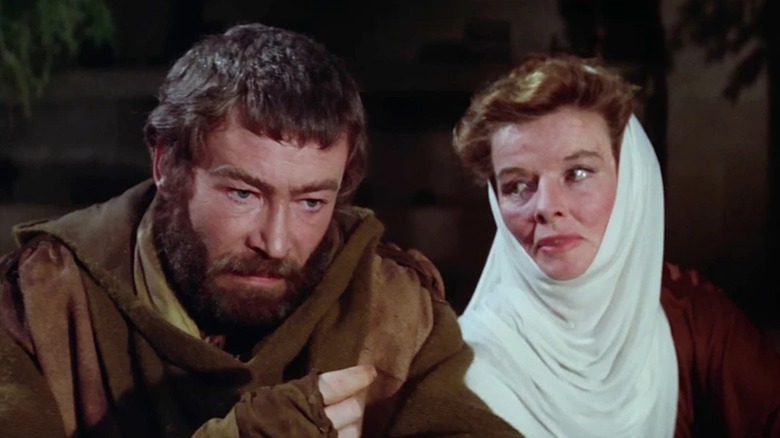
Andy Weir is a fine writer whose novels have spawned two superb movies: Ridley Scott's "The Martian" and Phil Lord and Christopher Miller's "Project Hail Mary." His science fiction is a cross between Carl Sagan and Steven Spielberg. I suppose that makes it Robert Zemeckis' "Contact." It's suffused with hope and a respect for hard science, which is vital at a time when a trillionaire has a self-serving hard-on for landing on Mars, and the current United States Secretary of Health is an anti-vaccine maniac.
Still, "The Lion in Winter" is far too kind to Henry II's treatment of Eleanor (he had her imprisoned for over a decade), and while playwright James Goldman did go on to write the book to Stephen Sondheim's brilliant musical "Follies," he was nowhere in Robert Bolt's league. Historical liberties are taken, which, when you're driving at a greater truth, is acceptable, but "The Lion in Winter" feels counterfeit. I don't know how you could examine the historical record and view this as a romantic tragedy.
Weir has said he's a politically neutral writer, so he can comfortably excuse the overtly disturbing fantasy that is "The Lion in Winter." This is not a condemnation. He wants to believe the best of humanity. I just wish he'd found inspiration from a less problematic story.