

Clint Eastwood's '70s Heist Movie From A Visionary Director Is A Must-Watch On Tubi
We may receive a commission on purchases made from links.
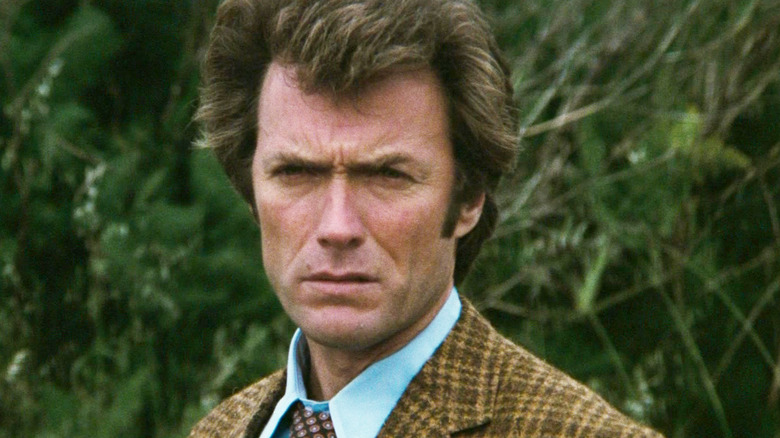
In 1974, Clint Eastwood starred alongside Jeff Bridges in the crime action comedy "Thunderbolt and Lightfoot." It remains one of his best '70s movies, with Eastwood embarking on a bank job with his new pal Bridges and some fellow crooks. The film, which can now be seen for free on Tubi, was overseen by the great Michael Cimino in what was his directorial debut. In reality, however, Cimino basically had to hand over control to Eastwood.
The Clint Eastwood of 1974 was not the same Clint Eastwood of even just five years earlier. Back in the late 60s, the actor was looking for a way to cement his leading man status Stateside. Having captured attention with Sergio Leone's "Dollars" trilogy, Eastwood still struggled to land parts in the United States. 1968's "Hang 'Em High" changed all that. The first film produced by Eastwood's own Malpaso Company was a hit, and after that Eastwood was off to the races.
Three years later, he not only debuted as Harry Callahan in Don Siegel's "Dirty Harry," but he also made his directorial debut with "Play Misty For Me." He then gave us one of the great dark Westerns in 1973 with "High Plains Drifter" before delivering more classic Dirty Harry moments in "Magnum Force." By 1974, then, he was a true Hollywood force. Michael Cimino, who had co-written "Magnum Force," wasn't quite ready to deal with the full power of this newly anointed Hollywood king. But that's exactly what he had to do when his script for a heist movie — which he'd written with Eastwood in mind — was given the green light. Cimino was set to make his directorial debut. But "Thunderbolt and Lightfoot" would ultimately be Eastwood's movie in more ways than one.
Clint Eastwood and Jeff Bridges are great in Thunderbolt and Lightfoot
Today, Michael Cimino is known for his Oscar-winning 1978 war movie "The Deer Hunter" and the infamous box office flop that killed the Western "Heaven's Gate." In the early 70s, however, he was a commercial director and upstart screenwriter making some headway by collaborating with Clint Eastwood.
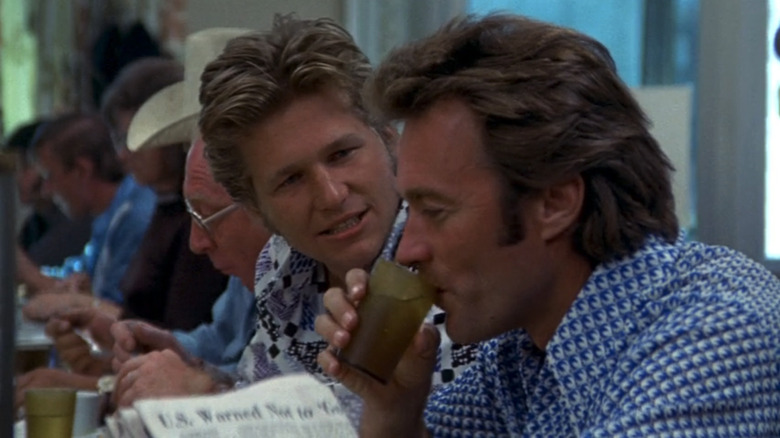
After "Magnum Force," Cimino's "Thunderbolt and Lightfoot" was picked up, and he was given his first feature directing gig. The story follows John "Thunderbolt" Doherty (Eastwood), a bank robber on the run. After disguising himself as a preacher, he's almost killed by a member of his former gang, who tracks down Thunderbolt while he's delivering a sermon and opens fire. But Thunderbolt flees the church and is rescued by car thief "Lightfoot" (Jeff Bridges). The pair then embark on a series of crimes involving car thefts and sex workers, before setting off to retrieve the stashed loot from Thunderbolt's previous robbery of a Montana bank. When they're captured by two members of his former gang, Red Leary (George Kennedy) and Eddie Goody (Geoffrey Lewis), Thunderbolt hatches a plan to rob the very same bank with Leary, Goody, and Lightfoot.
As Patrick McGilligan, author of "Clint: The Life and Legend" put it, "If there is one film of Clint's from the '70s that stands up to repeated viewings, it is 'Thunderbolt and Lightfoot' — a consummate caper film, a disquieting buddy-buddy story, a rich acting and character contrast." Indeed, Thunderbolt is one of Eastwood's best roles. But Lightfoot is also one of Bridges' best. In fact, the young actor arguably steals the show, earning an Academy Award nomination for Best Supporting Actor. Meanwhile, Cimino proves his worth as a director. The only problem is that Eastwood was really the one calling the shots.
With Thunderbolt and Lightfoot, Michael Cimino delivered a hit that he ultimately disowned
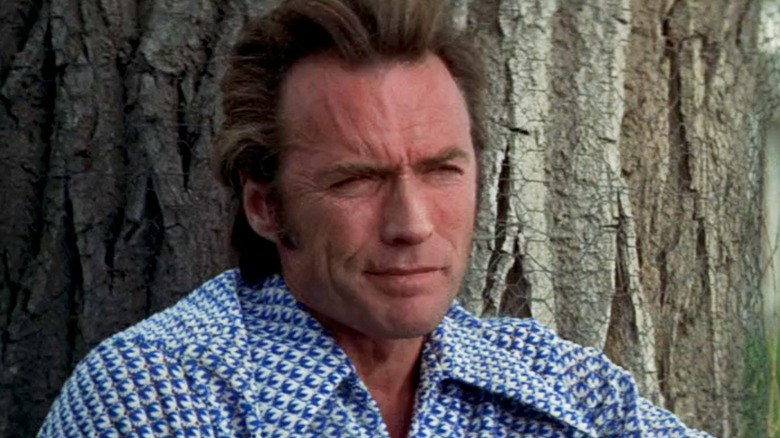
"Thunderbolt and Lightfoot" was shot before the Directors Guild of America instituted a rule named after Clint Eastwood that prevented stars from usurping their directors. With his Malpaso Company producing and a proven talent for directing via "Play Misty for Me," Eastwood was very comfortable "riding herd" on Michael Cimino, as he put it in "Conversations with Clint: Paul Nelson's Lost Interviews with Clint Eastwood, 1979-1983."
Regardless of their behind-the-scenes relationship, "Thunderbolt and Lightfoot" grossed $21.7 million at the box office on a budget $2.2 million and the critics loved it. The film maintains an 89% critic score on Rotten Tomatoes, with Richard Brody of The New Yorker calling it "a criminals-on-the-road movie that shifts toward a dazzlingly elaborate and painfully realistic heist tale." Variety praised Cimino for obtaining "superior performances" from his cast, while a more contemporary review from The Times' Joe Clay described it as a "light-hearted yet poignant buddy movie."
Despite its success, Cimino later played down his involvement in "Thunderbolt & Lightfoot," with Paul Nelson recalling in "Conversations with Clint" how the director claimed it wasn't really his own film. In response, Eastwood pulled no punches when talking about Cimino's war movie "The Deer Hunter," calling the celebrated film "indulgent" and implying it was inferior to his 1974 collaboration with the director. Since "Thunderbolt and Lightfoot" is available to watch right now on Tubi, you can make up your own mind.