

Clint Eastwood's Adaptation Of An Award-Winning Book Was A Total Box Office Flop
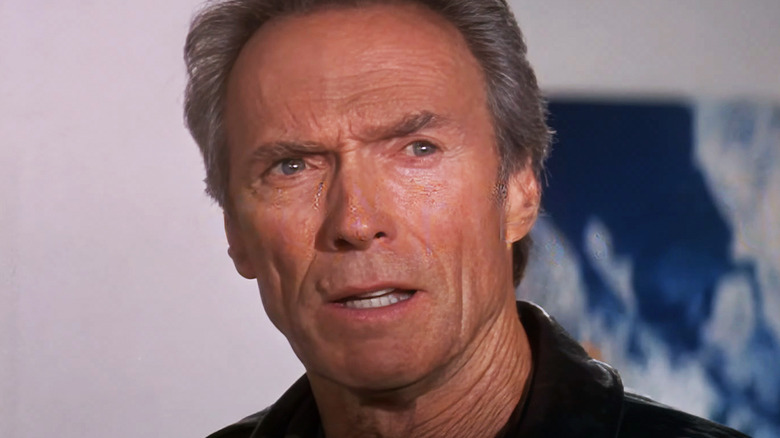
In the latter half of the 1990s, Clint Eastwood was in a post-"The Bridges of Madison County" slump. 1995 saw Eastwood produce the oil drama "The Stars Fell on Henrietta," which might be great for "Landman" fans, but debuted to a muted response from critics. After that, he wasn't able to secure a hit until 2000's "Space Cowboys," and even that caused him and the cast considerable pain. Otherwise, his late-'90s nadir involved Eastwood adapting John Berendt's award-winning 1994 book "Midnight in the Garden of Good and Evil." The resulting 1997 crime drama of the same name didn't help the actor/director break out of his slump. In fact, it extended it.
Berendt's book tells the real-life story of Jim Williams, an antiques dealer from Savannah, Georgia, who was accused and tried for the murder of 21-year-old Danny Hansford, with whom he'd had a sexual relationship. Williams was arrested for the killing in 1981 and faced four separate trials before finally being acquitted in 1989, one year before his death. Aside from recounting Williams' experience, Berendt's retelling of the story was populated by eccentric characters that brought Savannah to vivid life in all its Southern Gothic glory. The book broke records when it spent 216 weeks on the New York Times Bestseller list, before becoming a finalist for the general non-fiction Pulitzer Prize.
All in all, then, a pretty good showing for "Midnight in the Garden of Good and Evil." That is, until Eastwood came along and turned it into a film that didn't even recoup its budget, debuted to mixed reviews at best, and was pretty much repudiated by the original author.
Clint Eastwood's Midnight in the Garden of Good and Evil didn't live up to the book
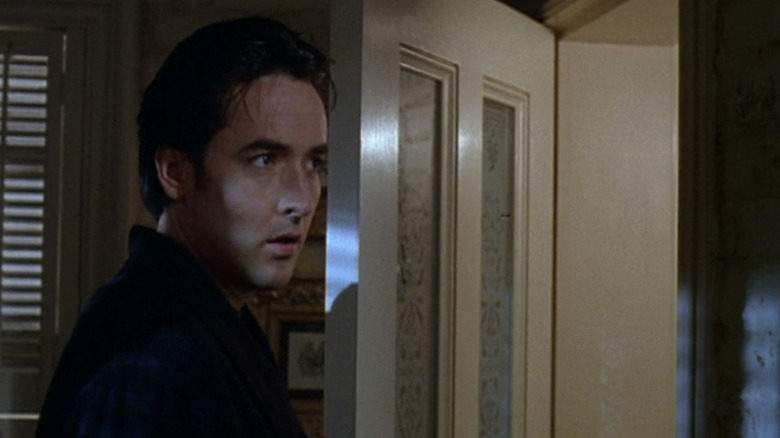
Clint Eastwood's "Midnight in the Garden of Good and Evil" was based on a script by John Lee Hancock, the man who later directed one of the biggest box office flops of all time with 2004's "The Alamo" (though he also directed one of the best Michael Keaton movies with 2016's "The Founder"). By the mid-90s, Hancock had directed 1991's "Hard Time Romance' and written Eastwood's acclaimed 1993 crime thriller "A Perfect World." When the two re-teamed for "Midnight in the Garden of Good and Evil," however, they fell short of perfection.
Eastwood and Hancock's film follows John Cusack's John Kelso, a journalist and the film's stand-in for John Berendt, as he travels from New York to Savannah to write a piece on Kevin Spacey's Jim Williams and his renowned Christmas party. There, Kelso meets many charmingly oddball characters and becomes intrigued by singer Mandy (Alison Eastwood). A young Jude Law plays male escort and Williams' lover Billy Hanson — the film's version of Danny Hansford — in what was one of the actor's first big roles.
After Williams is accused of shooting Hanson, Eastwood and Hancock's film combines the antique dealer's multiple trials into a single trial, which, by itself, sort of undermines the real ordeal through which Williams persevered. What's more, despite multiple real-life Savannah residents portraying themselves in the film, Eastwood failed to capture the allure of the setting in the same way that Berendt had in his book. That in and of itself might have been an impossible task, however. Regardless, "Midnight in the Garden of Good and Evil" debuted in November 1997 and ended up grossing just $25.1 million on a $35 million budget. The critics weren't too impressed, either.
Adapting Midnight in the Garden of Good and Evil was an impossible task
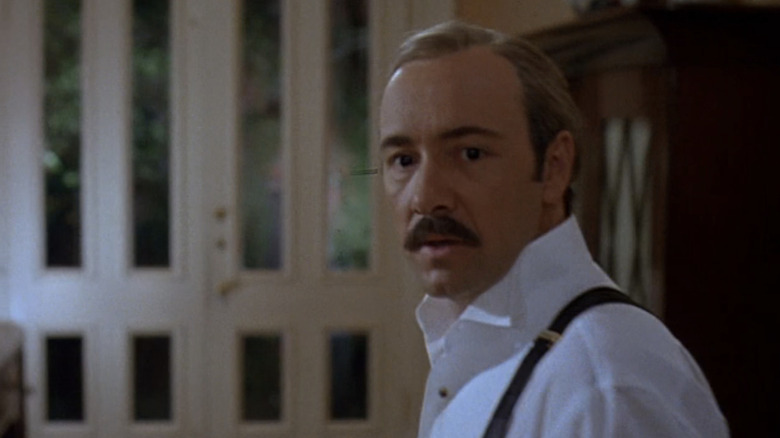
During a 2015 interview, "Midnight in the Garden of Good and Evil" author John Berendt told The Packet, "Kevin Spacey played Jim Williams — badly. He didn't even come close." According to the author, he had offered Spacey the chance to listen to recordings of Williams, but the actor declined, claiming he'd already heard Williams on tape from one of his trials. "When I saw the movie, I was perplexed by the way Spacey portrayed Williams," Berendt continued. "Because he did it as if he were asleep. He talked as if he were in a fog or sleepwalking. Then I realized what had happened, and I thought it was hilariously funny." As the writer remembered it, Williams had popped a Valium before being cross-examined on the tape Spacey had heard, which, in his estimation, accounted for the actor's spaced-out portrayal.
While critics weren't quite as dismissive, they also weren't too kind to Clint Eastwood's film, which, at the time of writing, maintains a 50% critic score on Rotten Tomatoes based on 38 reviews. In Roger Ebert's estimation, Eastwood was working against an impossible tide from the very beginning. "Something ineffable is lost," he wrote, "just by turning on the camera: Nothing we see can be as amazing as what we've imagined." Otherwise, David Ansen of Newsweek felt the film's biggest miscasting was Eastwood as director, who, according to the writer, "approaches the story like a tourist." But there is something to be said for the film, which has some decent performances and is arguably one of the best movies set in Georgia. Still, it did little to revitalize Eastwood's career in the late '90s. You're better off reading the book.