

5 Forgotten Dystopian Movies That Still Hold Up Today

Science fiction writers have three ways to envision the future. Forced to live in the present, a sci-fi writer can look around, see turbulence and horror all over the world, and respond by imagining a future in which all the horrors have ended. Things may be bad now, but humanity will always hold an element of promise. Eventually, we will unite, the world will improve, and possibly even transform into a utopia. See: "Star Trek."
Other sci-fi writers, perhaps feeling more pragmatic, will wisely know that humans, even if they have access to alien culture and high-end super-technology, will still be petty idiots. We will never advance so much that we become something we can easily recognize in the present day. The future won't be bright, but it won't be dim either. It will be about the same level of luminosity. See: "Futurama."
Many authors, however, may feel that the present is teetering on the precipice of something terrible. Villains have gotten what they want all too often in this world, and there's no reason to believe the future won't be even worse than what we're currently seeing. Dystopian stories extrapolate the worst elements of society to their extreme — wealth inequality, disease, disaster — and try to picture how, or if, we'll survive. Dystopian fiction can function either as a cautionary tale, of course, or as an expression of despair. Either way, though, dystopian sci-fi can be exhilarating, activating our imagination and allowing us to ponder the horrors of the present safely.
Below are five dystopian sci-fi movies that activate those parts of one's brain. Some of them may be obscure or forgotten, but they are all worthy of your investigation.
Alphaville (1965)
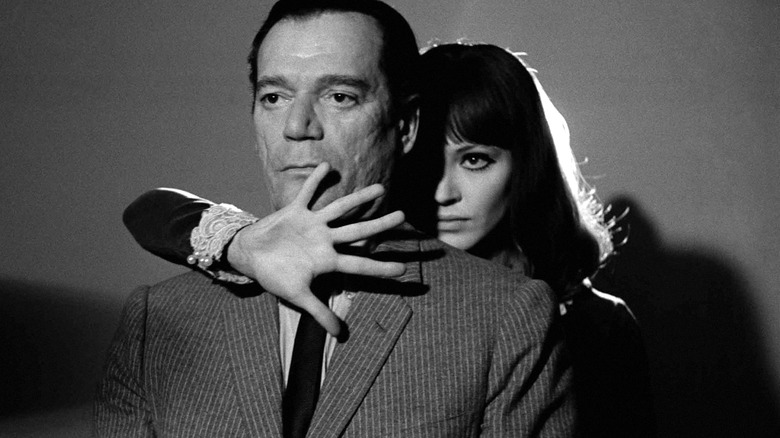
It's still a little mind-blowing to realize that Jean-Luc Godard, a main staple at film schools, once made a science fiction movie. His 1965 film "Alphaville," however, is stripped down and aesthetically intimate, depicting its futuristic dystopia as shockingly humdrum. "Alphaville" stars the taciturn Eddie Constantine as a futuristic government agent named Lemmy Caution, a man who comes from a vaguely described Outlands.
The movie follows his mounting spy efforts, all presented matter-of-factly. Caution, undercover as a journalist for a Russo-French newspaper, first has to locate a missing fellow agent named Henri. Secondly, he aims to assassinate the creator of the dystopian city of Alphaville, a man named Professor von Braun (Howard Vernon), clearly named after Wernher von Braun, the real-life Nazi rocket scientist who moved to the United States. Von Braun will eventually reveal his real name: Leonard Nosferatu. Finally, Caution has to confront and destroy Alpha-60, the sentient computer that runs all of the city's infrastructure.
The dystopian elements of "Alphaville" are communicated gradually throughout the film. For instance, political dissidents and student protestors are actually created by a brainwashing factory, and then sent to other areas to give their overlords an excuse to use violence as anti-protest. Von Braun's daughter, played by Anna Karina, doesn't know the meanings of words like "love" and "conscience." It's all very dreamy, but also very bleak. Lemmy Caution is a jaded character who behaves more like a film noir hero than a sci-fi revolutionary. He is stoic and detached. Indeed, the movie is so detached that it barely plays like sci-fi at all.
But this is what a dystopia looks like to Jean-Luc Godard. It's the real world, but suckier.
Turkey Shoot (1982)
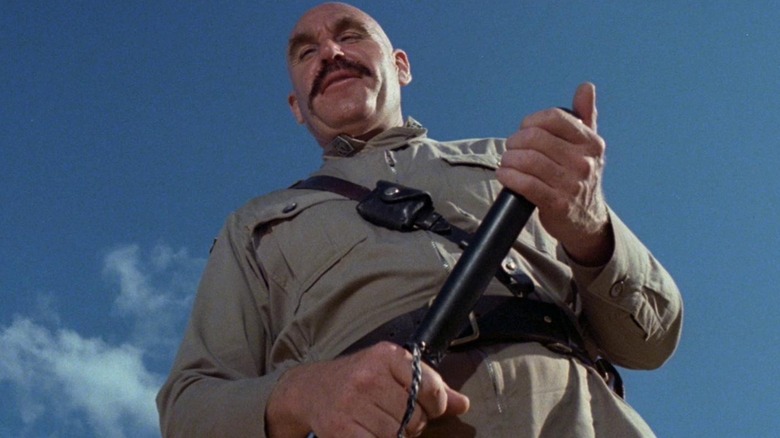
Brian Trechard-Smith's 1982 prison flick "Turkey Shoot," also known as "Escape 2000," is one of the most exciting, violent, lascivious, awesome B-movies of the 1980s. There was something about Australian exploitation movies that just hit harder. Set in the distant future of 1995, an extreme right-wing government has taken over the world, and so-called deviants are arrested by the score and sent to brutal prison camps for "re-education." The main characters are a long-imprisoned dissident named Paul (Steve Railsback) and a newly imprisoned shopkeeper named Chris (Olivia Hussey), who is gentle and kind and was arrested only for helping dissidents on the outside.
Naturally, the prison wardens are gleefully sadistic and regularly assault and murder their charges. The higher-ups in the system also annually invite rich aristocrats to hunt the prisoners for sport. Prisoners are set free in the outback and given a three-hour head start before rich maniacs with crossbows chase them down. This movie is like a blend of "Escape from New York" and "The Most Dangerous Game," but with a lot more violence and, for some reason, a werewolf; the werewolf character is never really adequately explained.
Of course, the prisoners eventually fight back, and the evil prison wardens get their just desserts in a fiery, riotous conflagration. "Turkey Shoot" may be the best B-movie you haven't heard of, and it will blow your mind. For my money, it's better than any "Mad Max" movie. It's certainly more cinematically pure, recognizing that we, as possessors of lizard brains, want to see mayhem and violence before we want a self-serious, dystopian tone of sadness. I'd rather watch an imaginary aristocrat get stabbed in the head with an explosive arrow. It's one of the best sci-fi movies of the '80s.
Cherry 2000 (1988)

Steve De Jarnatt's 1988 dystopian "Cherry 2000" clearly came out of the post-AIDS period, as it centers on a sterile, cautious form of dating that many adopted for an abundance of caution. In the future of "Cherry 2000," in the year 2017, people have to go on dates with their lawyers present, and negotiate every romantic and sexual encounter with a strict, litigious eye. Many people, as a result, have decided to marry robot sex slaves instead of people, more content with the pre-programmed affection.
The main character, Sam (David Andrews), lives in bliss with his sex-bot, the comely Cherry (Pamela Gidley), a rare advanced model of gynoid. Sadly, Cherry isn't 100% waterproof and shorts out when she and Sam have sex in a puddle on their kitchen floor. Sam is able to salvage her memories on a disk, but requires a new body. Sadly, Cherry 2000 models are rare and hard to find, and he has to travel to a distant city — the dangerous and mythical Las Vegas — to get a new one.
By 2017, however, the areas outside of cities have become nuclear wastelands, and Sam will require the aid of a badass, fast-driving wasteland warrioress to guide him. He teams up with a gun-toting tracker named Edith (Melanie Griffith, star of "Working Girl," one of the most rewatchable films of the 1980s), and they set off to find him a new sex-bot. Naturally, Sam will find that interacting with a real person is more rewarding than living with an obedient, personality-free sex bot.
The premise is gloriously sleazy, but weirdly prescient. A man just wants to flirt with his AI girlfriend to avoid talking to real women and will trek through dangerous areas just to avoid modern dating. Where have we seen that before?
Fortress (1992)
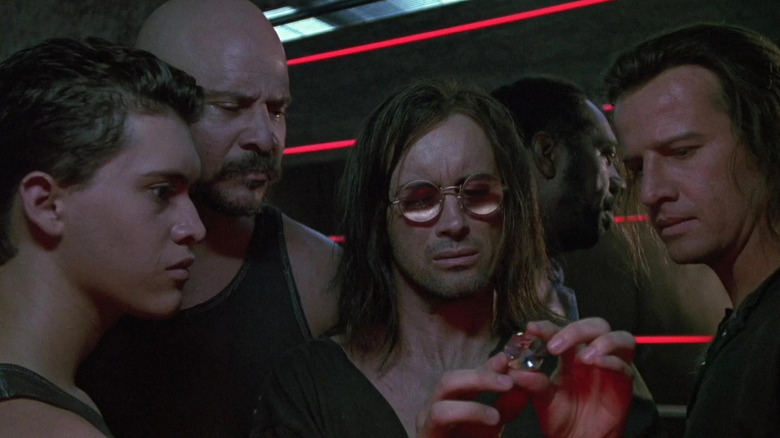
Stuart Gordon's 1992 film "Fortress," like "Turkey Shoot," takes aim at the increasingly corrupt prison systems in the world. But whereas "Turkey Shoot" is about corrupt ruling classes using prisons as their own murderous playgrounds, "Fortress" posits that prisons will be ceded to technology and artificial intelligence. Christopher Lambert plays Brennick, a man thrown into prison for daring to have a second child in a one-child-only state in the distant future of 2017. His wife Karen (Loryn Lockling) miscarried her first child, but a second is still enough to get them both condemned to a sentence in the Fortress, a high-tech prison complex of bottomless brutality.
In the Fortress, prisoners' stomachs are implanted with "intestinizers," which, when activated, give them crippling stomachaches. They can also be exploded, killing prisoners by remote. The bars in the prison are flesh-burning lasers, and the guards are weapons-encrusted cyborgs, wired directly into the prison's computer mainframe. The warden at the Fortress is Director Poe, an "enhanced" human who is partly machine. Poe butts heads with the intelligent computer system that runs the prison named Zed-10, voiced by Carolyn Purdy-Gordon, Stuart's wife.
Brennick eventually befriends other prisoners played by Clifton Collins (credited as Clifton Gonzalez-Gonzalez), Tom Towles, and Jeffrey Combs. They find ways to subvert the prison system, remove their intestinizers, and lead a revolt. The late Stuart Gordon always had a great eye for B-movie excitement, and "Fortress" is full of awesome violence. In addition, of course, to the commentary on the world's prison corruption. If the criminal justice system can be automated and the laws cannot be interpreted, then there's nothing stopping a glitch or a technicality from ripping people's lives away.
High-Rise (2015)

Based on the novel by J. G. Ballard, Ben Wheatley's "High-Rise" posits that high-tech luxury is a prison. As the title would denote, "High-Rise" takes place in a tall apartment complex that is stratified by class. Middle-income citizens live on the lower floors, while the rich live on the upper floors. The building is automated and glorious, designed to meet all citizens' needs. It had a gym, a pool, a grocery store, and a school. There's no reason to leave. And people don't.
Scheduled power outages interrupt people's days. Parties become wilder, and neighbors complain. Trash chutes begin to clog, and the water shuts off from time to time. When the power goes out, people start partying and wrecking stuff. Food begins to run out. Before long, the high-rise has become a tribal land of chaos and terror. Who is to blame? Is it the low-class documentarian Richard (Luke Evans)? Is it the upper-class stooge Royal (Jeremy Irons), who lives on the building's top floor? The main character Laing (Tom Hiddleston) will investigate. The conclusion, however, may be that people don't need a special catalyst that forces them into darkness. They may just be violent by nature, and the class strata enclosed in a modern high-rise are all that is required to reveal those impulses.
"High-Rise" was a bit of a bomb when it came out, and its politics are, of course, quite direct, but that doesn't change the fact that it's an effective, chaotic drama. It captures the bleak tone of Ballard's book perfectly, including its sense that there is no hope. Human nature will tear itself apart. All it needs is ascetic, solitary modern tech and a modicum of luxury.