

Frank Sinatra And Gilligan's Island Star Alan Hale Jr. Crossed Paths In This '50s Movie
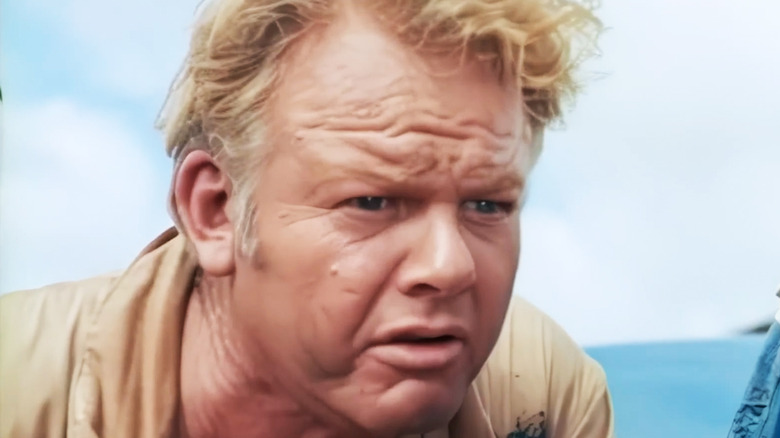
Frank Sinatra and Gordon Douglas worked together on five films, and it all started with 1954's "Young at Heart." The musical sees ol' Blue Eyes play a sulky songwriter who becomes romantically entangled with the daughter of a musical patriarch. It wasn't quite as prestigious an affair as Sinatra's classic war movie from the year prior, "From Here to Eternity" — for which he won an Oscar. But "Young at Heart" was a charming tale that showcased not only Sinatra's charisma and Douglas' practiced hand, it also featured a young Alan Hale Jr., who played a supporting role in the film and added yet another icon to his list of esteemed collaborators.
"Young at Heart" might have been the first time Douglas and Sinatra worked together, but it was the second time the director and Hale Jr. had collaborated. Their first experience with one another was when Hale Jr. appeared in "Up Periscope," a 1959 World War II drama that Douglas directed (and star James Garner absolutely hated) in which Hale Jr. played a naval officer who isn't given too much to do. Thankfully, "Young at Heart" provided a little more for the actor to work with, although he was hardly the film's lead.
Hale Jr. plays Robert Neary, a banker and husband to one of three women who all fall for a handsome musician. Like with so many of his roles at the time, the future "Gilligan's Island" star isn't there to do much in terms of propelling the story. But again, he's given more to do there than in "Up Periscope," and he even shares several scenes with the film's stars, which included both Sinatra and Doris Day.
Young at Heart was a charming story about the transformation of a cynic
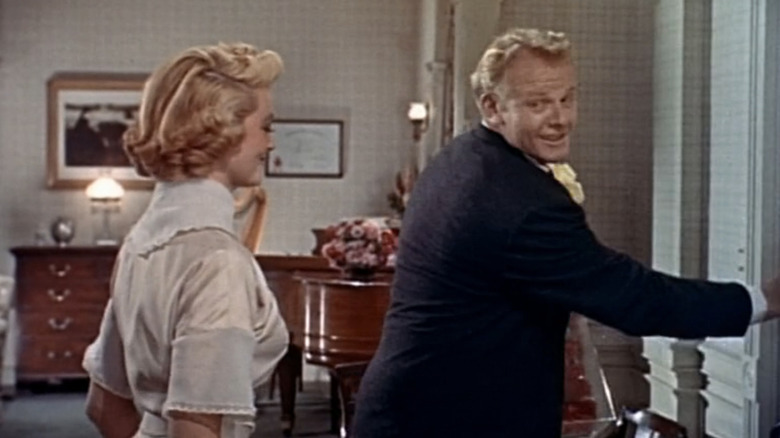
By 1954, Alan Hale Jr. had already appeared alongside Gregory Peck in one of the star's best Westerns, "The Gunfighter," and worked with Kirk Douglas on 1952's "The Big Trees." Still, it must have been a thrill to share the screen with Frank Sinatra and Doris Day.
"Young at Heart" stars Day (who was given top-billing over Sinatra) as Laurie Tuttle, one of three daughters of the widowed musician Gregory Tuttle (Robert Keith) alongside her sisters Fran (Dorothy Malone) and Amy (Elisabeth Fraser). When the piccolo-playing patriarch invites composer Alex Burke (Gig Young) to stay at the family home to work on a musical, the girls all fall for his charms. In time, Alex even proposes to Laurie, and she accepts.
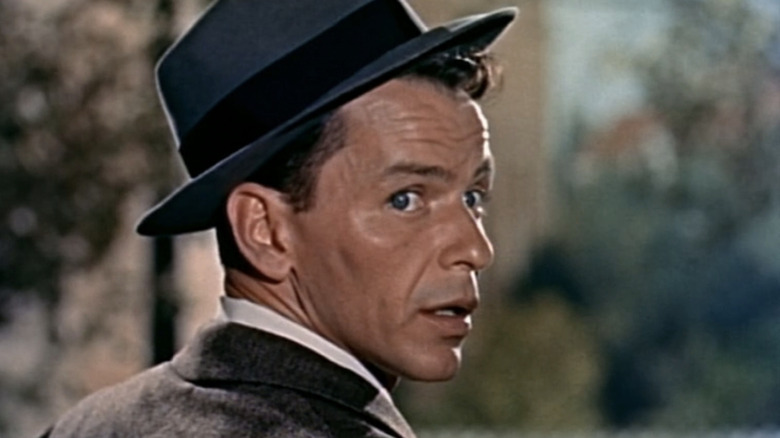
Soon, however, Alex invites the jaded and cynical songster Barney Sloan (Sinatra) to help him with the musical. The new arrival quickly develops a crush on Laurie, who tries to change Barney's bleak outlook on life. As the two grow closer and she learns about Amy's feelings for Alex, Laurie ultimately abandons Alex at the altar to elope with Sinatra's sullen songwriter. Meanwhile, Hale Jr. plays Fran's fiancé Robert Neary, aka Bob, who weds his bride after Alex and Laurie initially announce their engagement.
"Young at Heart" was a remake of 1938's "Four Daughters," and in the original film, Sinatra's character (played by John Garfield) perishes. But the Chairman of the Board wasn't having anything of the sort and only signed on for "Young at Heart" under the condition Barney survives the movie. It turned out to be a positive development, altering the 1954 film in a way that made it a much more uplifting story about the transformation of a cynic.
Young at Heart came at the perfect time for Frank Sinatra
Gordon Douglas, often described as a journeyman director for the sheer amount of pictures he made, was much more creative and original than you'd expect of a filmmaker who labored under that description. In 1954, he made the nuclear monster movie "Them!" The first of its kind to feature bugs as the massive creatures in question (ants, to be specific), "Them!" comes recommended by the great Steven Spielberg himself and stands as one of the best examples of the sub-genre to which it belongs. Then there's 1951's "I Was a Communist for the FBI," a well-received noir film based on real-life events that, while unapologetically anti-Communist, proved Douglas was as adept at crafting taut thrillers as he was sci-fi spectacle.
Between those two came "Young at Heart," bolstered not only by a newly-reinvigorated, post-"From Here to Eternity" Frank Sinatra but by the singer's own rendition of the title song as well. This was the start of a new era for Sinatra, who had inked his deal with Capitol Records the year prior and released his debut album for the label, "Songs for Young Lovers," in January 1954. That same month, he debuted his take on "Young at Heart," which became a hit and was ultimately named Song of the Year by Billboard just ahead of the film's release the following December.
It seemed to work. "Young at Heart" was well-received and kicked off a series of collaborations between Sinatra and Douglas, who later oversaw the 1966 remake of John Wayne's Oscar-winning 1939 Western "Stagecoach." Meanwhile, Alan Hale Jr. continued to mostly play supporting roles until he was cast as Captain Jonas Grumby, aka The Skipper, and set sail for Gilligan's Isle 10 years after he'd appeared opposite Sinatra.