

G.I. Joe: The Rise Of Cobra's Original Ending Would Have Made The Movie Even Worse
"G.I. Joe: A Real American Hero" has had poor luck translating to film. The 1987 movie, a spin-off of the cartoon series, is mostly remembered for its goofy, "Nausicaa"-inspired snake people villains, Cobra-La. It at least has a kick-ass opening sequence of the Joes stopping their terrorist enemies, Cobra, from destroying the Statue of Liberty, which is better than anything the live-action "G.I. Joe" movies have managed.
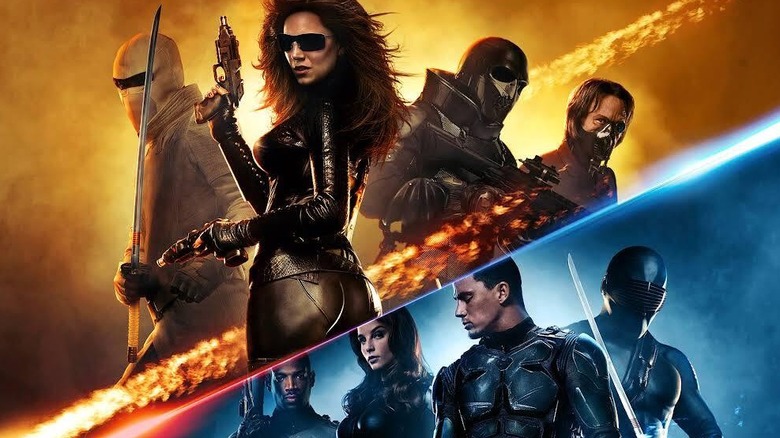
There've been four attempts to start a "G.I. Joe" movie franchise: 2009's "G.I. Joe: The Rise of Cobra," 2013's half-sequel/half-reboot "G.I. Joe: Retaliation," 2021's "Snake Eyes," and the tease of a crossover with "Transformers" at the end of 2023's "Transformers: Rise of the Beasts." None of them got off the ground. The Stephen Sommers-directed and goofy-in-all-the-wrong-ways "Rise of Cobra" set things off on the wrong foot, but it could've gone even worse.
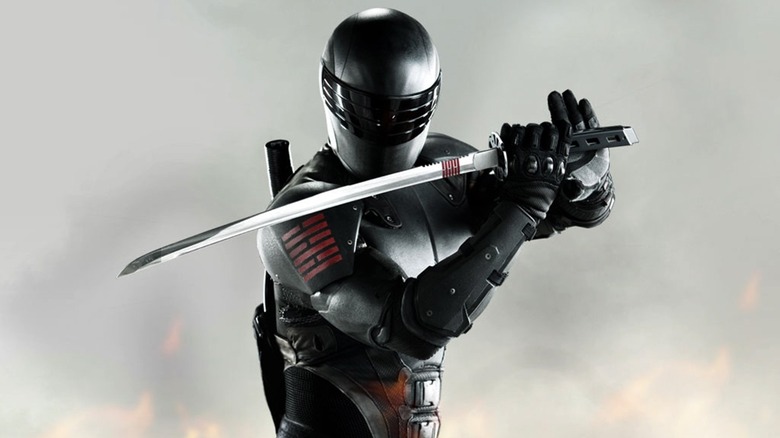
Easily the most popular "G.I. Joe" character is Snake Eyes, who stands out among the team of army grunts by being a trained ninja who fights with a sword. He's also distinguished by his silence, something "Rise of Cobra" stays loyal to, but almost didn't. In a 2009 interview with MTV, producer Lorenzo di Bonaventura explained that Snake Eyes (Ray Park) was going to have one line of dialogue at the end of the film as a joke.
Thankfully, the film had a creative consultant — Larry Hama, writer of the original "G.I. Joe: A Real American Hero" comics and spiritual creator of the franchise — to talk them out of this. "What Larry said was, 'No matter what you guys think, you can't have Snake-Eyes utter a word,'" recalled di Bonaventura. "The Rise of Cobra" makes a lot of ... questionable changes to its characters, particularly the Baroness (Sienna Miller), but this would've taken the cake.
Why it was so important Snake Eyes not talk in G.I. Joe: The Rise of Cobra
For fans of "G.I. Joe" sibling series "Transformers," Lorenzo di Bonaventura is an infamous name often scapegoated for franchise mismanagement. The idea of having Snake Eyes talk definitely feels akin to the original "Transformers" script having few actual Transformers characters.
In most versions, Snake Eyes literally can't talk because of some war wounds. In "Rise of Cobra," he only took a vow of silence after his sensei's murder. That feels like a holdover from plans for him to eventually speak. But why would that be such a sacrilegious thing? Let's go back to the very beginnings of "G.I. Joe" and how Snake Eyes became Larry Hama's signature character.
The "G.I. Joe" toyline spun out of Hasbro and Marvel Comics' creative relationship. (That's why Marvel helped produce the '87 "G.I. Joe" animated movie.) Hasbro wanted to revive "G.I. Joe" toys of the 1960s to compete with the success of "Star Wars" action figures. Larry Hama had recently pitched a military-themed comic set in the Marvel Universe called "Fury Force," about Nick Fury leading a team against HYDRA.
Hama's pitch was repurposed into the branded "G.I. Joe" comic, he designed characters for the comic and toys, and the rest is history. Under Hama, the "G.I. Joe" comic was a roaring success. He wrote almost all 155 issues of the run, and as a Vietnam War veteran, he was able to write the military setting with authenticity.
Snake Eyes' character bio and toy design were a complete blank slate (he wears a mask, has no real name, etc). That gave Hama, who writes issue-by-issue and spurs outlines, room to gradually fill in the holes. Even as Hama explored who Snake Eyes was, he decided to keep some mystery.
Snake Eyes doesn't need words to be the hero of G.I. Joe
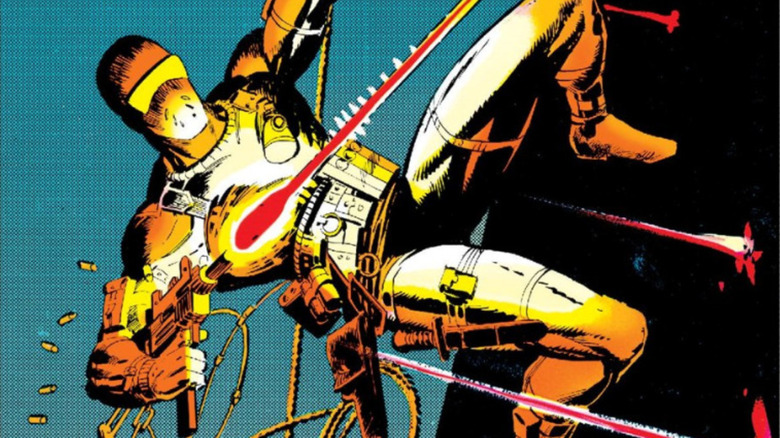
"G.I. Joe: A Real American Hero" issue #4 technically gives Snake Eyes' "dialogue" when he's journaling on a recon mission, which becomes the comic's narration. Even that feels like an early aberration. Hama later told Snake Eyes' origin in issues #26-27. The flashback sequences still pointedly never show Snake Eyes' face, never reveal his true name, and he has no dialogue in them.
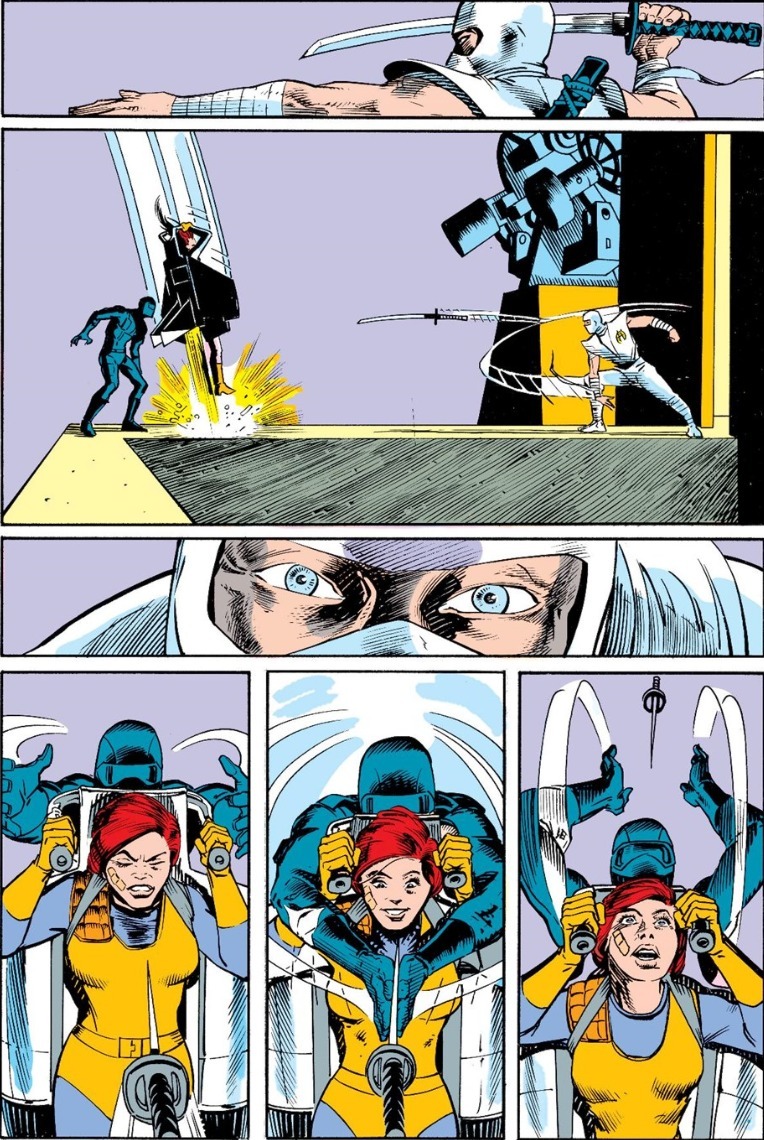
The most famous issue of Hama's run, Issue #21, "Silent Interlude," is built on Snake Eyes' silence. It sees him infiltrating a Cobra fortress to rescue his fellow Joe, Scarlett, all told without any dialogue.
 Marvel Comics
"Silent Interlude" solidified Snake Eyes and Scarlett as the Joes' power couple. (The "G.I. Joe" cartoon made the more predictable choice to pair Scarlett with the Joes' leader, all-American soldier Duke). This issue also introduced Storm Shadow (played by Lee Byung-hun in "Rise of Cobra"), a member of the Arashikage ninja clan which trained Snake Eyes. Over the years, they've been vicious enemies, brothers-in-arms, and everything in-between.
Hama's Japanese heritage is essential here. If Hasbro had demanded Cobra have a ninja villain like Storm Shadow, another writer could've created a caricature, but Hama gave him pathos. In turn, he reshaped Snake Eyes from a masked commando into another ninja — one whose actions speak louder than any words.
While Snake Eyes is the most popular Joe, a masked, dialogue-free character is no Hollywood bigwig's vision of a leading man. When Snake Eyes did get his own movie in 2021, that version of him (played by Henry Golding) was often heard talking and seen without his mask. Casting an Asian man to play Snake Eyes, though, was a change Hama didn't mind.