

5 Sci-Fi Books That Deserve A Big Budget TV Adaptation
When Isaac Asimov wrote the first "Foundation" novel in 1951, there was likely no dream in his head, nor in the heads of his many readers, that it would one day be visualized as an elaborate, big-budget TV series. The mythology was too arch, the world too large to be practically adapted to a visual medium. "Foundation," as /Film once explained, takes place in a very, very distant future, beginning about 18,000 years after the events of Asimov's famed Robot stories, and that's just when the "Foundation" story kicks off. One might think that it would cost too much to feasibly envision. But, thanks to show creators David S. Goyer and Josh Friedman, "Foundation" is now a hit TV series on Apple TV, which ran for 30 episodes over its three seasons.
Other expansive sci-fi novels have received similar treatment in recent years. Frank Herbert's "Dune" series was expanded into a prequel series called "Dune: Prophecy," set 10,000 years before Denis Villeneuve's film adaptation. James S.A. Corey's "Expanse" novel series was turned into a successful six-season series back in 2015. It seems that outsized sci-fi book series are now ripe for the plucking, provided a streaming service is willing to pony up the dough and adapt them properly.
And, naturally, that sparks the imagination. Readers of unadaptable sci-fi epics are now beginning to think that their favorite novels might actually be adaptable after all. An obscure location, a fully realized universe, or an expansive time span is no longer an impediment to sci-fi novel adaptation. And if that's true, let's start spitballing what we'd like to see next. Here are five sci-fi epics, each one requiring big-budget treatment, that we'd like to see adapted next.
Red Mars by Kim Stanley Robinson
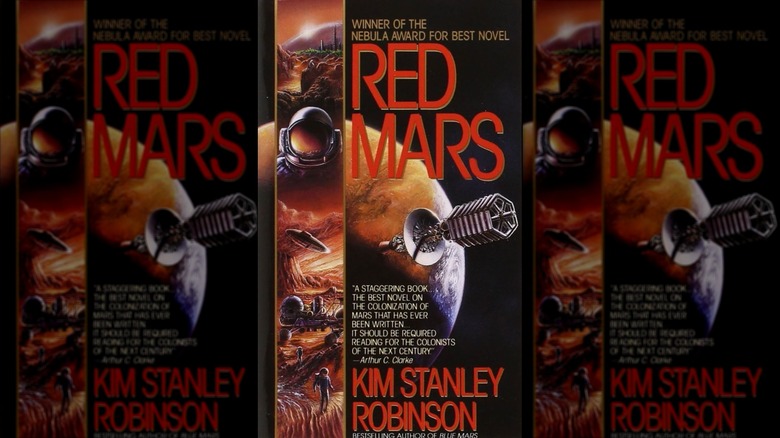
It's 2026, so this is the perfect time to develop Kim Stanley Robinson's 1992 novel "Red Mars" for the small screen, since it begins in 2026. The novel follows the first colonists who travel to Mars to build a settlement. A large portion of the book is devoted to the philosophical clash between the various colonists, who all come from either America or Russia. On the one hand, some colonists believe that Earthlings have no right to mess up the natural order of the Martian landscape. Another feels that spreading life to other planets is a moral necessity, given that life is considered a rare galactic resource. The former are the Reds, the latter are the Greens.
Science nerds love "Red Mars" because it walks through, step by step, what might be required to terraform Mars. How will they get water, for instance? Why, just explode a nuclear bomb under the planet's permafrost, of course. The novel continues through multiple decades, exploring what happens back on Earth — it essentially falls under corporate control — and how Martian societies should evolve; should they even be subject to Earthly traditions? There are wars and revolutions. There's a lot to it.
And "Red Mars" was only the first part of a series. Robinson followed it with "Green Mars" in 1993, "Blue Mars" in 1996, and finally "The Martians" in 1999. The whole series spans the year 2212. The second book is more explicitly about planetwide terraforming, the third is about the formation of oceans, and the fourth is a series of short stories set in the Martian universe. A single movie couldn't handle all this.
But a TV series? Yes. It fell off the tracks once, so now is the time to try again.
Wild Cards, created by George R.R. Martin
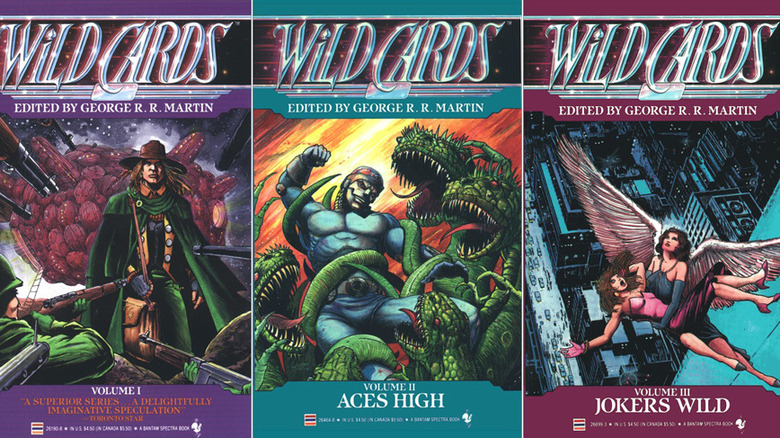
Fans of author George R.R. Martin, the mastermind behind "Game of Thrones," might also know about his anthology project "Wild Cards," which he created and edited with Melinda M. Snodgrass. "Wild Cards" is a long series of books that began its run in the mid-1980s and has featured dozens of authors contributing short stories under the same premise.
And the premise is wild. "Wild Cards" begins in 1946 and envisions an alternate American history wherein New York City was exposed to a strange alien virus from the planet Takis. 90% of the people exposed to the virus are killed immediately. Another 9% have their DNA mutated, becoming strange-looking animal people or merely disabled in some way. They are referred to as Jokers. 1% of the population, however, develops X-Men-like superpowers and are referred to as Aces. Unlike the X-Men comics, though, the tonal approach to "Wild Cards" was to take a somewhat more detailed, grounded approach to super-beings being among us (Martin once wrote a scientific essay on the series), and the stories were all intimate and creative. The idea for "Wild Cards" came into being when Martin was playing a superhero-themed RPG with some buddies.
From 1987 to 2024, there have been 34 "Wild Cards" anthologies published, and Martin's name on a superhero project might still be interesting (even if the superhero genre has severely contracted in recent years). Hulu was working on a TV series for a while, but that project seems to have been stuck in Development Hell for years. Perhaps the time has finally come.
A Wrinkle in Time by Madeleine L'Engle
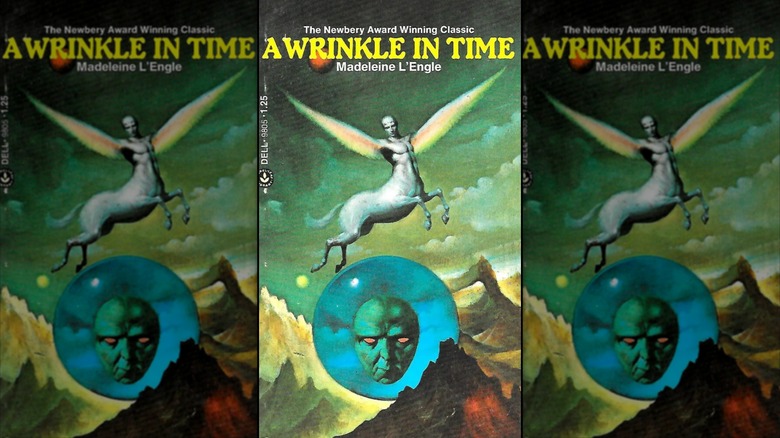
Every schoolchild of a certain age has read Madeleine L'Engle's 1962 sci-fi/fantasy novel "A Wrinkle in Time," as it is creative, expansive, and accessible. It also carries the healthy message that creativity and gentleness are powerful forces in the universe, able to overwhelm the powers of aggression and conformity. The story follows Meg Murray and her brother as they meet unusual interplanetary travelers who inform them that their missing father was working on a new form of space travel technology. They trek to other worlds and meet strange cosmic beings who live in bliss, but who are under attack by an unknown evil force called the IT.
It's worth noting right away that "A Wrinkle in Time" has already been adapted into a TV movie in 2003 and a theatrical feature in 2018. Neither version, however, was very good, and the 2018 movie, despite an impressive cast that included Oprah Winfrey, Reese Witherspoon, Mindy Kaling, and Chris Pine, bombed pretty heavily. The movie was accurate to the book, but felt rushed and overly detailed. /Film called it an ornate mess.
A big-budget TV show could walk viewers a little more carefully and slowly through the events of L'Engle's novel, more openly discussing its themes of religion and feminism. The book is mellow and spooky; it's not a wild ride or a "big adventure," so a slow pace and longer running time would be more apt. Also, "A Wrinkle in Time" was only the first book in a series that also included "A Wind in the Door" (1973), "A Swiftly Tilting Planet" (1978), "Many Waters" (1986), and "An Acceptable Time" (1989). The stories of those books could extend the series for many years.
The Xenogenesis Trilogy, a.k.a. Lilith's Brood by Octavia E. Butler
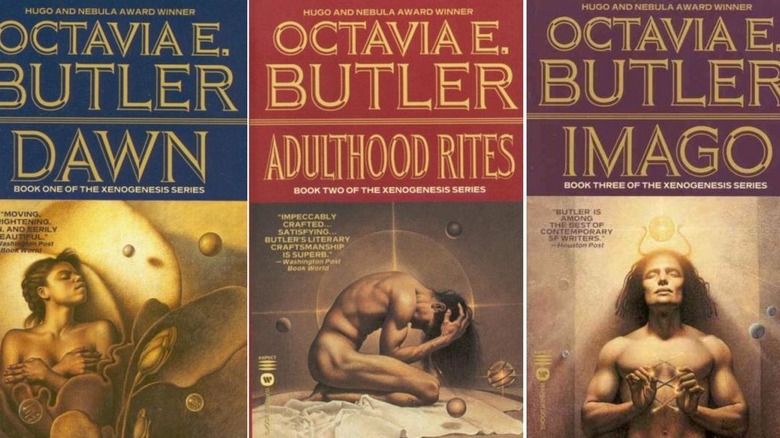
Octavia E. Butler's Xenogenesis trilogy is better known as the Lilith's Brood series, incorporating the novels "Dawn" (1987), "Adulthood Rites" (1988), and "Imago" (1989). The books are set 250 years after Earth has been devastated by a nuclear war and are told from the perspective of a human woman named Lilith Iyapo, who has been taken aboard a spacecraft belonging to a species called the Oankali. The Oankali are wholly benevolent and aim not only to make the Earth habitable again but also to fulfill their own biological imperatives to mate with humans and create a new species. The Oankali have three sexes: male, female, and ooloi, the latter of which can somehow manipulate genes.
The trilogy traces the building of a new human/Oankali admixture species and how some humans reject their new alien counterparts. In the second book, the ooloi make all humans infertile, and the third book follows the fate of a character named Jodahs, who is Lilith's half-alien offspring. The books are very sexual and explore the fluid nature of gender and sexuality in a meditative fashion. There is also the notion that ooloi see cancer as a superpower, as they can manipulate cancer cells and transform them into beneficial things.
This kind of broad, expansive exploration of the next evolution of humankind, and our eventual breeding with alien beings, could never be handled by a single feature film, so a big-budget TV series would be perfect. Butler's views are almost Roddenberrian in their sex-positivity but mercifully lack Roddenberry's ultra-male lasciviousness. The future is not male or female, but something new entirely. And we won't need machines or aggression. We'll just need profound physical understanding.
Butler's "Kindred" was already adapted. Why not Lilith?
The Hainish Cycle by Ursula K. Le Guin
It's easy to see why Ursula K. Le Guin's long series of novels known as the Hainish Cycle hasn't been adapted yet: it's huge. The first book in the series, "Rocannon's World," was published in 1966 and has been followed by 11 sequels through 2017, not to mention about a dozen short stories. The Hainish Cycle, however, doesn't follow a single narrative throughline, really, and is more a large collection of stories that are all set in the same expansive universe.
The Hainish Cycle takes place in a near-future in which Earth lives among a local community of solar systems populated by humans. In Le Guin's universe, humans didn't come from Earth, but were seeded across various worlds by the peaceful residents of the planet Hain. The various planetary colonies are contacting one another for the first time and are trying to set up, essentially, the Federation from "Star Trek." The humans from the different colonies have been genetically tinkered with by the Hainians, so some of them are waking dreamers, while others are intersex and can shift between male and female, depending on their mating drives.
There are consistent players throughout the series. The Federation is the League of All Worlds, and it eventually united under the name of the Ekumen. There is a species of androgynous Gethenians, and they aim to be the 84th planet in the organization. There is talk of the history of space travel, and many other details besides.
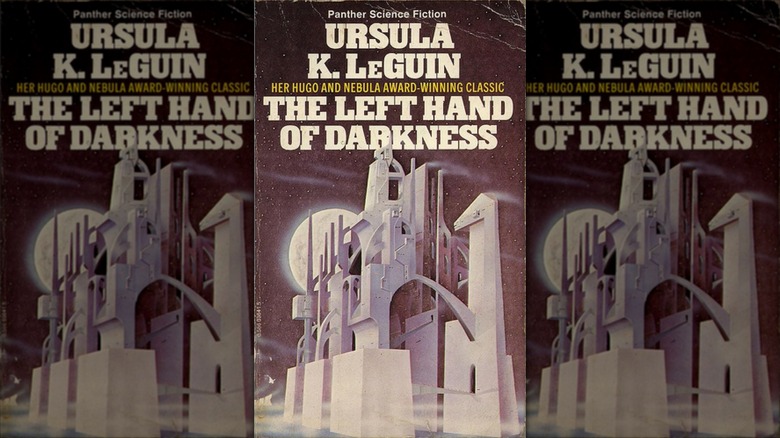
Le Guin's approach was more of an anthology, and one might see a Hainish TV series based on "The Left Hand of Darkness" to start (a movie would also have been good), with each subsequent season covering a new world or element of the Hainish universe.