

How Supergirl's Box Office Failure Could Reshape The Future Of James Gunn's DC Studios
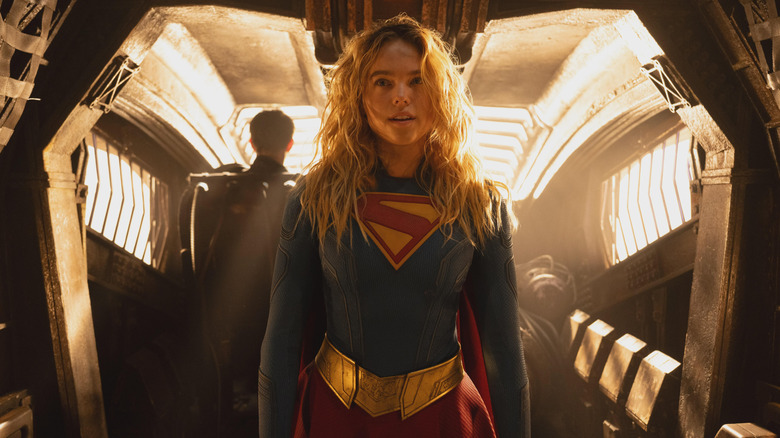
Craig Gillespie's new film "Supergirl" was released on Friday, June 26, to middling reviews and very poor box office. Deadline claims the film's budget was $186 million, and it only opened to $38 million in the United States and Canada, with an additional $30 million coming in from overseas. One might chalk up the film's failure to bad timing. Although they dominated the box office (and all movie-driven discourse) throughout the 2010s, superhero movies have been sauntering vaguely downwards, in box office and cultural estimation, for the last six years.
Broadly, the Marvel Cinematic Universe movies released since "Avengers: Endgame" in 2019 haven't rattled the zeitgeist in quite the same way as the films leading up to it, and the major successes have been scant. While both "Spider-Man: No Way Home" and "Deadpool & Wolverine" were billion-dollar ultra-hits, it's worth pausing to note that both of those movies were crossover specials, incorporating characters from decades-old movies. Those films felt more like last-hurrahs or victory laps than new ways to move the genre forward.
For DC, who could forget the many films in the decade-long DC Extended Universe overseen by Zack Snyder? That grimdark version of the DC universe also had a few major hits, but also incorporated major bombs like "Black Adam," "Shazam! Fury of the Gods," and "The Flash." By 2023, when the DCEU petered out, it felt like the genre was dead and buried.
That didn't stop DC Studios from trying, though, and James Gunn and Peter Safran unwisely rebooted the entire rigmarole on the big screen in 2025 with Gunn's "Superman," featuring a brighter, brisker rendition of the character. A recent report from The Wrap, however, notes that the failure of "Supergirl" (which Gunn and Safran produced) might spell a grim future for Gunn and, by extension, the DCU in general.
Some industry insiders think James Gunn might be out of a job

James Gunn and Peter Safran, it should be noted, announced not just a few superhero movies, but an entire cinematic universe. "Superman" was the first film in a series that, it seems, Gunn wants to survive for decades. The next film in the series, "Clayface," is due in theaters this October. Two TV shows, "Creature Commandos" and "Peacemaker," are also part of the cinematic universe, and the Green Lantern series "Lanterns" will debut this August. This entire wave of movies and shows falls under the ambitious banner of "Gods and Monsters," the first chapter of the new DCU.
In the wake of the disastrous opening for "Supergirl," The Wrap spoke to an unnamed agent who suggested that James Gunn might need to look over his shoulder:
"I don't know how nervous DC is, but certainly James Gunn should be nervous. [...] There will always be a DC, and the current execs have survived previous regime changes, but I don't think Gunn survives."
The Wrap pointed out that the intended audience for "Supergirl" didn't care to see the movie. The idea was to lure in Gen-Z women, but the bulk of people who saw it were men over 25. Another unnamed insider quoted by The Wrap noted that the age of obscure superhero characters opening huge-budget movies is long in the past. James Gunn had great success in the mid-2010s with "Guardians of the Galaxy," which was based on relatively obscure Marvel characters. Supergirl isn't as big a figure as Superman, Batman, or Wonder Woman, and giving her a $186 million film in 2026 was an unwise move. The audience just isn't interested anymore.
Will the DCU change shape, or was this an isolated incident?

In a very good post-mortem, /Film's Ryan Scott noted five reasons why "Supergirl" flopped, and they all sound legit. He noted that the DCU wasn't well-established enough yet to stray into the B-list, the budget was too big, and, most importantly, that the once-ubiquitous hype around the superhero genre has died down immensely in the last few years. Some have noted that superhero movies with female leads tend to draw a lot of noisy ire from a particularly sexist sewer of the internet and get review-bombed as a result, but I think we're better off ignoring the sexist jerkwads who have nothing of interest or intelligence to say. The "girl equals bad" crowd doesn't move the needle as much as they might like to think.
"Supergirl," however, might have faltered because of its tone. "Superman" was notable because it was a colorful, brightly-lit antidote to the insufferable angst of the DCEU before it. "Supergirl" fell right back into that angst, featuring an angsty character living in grossly over-designed sci-fi spaces. /Film's BJ Colangelo found things to like about the film in her review, however, giving it a 7 out of 10.
DC Studios' co-CEO Peter Safran, meanwhile, tried to spin the failure of "Supergirl" as disappointing but by no means large enough to derail his and Gunn's decade of planned superhero movies. It was one failure in an intended expansive project of many movies and TV shows.
If the industry insider is correct and Gunn and/or Safran are about to be canned due to "Supergirl" underperforming and the looming WB/Paramount merger — which, if approved, will put new people in charge at the top of the company — then the DCU may change course or halt altogether.