

Dustin Hoffman Starred In One Of The Best Thrillers Of The '70s
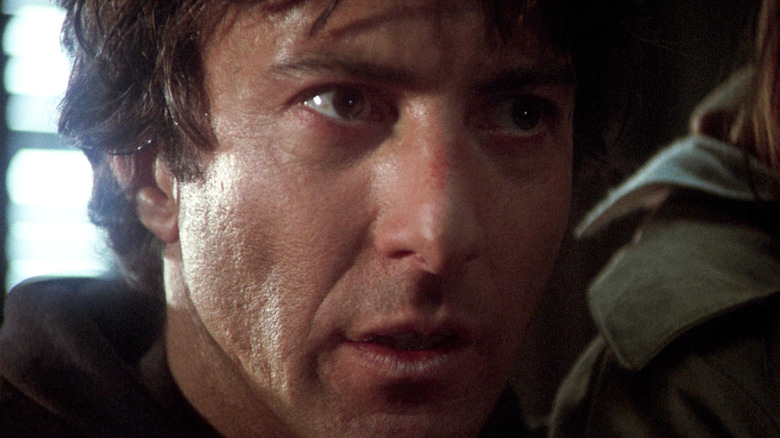
Pop quiz: Which actors are most synonymous with the New Hollywood of the late 1960s and '70s? Al Pacino? Robert De Niro? Jack Nicholson? All fine answers, but a spot must be reserved for Dustin Hoffman, who holds a serious claim at being the best actor ever.
Hoffman exploded as a leading man in the 1960s with "The Graduate" and then "Midnight Cowboy" (a two-hander with Jon Voight, granted). He received a Best Actor Oscar nomination for both parts, and by the turn of the decade, Hoffman had clinched a win at the 52nd Academy Awards for the 1979 divorce drama "Kramer vs Kramer," where he co-starred with Meryl Streep. "Kramer vs Kramer" doesn't carry the same edge today when divorce is normalized, but it's still a well-acted powerhouse drama.
Even if he didn't win any Oscars for them, some of Hoffman's best parts came earlier in the 1970s. One of them? His lead role as Babe Levy, a graduate student swept up into international criminal espionage, in "Marathon Man." The title refers to Babe being a literal recreational marathon runner, one who is soon on the run for his life.
A reunion for Hoffman and "Midnight Cowboy" director John Schlesinger, "Marathon Man" pits Hoffman against a more formidable scene partner than Voight: Sir Laurence Olivier, playing Nazi war criminal Christian Szell (one of the best movie villains of the 1970s).The most enduring "Marathon Man" scene is when Szell, grilling a clueless Babe for information, gives his prisoner some unneeded dental work.
Marathon Man" is not even the best movie that Hoffman has ever made, let alone the best 1976 thriller he made. ("All The President's Men" still takes that crown.) That's no slight on "Marathon Man," but rather praise for the superlative highs of Hoffman's filmography.
Marathon Man turns historical injustice into thriller dynamite
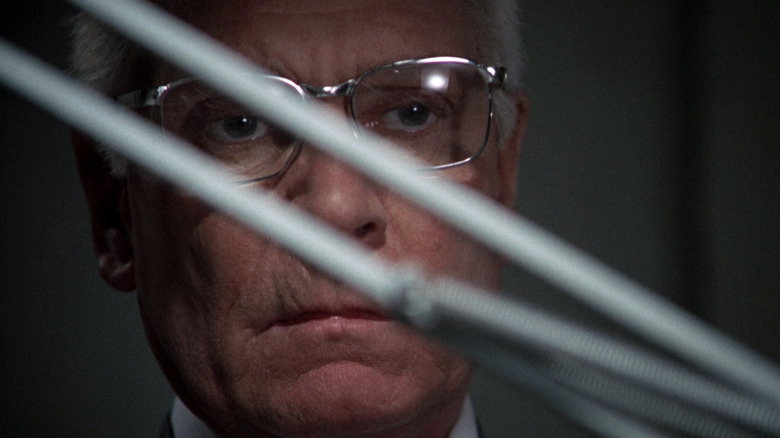
In "Marathon Man," Babe's older brother Doc (Roy Scheider) is a secret agent working to capture Szell, who escaped Germany after World War II with the stolen wealth of Jewish Holocaust victims and has set up a diamond smuggling ring. After Szell murders Doc, he has Babe captured to get any potential information out of him.
(Most of this exposition is delivered during a car chase sequence, when one of Doc's colleagues is seemingly helping Babe escape. This serves to keep the movie light on its feet, not bogged down in conspiratorial details; you wouldn't expect a movie called "Marathon Man" to slow down, would you?)
Szell's wealth has a particularly unsettling origin. A trained dentist, he literally pulled gold tooth fillings from the mouths of concentration camp prisoners; Szell may be a fictional Nazi, but this is real history. A man who's a Nazi war criminal and a dentist? Szell may seem like a simplistic attempt at making the scariest villain ever, but there's deeper meaning.
Dustin Hoffman, John Schlesinger, and William Goldman (screenwriter of "Marathon Man" and author of the original book) were/are all Jewish. That gives them a personal stake in seeing justice brought to an escaped Nazi, one kept rich by what he stole from Holocaust victims. In her then contemporary review of "Marathon Man" for the New Yorker, critic Pauline Kael called the movie "a revenge fantasy" — "['Marathon Man' is] 'Death Wish' with a lone Jewish boy getting his own back from the Nazis."
Kael admittedly wasn't impressed by the flick beyond Hoffman's performance, saying it was "fouled up right from the word go." If you want to contest film criticism's most famous iconoclast, give "Marathon Man" a shot.