

The Star Trek: Deep Space Nine Episode Fans Rarely Talk About — But Absolutely Should
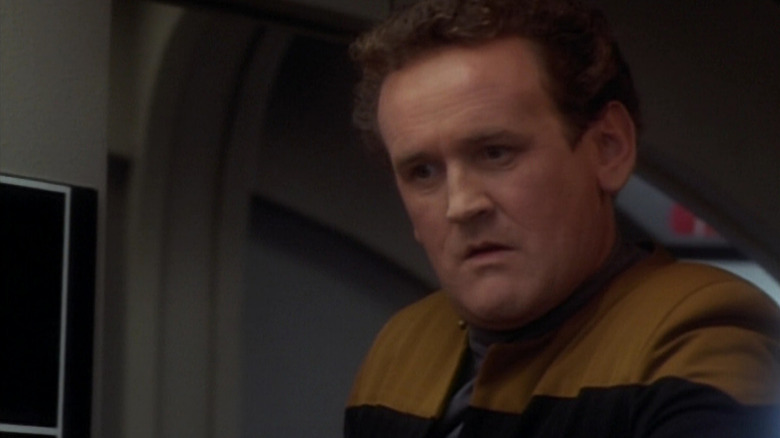
The "Star Trek: Deep Space Nine" episode "Whispers" (February 7, 1994) is told in flashback. The eternally beleagured Chief O'Brien (Colm Meaney) recalls an event from a few days prior, during which he was on an away mission to visit an alien species called the Parada. The Parada are preparing for an upcoming peace summit of some kind and require Starfleet's aid in setting up security measures.
When he returned from those talks, though, something was amiss back on Deep Space Nine. O'Brien's wife Keiko (Rosalind Chao) and young daughter Molly (Hana Hatae) were suddenly cold and weirdly distant. At work, he found that other engineers were working on security measures without his knowledge, all under the express orders of his commanding officer, Commander Sisko (Avery Brooks), the best captain in "Star Trek."
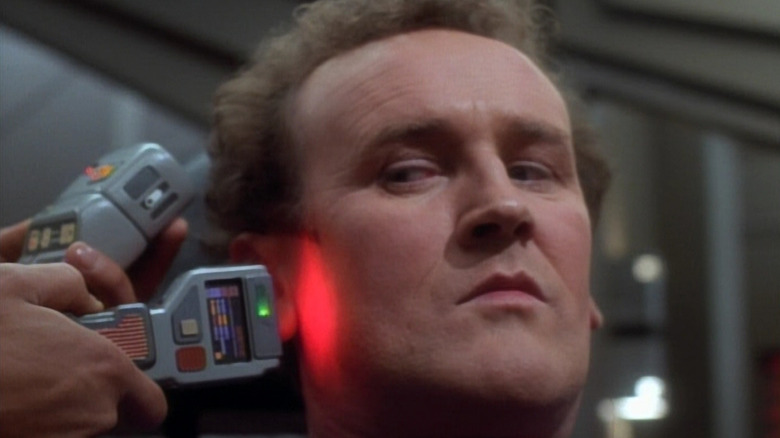
O'Brien begins to notice people having secret conversations as they glance in his direction. Why is Sisko having a conversation with Keiko, and what was it about? Why did Dr. Bashir insist on giving him such a long and invasive medical scan? Even the station's chief of security, Odo (Rene Auberjonois), seems to be eyeballing O'Brien with suspicion. Why is everyone acting so weird?
Trekkies will immediately know that something's amiss. "Whispers" came partway through the second season of "Deep Space Nine," so audiences all naturally understood that everyone was behaving out of character. Audiences will spend the entire episode looking for clues as to why everyone seems so paranoid. Is O'Brien in a parallel universe somehow? Did he contract a weird disease he doesn't know about? Trekkies will begin placing bets as to what is going on.
Of course, the truth will be revealed, but it may not play out exactly how you might expect. "Whispers" is largely forgotten, but weirdly gripping.
Whispers is a great 'mystery' episode of Star Trek
The twist in the episode might be predictable, it's one of the oldest tricks in the sci-fi book — but it's still fun. The crew of Deep Space Nine shows up and attempts to arrest O'Brien for unspecified crimes. What? O'Brien, being clever, manages to flee and escape the station on a runabout, determined to return to Parada.
At this point, it is revealed that O'Brien was kidnapped by the Parada at the beginning of the episode and replaced with a preprogrammed clone. We had been following the clone this entire time. The clone didn't know this, but it had been programmed to return to Parada and serve as an assassin during the aforementioned peace summit. There is a chase and a kerfuffle in the back third of "Whispers," leading to a climax back on the Parada planet. The clone O'Brien will learn the truth when he sees the original O'Brien in the flesh. Of course, the clone O'Brien has the original's memories, so when it gets shot, its final thought is to send love to Keiko and Molly.
There is nothing revolutionary about "Whispers." It doesn't introduce any new story wrinkles into the "Star Trek" canon, and it doesn't bring any new character developments for O'Brien. Indeed, O'Brien spends the bulk of the episode locked up.
Some Reddit users have been talking up "Whispers," noting the heartbreaking nature of the clone's story and the episode's generally strong storytelling. "Whisper" was written by Paul Robert Coyle and directed by "Star Trek" veteran Les Landau. Sometimes, in their rush to make 26 episodes in a season, the makers of "Star Trek" stumble upon a simple bottle episode that transcends the others in skill and quality.
The universe hates Miles O'Brien
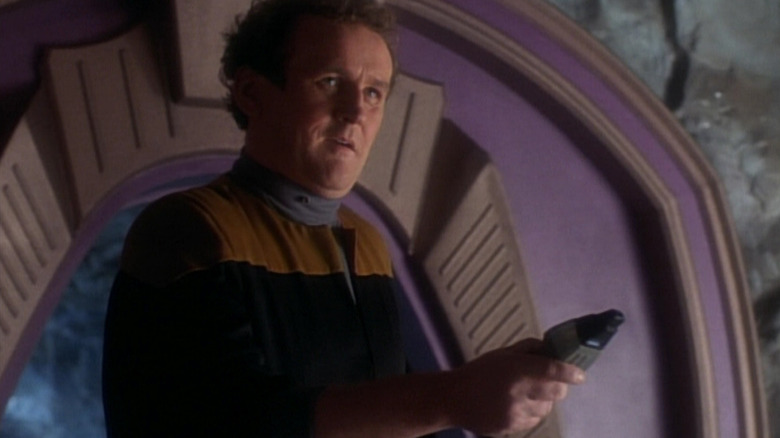
Fans of "Star Trek: Deep Space Nine" are familiar with a notable trope that began with "Whispers," which we have nicknamed "O'Brien Must Suffer" or "The Universe Hates Miles O'Brien." It seems that the character of Miles O'Brien underwent far more torture and trauma than any other character on the series, and suffered so much that it almost became comedic.
One might immediately think of the episode "Tribunal," which aired in the same season as "Whispers." That episode was reminiscent of Franz Kafka's "The Trial," seeing O'Brien apprehended by the Cardassians and put on trial for an unspecified crime. The Cardassian court system isn't designed to find people not guilty, so O'Brien is pretty much screwed. He is also stripped and beaten in prison. The man had a hard time.
And speaking of hard times, many fans love the episode "Hard Time," in which O'Brien's brain was implanted with the false memories of a 20-year prison sentence, even though in actuality, he only aged a few hours. In his false 20-years in prison, he recalled befriending, and then betraying, and then murdering, a fictional cellmate. O'Brien awoke from his experience wholly traumatized.
And even O'Brien's family is often tormented. In "Time's Orphan," a time warp forces O'Brien's daughter Molly to remain on a planet for many years unattended. They find her when she's 18, having raised herself in the woods and become a feral wild child. So, yeah, O'Brien always suffered and suffered and suffered some more. Luckily, his reputation was secure. According to "Star Trek" lore, he would become one of the most important people in the galaxy. Although there have been a lot of "Star Trek" reboots recently, Colm Meaney doesn't think he'll play O'Brien ever again.