

The 1973 Clint Eastwood Movie Fans Rarely Talk About — But Absolutely Should
We may receive a commission on purchases made from links.
Today, audiences aren't surprised to see a grounded drama directed by Clint Eastwood. Take 2024's most intense courtroom drama, "Juror #2," for instance. But back in the early 70s, viewers and critics were still becoming acquainted with the screen legend's directorial talent. His 1973 drama, "Breezy," simply wasn't seen by enough people to firmly establish Eastwood as a capable drama director, and even today is mostly overlooked in retrospectives of the man's filmography. But the film is more noteworthy than you might think.
Per Letterboxd, "Breezy" is his second-least-watched movie, with 8,000 logs, compared to half his filmography, which has a minimum of 50,000 logs. "Breezy" also has a 3.6 rating on the site, placing it above movies like "Sully" and "American Sniper." Yet the 1973 drama isn't talked about nearly as much, which is almost certainly because Eastwood didn't star. That, and the film is also a mature emotional drama, a far cry from the kind of cowboy/cop action with which Eastwood had made his name.
In 1971, the same year he debuted as "Dirty" Harry Callahan, Eastwood released his directorial debut, "Play Misty for Me," in which he also starred. The thriller about a DJ stalked by a deranged listener was successful, and Eastwood followed it up by stoking the ire of John Wayne himself with "High Plains Drifter," a revisionist Western that saw its star revisit the mysterious-stranger archetype to great success. His third directorial effort was "Breezy," and it was about as far from both "Misty" and "Drifter" as you could get in terms of tone.
Clint Eastwood decided not to star in his age-gap romantic drama
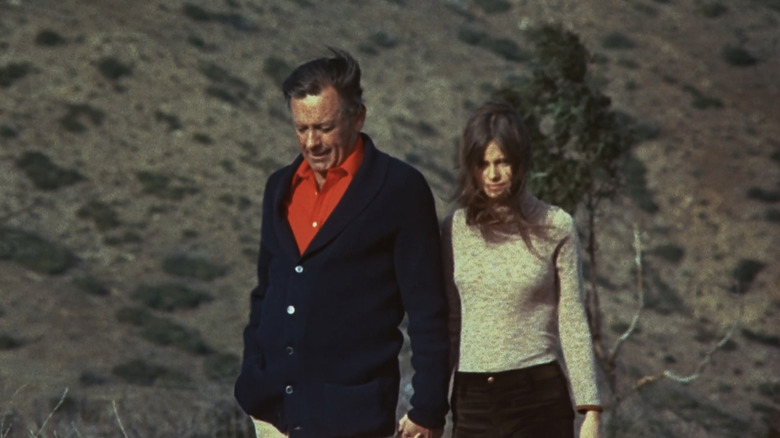
"Breezy" isn't remembered as one of Clint Eastwood's best directorial efforts, but it might be one of the most interesting. His third film as director was also the first in which he didn't star. Writer Jo Heims (who also wrote "Play Misty for Me" before Eastwood handed it to Dean Riesner) originally penned "Breezy" with Eastwood in mind for the lead. But the then 42-year-old actor felt he was too young to play the part of a lonely divorcee and decided to direct instead. 54-year-old William Holden then took on the role of divorced real estate agent Frank Harmon.
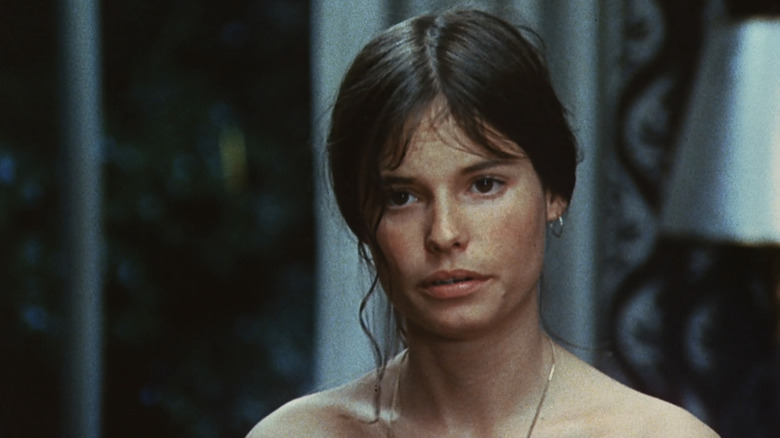
Edith Alice "Breezy" Breezerman was played by 19-year-old Kay Lenz, whose only other film role had been a small one in "American Graffiti" that same year. After escaping from the car of a lascivious man who offered her a ride, the teenage hippie sits on the curb near Frank's Laurel Canyon home. Harmon meets her and is initially irritated by her constant chatter, but agrees to give her a ride down the hill. After finding an injured dog on the side of the road, Breezy is overcome by emotion and runs off, leaving her guitar behind.
So begins a relationship between two seemingly mismatched lovers, with Breezy continually finding reasons to return to Frank's life and eventually breaking through his gruff facade. But Frank has trouble accepting their age gap, leading to yet more trouble for the pair's May-December romance.
In the book "Clint Eastwood: Interviews," the actor is quoted as saying he "liked the whole comment on the rejuvenation of a cynic," and that he saw the film as being about "just deciding to exist." Audiences and critics of the time didn't necessarily see it the same way.
Breezy wasn't a success but is worth a revisit
Variety's review of "Breezy" (via AFI) was hardly complimentary. According to the reviewer, "Too much laugh/smile/chuckle sitcom patter and situation make the film more like a TV feature." Other reviews were of a similar tenor. Even Richard Schickel, author of "Clint Eastwood: A Biography," wasn't a fan, writing, "For a work exploring such a potentially explosive — and, to many minds, scandalous — sexual encounter, it is not a very sexy movie." Another Eastwood biographer, Patrick McGilligan, wrote in his book "Clint: The Life and Legend," that "the thinness of the story, the ordinariness of the dialogue, cried out for a rewrite," and noted that "in Clint's career, nothing would rival it as a flop" (though nothing was more of a critical flop than Eastwood's 1985 gangster flick that Roger Ebert absolutely hated).
Exact box office numbers are tough to find, but Eastwood claimed the film cost $725,000 before overheads. Schnickel claims it made back its budget. Still, "Breezy" didn't get a video release until 25 years after its theatrical run, and Eastwood stayed away from love stories for two decades.
But if Letterboxd is anything to go by, the film played much better with modern audiences, who enjoyed the May-December romance and generally view it as an unseen gem in Eastwood's filmography. Users cite everything from the film's vintage L.A. showcase to its pacing, with one even claiming that "Breezy" was "a more nuanced film" than they expected. Most also seem to have enjoyed what is frequently described as a "gentle" tone, which makes the questionable-at-best relationship easier to take. There's no doubt "Breezy" is an interesting, overlooked Eastwood movie, and a heck of a lot better than that awful gangster movie he made in the '80s.