

What Do Star Trek's Nacelles Do? A Quick Guide To The Important Starship Part
We may receive a commission on purchases made from links.
Welcome to Trekspertise, a series where we break down the technology, history, details, and decisions that make the Star Trek universe so complex — and so fun.
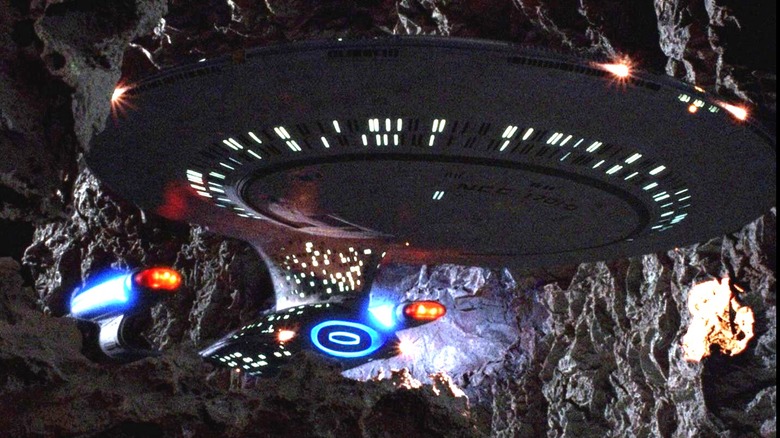
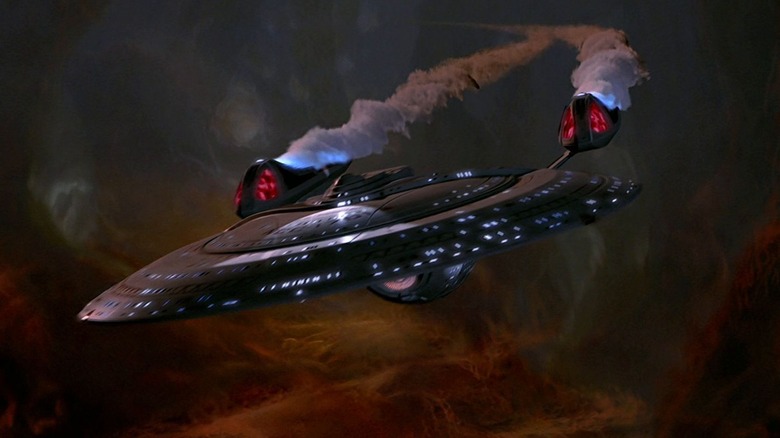
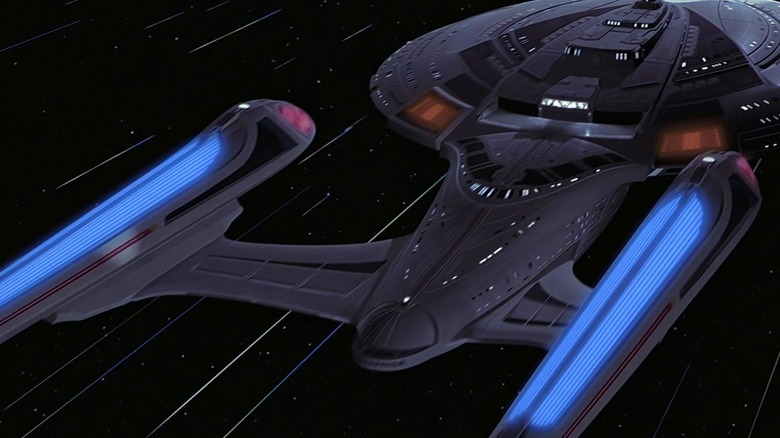
The warp nacelles are the tube-shaped engines that are held aloft from the hull of a Starfleet vessel on "Star Trek." They almost always come in pairs, and serve as a ship's primary means of propulsion. On the original "Star Trek," they had red, rounded tips. From "Star Trek: The Next Generation" onward, they also had long glowing blue lights down their sides.
In brief, the nacelles are the engines of a Starfleet vessel, and function by shaping the warp field around a starship, allowing it to stay in one piece as it zips along through space. To remind readers, Starfleet vessels don't actually fly faster than light, but instead "warps" space around them. The warp field "bunches up" actual physical space. A vessel would then travel at sub-light speeds across the bunched-up space, and then re-stretch it back to normal. This allows it to traverse great distances without, technically, breaking the laws of physics. The nacelles need to be at the outer edges of a ship's design so that the warp fields they generate will encompass the entire vessel.
Nacelles, it should be noted, are not like rocket engines in the least. They don't propel the ship by firing rocket blasts out the back. But if you were painting a somewhat abstract portrait of the USS Enterprise, and you added long glowing lines of energy streaking out of the rear portions of the nacelles as it blasts across the galaxy, you'd be forgiven. You might even fetch a pretty high price from a collector at your local "Star Trek" convention.
The nacelles are essentially the warp engines of a Starfleet vessel
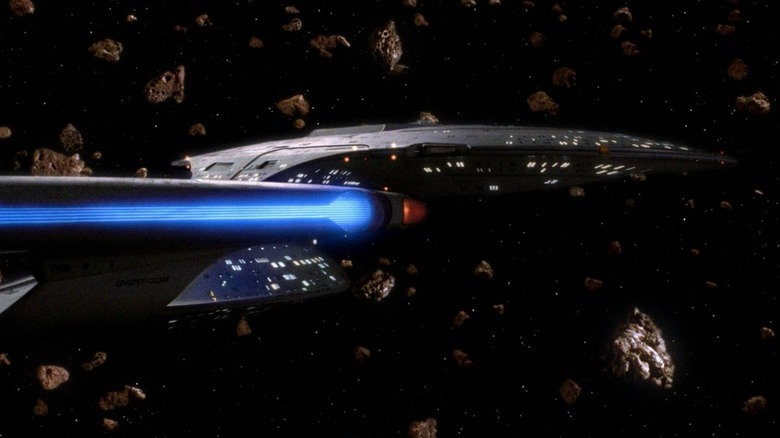
"Star Trek" creator Gene Roddenberry, as some Trekkies may know, had four strict rules when it came to designing the franchise's starships. For one, Starfleet vessels had to have two warp engines, held aloft from the ship's hull. Secondly, the engines had to be angled in a specific way, possessing at least a 50% line-of-sight on each other across the hull; Starfleet vessels were not to be flat across. Thirdly, the warp nacelles had to be visible from a front view of the ship; a saucer section should not block the colored red tips of the engines from facing out into open space. And fourthly, the bridge of a starship had to be at the very top of a ship's primary hull; it couldn't be hidden away deep inside the ship somewhere.
All of these rules seem to have been derived merely from design aesthetics; Roddenberry wanted his ships looking a certain way, ensuring they would be unique to "Star Trek." Later on, however, some physicists noted that ships traveling faster than the speed of light would, in theory, have to produce a "safe zone" bubble around the main hull of a craft, meaning that widely spaced engines would be required. Perhaps without realizing it, Gene Roddenberry was leaning into the real-world science of faster-than-light travel. (We once quoted physicist Harold "Sonny" White on the matter in a separate /Film article.)
On "Star Trek," as laid out in the invaluable book "Star Trek: The Next Generation Technical Manual" by Rick Sternbach and Mike Okuda, the warp nacelles are said to be injected with power from the main engine, and activate the warp field coils. The coils are split toroids (of course), and produce a multilayered field that surrounds the starship.
Bussard ramscoops suck in particles and space gases
I won't go into the complex geometry of a warp field here, as it's too involved and too technical. I will express extreme comfort, however, with the fact that the makers of "Star Trek" gave so much thought to the physics of the franchise. /Film once asked a real-life astrophysicist what "Star Trek" gets right about space travel, and it was remarkable just how much the franchise nailed. Sadly, it was theorized that a warp engine would require way too much energy to actually operate in the real world. Luckily, "Star Trek" has the magical, fictional crystalline mineral called dilithium that can, via writerly convenience, channel the energy of matter/antimatter explosions into their engines. That would be a pretty handy source of power.
The red tips on the front end of a warp nacelle actually serve a different function than the engines themselves. According to the "Technical Manual," those red tips are called Bussard ramscoops, and they "scoop" up errant space particles and gas molecules that a Starfleet vessel might come across in their travels. They were named for the real-life physicist Robert W. Bussard, whose works on fusion and propulsion can be found online. The ramscoops on a starship convert the errant hydrogen atoms and other detritus directly into useable starship fuel. However, since hydrogen atoms are so sparsely scattered throughout space (about one atom per cubic centimeter of space), the ramscoops actually don't provide a lot of gas.
The ramscoops can be used for other functions as well. In "Star Trek: Insurrection," Commander Riker (Jonathan Frakes) used them to suck in huge amounts of explosive gas from space, then release it toward an attacking enemy vessel. A photon torpedo then ignited the fuel and exploded the enemy.
Why are there only two nacelles per starship?
Because of Gene Roddenberry's two warp nacelle design demand, the writers of the "Technical Manual" had to reverse-engineer a technical, in-universe reason why only two engines were needed. They came up with the idea that, in 2269, some experimentation was done using one or three warp nacelles, but the results of the experiments proved that two was the ideal number.
Of course, that hasn't stopped some starship designers from tinkering with the designs. For instance, the USS Stargazer, a ship very dear to Captain Picard (Patrick Stewart), had four nacelles. The additional nacelles apparently allow for more precise maneuverability, as they produce two, interacting warp fields. The "Manual" has a passage about how two full sets of warp coils can control timing differences, modifying the warp field geometry and, hence, a ship's heading.
It should be noted that the USS Stargazer was where Picard invented "The Picard Maneuver," a combat plan that involved going to warp for only a split second in the midst of battle, making it look like the ship was in two places at once for a moment. This would bamboozle an attacker, and allow for a swift strike. It seems like the four nacelles on the Stargazer permitted such a maneuver. Trekkies have never seen the Picard Maneuver done with any other ships. (The Stargazer was resurrected in "Star Trek: Picard.")
There is one drawback to warp nacelles, though, and it should seem pretty obvious. Because they are extended from a ship, nacelles are extremely vulnerable. Oh sure, they have shielding to protect them from the ordinary rigors of space travel, but it's extremely easy for an attacking vessel to target a warp nacelle and disable the Enterprise's engines.
So be careful out there, folks.