

Why Misery Director Rob Reiner Cut The Gore From The Stephen King Novel
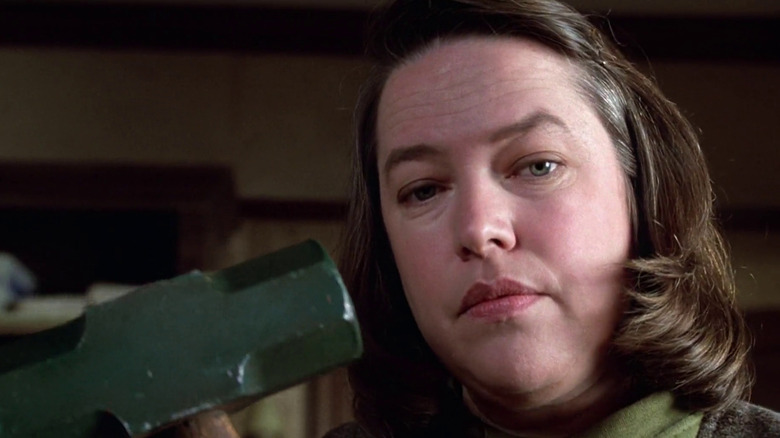
Stephen King's novel "Misery" was published in 1987, after the author was already celebrated as one of the most important horror authors of all time. By then, he had legions of obsessive fans and a dozen movies based on his work. "Misery," one can see, served as a comment on King's career.
"Misery," for those unfamiliar, is about a popular author named Paul Sheldon, best known for a series of tragic romances starring Misery Chastain. One night, while driving through the snow in a remote part of Colorado, Paul accidentally slides off the road and is seriously injured. He awakens in the nearby home of Annie Wilkes, a kindly nurse who also happens to be the world's biggest Misery Chastain fangirl. Annie keeps Paul in bed, happy to talk his ear off about his work. It doesn't take Paul too long to realize that Annie is suffering from some kind of violent mental disorder.
One can see how Paul serves as a Stephen King insert character; he wouldn't want to be trapped in bed with a superfan nearby. As the novel progresses, Annie gets increasingly violent and increasingly angry about Paul's books. She even cuts off one of his feet with an axe to prevent his escape. The violence ramps up from there.
"Misery" was adapted into a successful 1990 feature film by Rob Reiner, with James Caan and Kathy Bates as Paul and Annie. The film, however, wasn't quite as violent as the book, with the foot-severing replaced by a mere hobbling (still horrifying). Back in 1990, Reiner spoke with the Los Angeles Times and explained that he toned down the film's gore because he wanted it to play more like an intellectual "chess match" rather than a mere horror show.
Rob Reiner wanted Misery to be more intellectual than gory
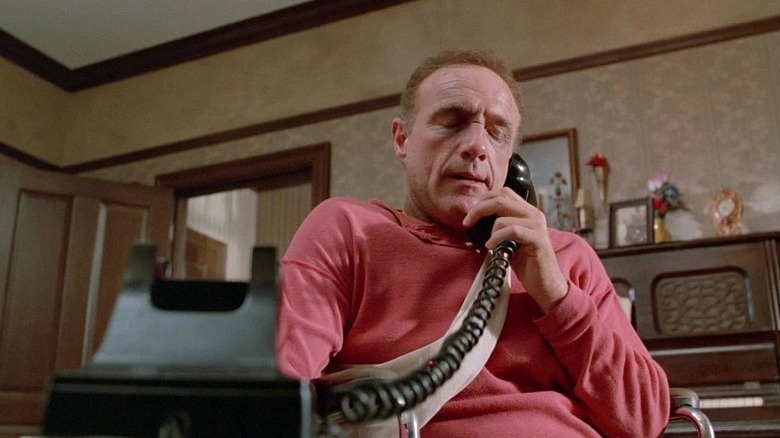
It should be noted that there are several notable differences between Stephen King's novel of "Misery" and Rob Reiner's film version. As already stated, the foot-removing axe from the book was replaced by an ankle-smashing sledgehammer. That's still plenty violent, and Reiner films Paul's feet being injured, but there's no spurting blood.
Also, there's a sheriff character in the book who is murdered by a knife and then run over with a lawnmower. In the film, where he is played by Richard Farnsworth, the sheriff is merely shot in the chest. In both the book and the movie, Annie is tricked at the end and suffers a specific retribution at Paul's hands. I shan't reveal what those entail, other than to note that the book is a little more salacious. And those are just the broad strokes. Stephen King fans will be able to point out many other differences.
When it came to making the movie, Reiner was eloquent as to why he wanted to tone down the violence. He was quoted as saying:
"We got rid of the most gory and horrific parts. [...] I wanted to concentrate on the idea of this chess match between the artist and his fan. You definitely see in this film why fan is short for 'fanatic.' It's tricky, because to some degree, getting attention is a real compliment. But if you go one step farther ..."
Reiner seems to want to complete that thought with the phrase "you've gone too far." "Misery" is out of Reiner's usual wheelhouse, so he clearly wanted to pay attention to the horror of it all. It's easily Reiner's most horrific movie. Well, unless you count "North."
Misery was an awards darling
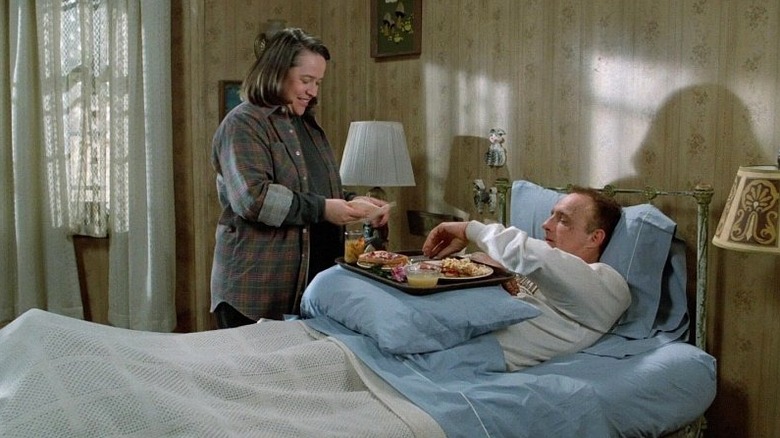
Rob Reiner's toned-down-gore approach might have been correct. "Misery," while still possessing some violent scenes, is all the more powerful for being about the psychological interplay between a hostage and his captor. Annie is an indelible character, as she follows a mad logic all her own. She is a fangirl who smashes the ankles of her favorite author, but she is weirdly understandable. Paul, meanwhile, is an intelligent man with no recourse. He is trapped by his own fame. Yeah, "Misery" was definitely a Stephen King self-insert tale.
Kathy Bates won an Oscar for her performance as Annie. This may surprise some readers, but "Misery" remains, to date, the only film based on a Stephen King novel to win an Academy Award. "Carrie" was nominated for two in 1976. Rob Reiner's "Stand By Me," based on the novella "The Body," was nominated for Best Adapted Screenplay in 1986. The 1994 film "The Shawshank Redemption" was nominated for seven Oscars, including Best Picture. And 1999's "The Green Mile" was nominated for four Oscars, including Best Picture. None of those films won their awards. Only "Misery" won for Best Actress.
"Misery" also came in the middle of an extended hot streak from Reiner, who had just come off "The Princess Bride" in 1987 and "When Harry Met Sally..." in 1989. After "Misery," Reiner continued his run with the hit courtroom drama "A Few Good Men." It's wild to think that Reiner, such a good-natured guy, was capable of tackling such a bleak book with such aplomb. May he rest in peace. And may Stephen King never meet a real-life version of Annie Wilkes.