

It Took David Lynch 50 Years To Never Make His Weirdest Masterpiece
We may receive a commission on purchases made from links.
Welcome to The Best Movies Never Made, a weekly lookback at the most fascinating, strange, and tantalizing films that came within striking distance of reality, but never actually made it in front of cameras — and maybe should have.
In the invaluable Faber & Faber book "Lynch on Lynch," edited by Chris Rodley, the late David Lynch talked a little bit about his unrealized project "Ronnie Rocket." Lynch recalled the span from the mid-'70s, when he was working on "Eraserhead," through the mid-'80s, when he was working on "Dune," when he was going to Bob's Big Boy (the one in Burbank) on a regular basis. "Each day at 2:30 p.m.," he said, "I'd have several cups of coffee and a chocolate shake — a silver goblet shake." He admitted that the sugar rush gave him inspiration, and that he would jot down ideas on napkins at Bob's, "I'm heavily into sugar. I call it granulated happiness."
It was in the late 1970s, a little after "Eraserhead," was starting to find success, that Lynch admitted that he became "fixated" on a project called "Ronnie Rocket," an idea he had for a superhero-adjacent follow-up.
"Eraserhead" was, of course, a striking debut feature for the young filmmaker, and wise execs began calling Lynch about the possibility of hiring him for his next big project. Lynch admitted that, yes, a few unnamed studios called, and that he discussed "Ronnie Rocket" with them. When the studios asked what this movie "Ronnie Rocket" was supposed to be about, Lynch merely said "I don't like to say too much about something, especially when it's something strange or abstract. I told them basically it was about electricity and a three-foot guy with red hair."
The studio heads were very polite, but he didn't get a call back.
Lynch went on to make "The Elephant Man" instead, but the imagination is already aflame. What would a 1979-era David Lynch superhero-esque movie have looked like?
You can read the script for Ronnie Rocket, or: The Absurd Mystery of the Strange Forces of Existence
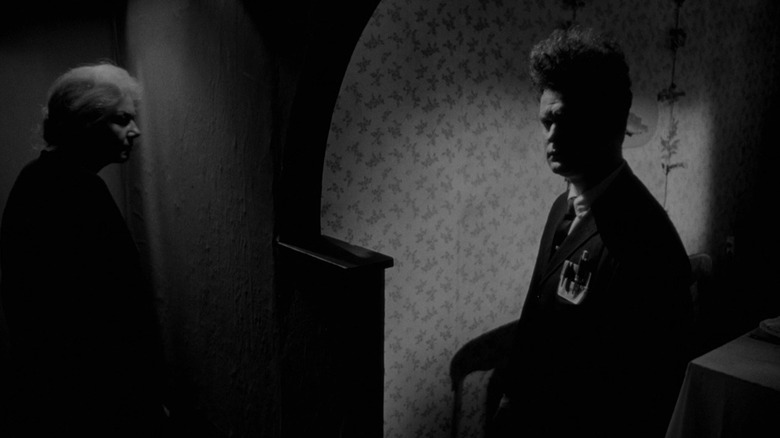
The full name of the movie was "Ronnie Rocket, or: The Absurd Mystery of the Strange Forces of Existence." One can read the screenplay online. A troupe called The Ever-Expanding Mysteries of the Mind even went so far as to read the entire script in audio format and put it on YouTube.
The film was also synopsized in Colin Odell and Michelle Le Blanc's book, simply titled "David Lynch." "Ronnie Rocket" follows the adventures of an unnamed detective who aims to travel into another dimension. The world seems impressed by him because he can stand on one leg. This will be key in his goals. The Ronnie Rocket of the title is Ronald d'Arte, a three-foot-tall teenager, who, during the film, suffers a strange surgical issue that leaves him reliant on electricity to survive; he has to plug himself in from time to time. Ronald finds that this affliction has given him an eerie affinity with electricity, and that he can use it to make some amazing music. He becomes a rock star and falls in with a tap-dancer named Electra-Cutie.
Lynch was quoted in the book "The Greatest Sci-Fi Movies Never Made" saying that he wanted to shoot "Ronnie Rocket" in color, as he was inspired by the use of high-contrast color in the works of Jacques Tati. In 1979, a color movie would have been a dramatic shift from the black-and-white nightmare of "Eraserhead."
A look through the script reveals a lot of themes that would continue to be explored throughout his work. There's a lot of factory-like industrial imagery, and many smokestack-encrusted settings. Lynch also used such imagery in "Eraserhead," "The Elephant Man," and his 1984 sci-fi film "Dune."
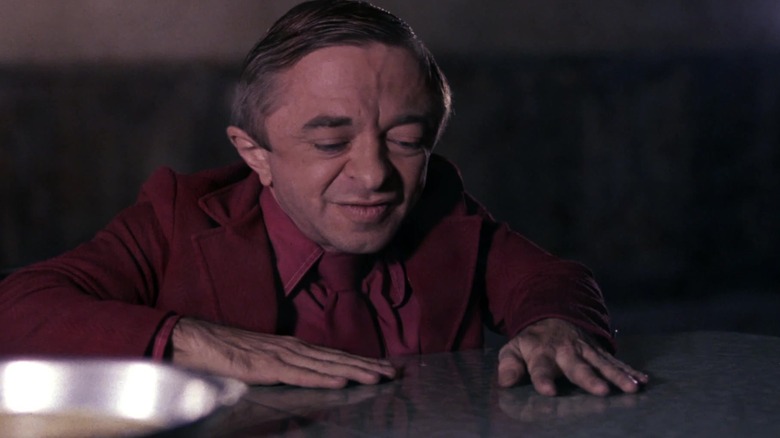
Michael Anderson from Twin Peaks might have played Ronnie Rocket
One doesn't have to read too much of the script to see that "Ronnie Rocket" was a little too weird for most mainstream studios. It's easy to see why the studios he talked to turned David Lynch down.
Initially, Lynch and his agent, Marty Michaelson, pushed hard to get "Ronnie Rocket" made, intensely hoping that it would be his follow-up to "Eraserhead." Lynch eventually hooked up with Stuart Cornfield, a potential producer, who was definitely interested, as he was already an "Eraserhead" fan. Confield was working for the then-still-forming Brooksfilms, the studio founded by Mel Brooks. Cornfield and Lynch knew that Brooksfilms was a potentially good match for the director, but they both seemingly came to the conclusion (described in "Lynch on Lynch") that "Ronnie Rocket" wasn't exactly right for the new studio. Lynch instead asked to peruse some already-written scripts, thinking he could direct one of them instead. That was how he found "The Elephant Man."
It wasn't a bad pivot, as "The Elephant Man" was a gigantic Oscar darling. But it did mean that "Ronnie Rocket" was about to enter an extended period of languishment. The project would reappear in Lynch's head every few years thereafter, and never see the light of day.
In the Odell and La Blanc "David Lynch" book, it is written that Lynch returned to "Ronnie Rocket" after "The Elephant Man" with every intention of casting Dexter Fletcher in the role. Fletcher, then only about 13 or 14, played the role of Byte's Boy in "The Elephant Man." This was 1981 or so.
As stated on Lynchnet.com, and in "Lynch on Lynch," the director had met actor Michael Anderson in 1987, and the actor would eventually go on to play The Man from Another Place on Lynch's "Twin Peaks," and Lynch was giving serious consideration to casting Anderson in the Ronnie Rocket role.
But note how many years have now passed since the first pitch of the script.
Ronnie Rocket couldn't get funding, but led to Blue Velvet
Let's scoot back before 1987 for a moment.
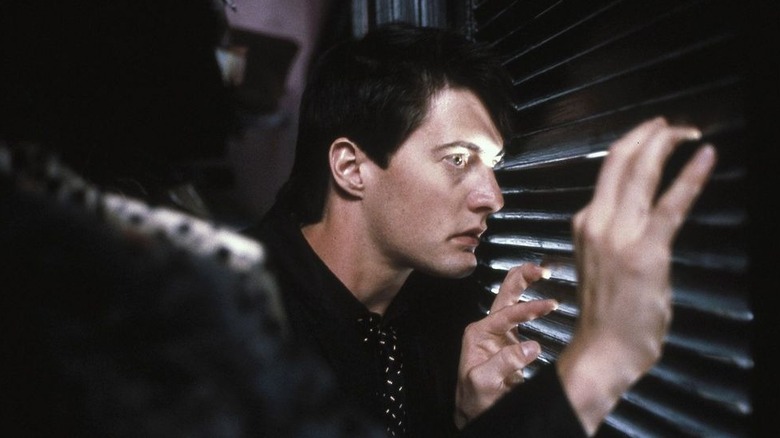
Prior to David Lynch's meeting of Michael Anderson, a stalled effort to make "Ronnie Rocket" in the mid-'80s led, in a roundabout way, to another of the director's masterpieces. In "Lynch on Lynch," he said:
"When I finished 'The Elephant Man,' I met Richard Roth, the producer of 'Julia.' He took me to lunch at [...] Hamburger Hamlet [...] and told me he read my script for 'Ronnie Rocket.' He'd liked it, but truly he said it wasn't his cup of tea. He asked me if I had any other scripts. I said I only had ideas. And I told him I had always wanted to sneak into a girl's room at night and that, maybe, at one point or another, I would see something that would be a clue to a murder mystery. He loved the idea and asked me to write a treatment."
After that meeting, Lynch went home and envisioned a severed ear in a field as a means of kicking off a mystery. This script would, of course, become "Blue Velvet."
After "Blue Velvet" became a sensation in 1986, and "Twin Peaks" was unspooling on TV in 1990, Lynch once again turned back to "Ronnie Rocket." At this point, Michael Anderson was still going to appear in the title role, and Lynch even went so far as to begin scouting locations (also stated in "Lynch on Lynch"). He wanted to find an old-fashioned industrial landscape for the movie, but all the intended locations were too up-to-date, too modern.
"Ronnie Rocket," it seems, was doomed to wait even longer.
Ronnie Rocket's score would have been a fusion of Miles Davis and the Cramps
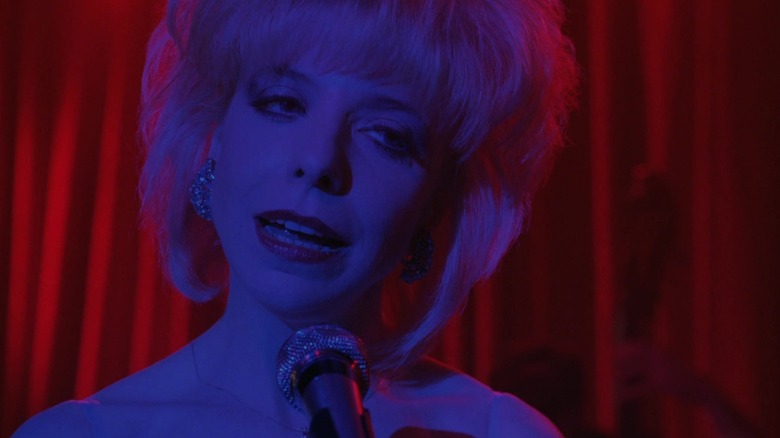
After David Lynch passed away in mid-January of 2025, musician Dave Alvin posted a remembrance on his Facebook page. He revealed a little bit more about the "Ronnie Rocket" project as it was forming about the time when "Twin Peaks" was on the air. This was now the early 1990s.
Alvin played guitar on some episodes of "Twin Peaks," and also played on a few tracks sung by Julee Cruise, whose first album Lynch co-produced. Alvin recalls a time when he and Lynch were spitballing music for "Ronnie Rocket," and described the experience thus:
"His storyline involved (and I ain't joking) a dwarf blues guitar player in early 1950s Chicago who is also an extraterrestrial from outer space. Mr. Lynch and I did three sessions where he would describe a series of abstract images to me then ask me to create some sonic landscapes to enhance the images. One of my favorites of Mr Lynch's scene descriptions was: 'Now, Dave, imagine an old conveyor belt full of liquid metal. The conveyor belt with the liquid metal then travels into these gigantic, antiquated, rusty machines where this liquid metal experiences some sort of loud, transmogrifying process inside the machines that turns the liquid metal into beautiful sparks of wild electricity. And please make it sound like Muddy Waters but also don't make it sound like Muddy Waters."
That is an amazing piece of musical direction. Alvin said that the ultimate piece he composed was a combination of Muddy Waters, "B*tches Brew"-era Miles Davis, and the Cramps. Sadly, Alvin didn't keep the tapes from those sessions.
But these early-'90s musical efforts to manifest "Ronnie Rocket" were swept up in Lynch's many other projects at the time – "Wild At Heart," for instance. By this point, Lynch was a huge celebrity, and making an arch, 1970s-throwback of "Ronnie Rocket" was far from a possibility.
Ronnie Rocket was too weird to live
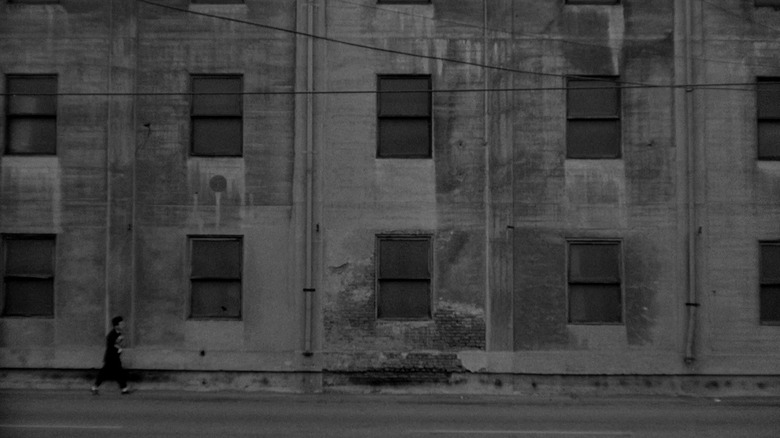
Back on the Lynchnet website, David Lynch said he tried to get "Ronnie Rocket" made as part of a three-picture contract the director signed with the studio CIBY 2000. Lynch pitched the idea, but CIBY passed on it. One can speculate that they, too, found the entire project too weird.
In a David Breskin interview, conducted in 1990, Lynch was asked directly if "Ronnie Rocket" was indeed officially dead. By then, all journalists had known about its struggle to be born. Lynch said:
"No, no, no, no, never, not in a million years. It's hard to say I'm going to make Ronnie Rocket next. I don't know if it'll ever be made. It's definitely not dead."
Lynch mentioned "Ronnie Rocket" again in 2013 BOMB Magazine interview, saying that "Ronnie" was still a possibility, but that the world of industrial smokestacks, where he wanted to set the movie, no longer existed. He noted that there was now too much graffiti to create the appropriate visual landscape.
A script for "Ronnie Rocket" was eventually found at auction, and it appears that Lynch had been making amendments all the way up until 2012. For Lynch, the dream never died. But in 2014 — about 36 after it was initially created — the real reason for "Ronnie's" failure to launch was finally revealed. Lynch spoke to the Daily Beast, and confessed, at long last, that the script for "Ronnie Rocket" just never hit a spot that he liked. Despite his decades-long push to get "Ronnie Rocket" made, he ultimately never came up with what he called "the big idea" at its core. Something, he said, was missing in the script.
So after all those years of fighting, "Ronnie Rocket" ultimately fell apart because David Lynch just wasn't 100% happy with the idea.