

How Daredevil: Born Again Cleverly Uses Color To Give Clues About The Show's Story
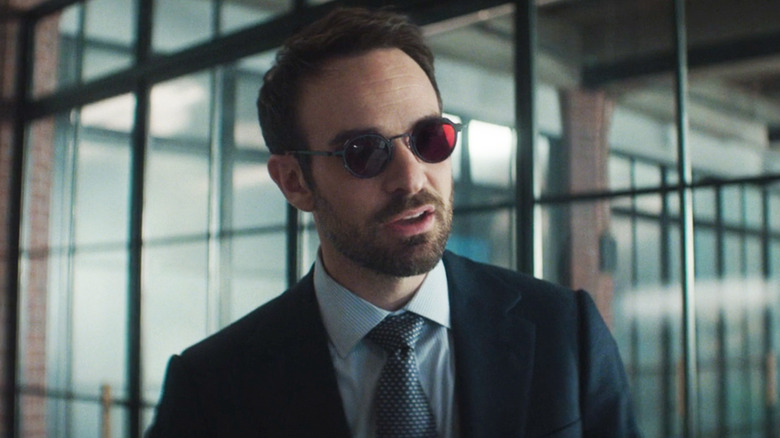
"Daredevil: Born Again" Season 1 showcased some stylish visual choices. For example, directors Justin Benson and Aaron Moorhead used the subtle but effective trick of changing the aspect ratio whenever Matt Murdock (Charlie Cox) used his super-sensory powers. But that wasn't the only visual cue Benson and Moorhead employed. They also focused on color, using red to emphasize major moments in Matt Murdock's story, plain white uplighting for when Wilson Fisk/Kingpin (Vincent D'Onofrio) is preparing for action, and blue to represent the inner soldier in Benjamin Poindexter/Bullseye (Wilson Bethel).
The original "Daredevil" series on Netflix was easily the best Marvel TV show ever made, providing a gritty street-level alternative to the wider Marvel Cinematic Universe while remaining tangentially related to it. After it was canceled, the MCU struggled to match its quality even with its finest small screen offerings. Then, a ray of hope: Charlie Cox was to return for a revival series that would be sort of related to the original, but also not.
Unfortunately, the first season of "Daredevil: Born Again" was basically a salvage job; the extensive reshoots that ultimately brought it to fruition were clearly evident. In 2026, "Daredevil: Born Again" returned for a politically shaky Season 2 that asked too much of audiences with its slow start. That said, the newly-revived show isn't without its charms. For one thing, the creators clearly put a lot of work into the visual language of the series.
Blue came to represent Bullseye in Daredevil: Born Again almost by accident
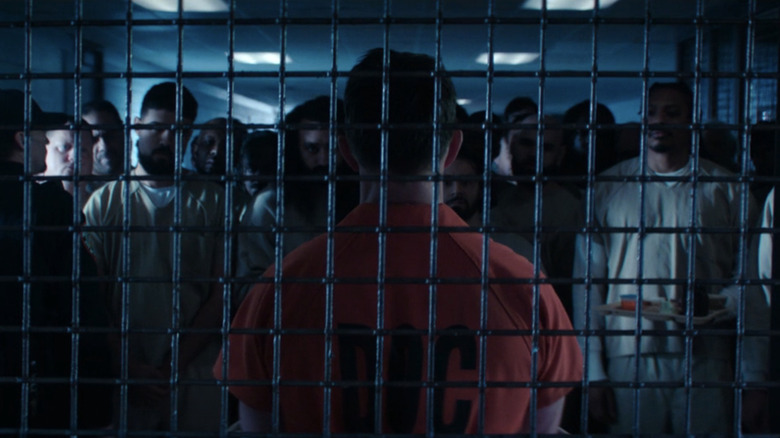
"Daredevil: Born Again" Season 1, Episode 8, "Isle of Joy," mostly focused on Bullseye in prison. The whole episode is a great showcase for the visual style of the show, with Wilson Bethel's character seen looking out of a window at a blue rose before he's led to the general population block and the blue lighting intensifies. It signals that Bullseye's rage is building, and by the end of the episode the color has come to symbolize his alter-ego emerging.
During an interview with Phase Hero, directors Aaron Moorhead and Justin Benson explained how they stumbled on the visual language for "Daredevil: Born Again" while shooting the scene in which Bullseye is being led down a prison corridor. Moorhead recalled how their gaffer placed controllable bulbs in the light fixtures. "They just pressed the button and it turned to party mode," he explained, "and it turned this really somber place into like a dance hall and it was super fun [...] then when it ends we kind of think about it, we're like, 'There's something here.'"
That prompted the crew to shoot a take using the blue lights. "We just did one take where at the very end everything faded to blue, which is Bullseye's color," said Moorhead. "Everyone was so enamored with it that we decided to run with it. But it was something we discovered right there on the day that has come to define the visual language of that character." Aside from providing an effective way of signposting Bullseye's internal state and a stark contrast to Daredevil's carmine glow, the blue lighting cues also pay homage to the comic book version of the character, who wore a blue suit.
Lighting was used for more than emphasizing powers in Daredevil: Born Again
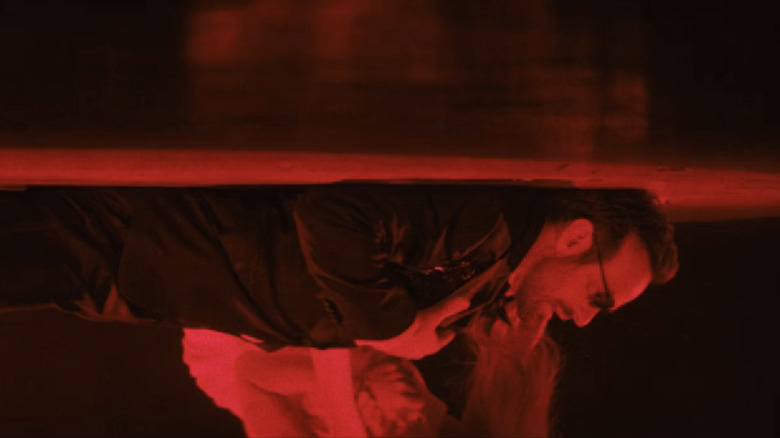
The "Daredevil: Born Again" Season 1 finale was dark, but "Isle of Joy" wasn't much lighter. At the very end of the penultimate episode, Bullseye shoots at Wilson Fisk only for Matt Murdock to jump in front of the bullet. The final scene shows Murdock lying on the floor as the lights fade to red and we get a beautiful reverse shot of the character.
Aaron Moorhead and Justin Benson spoke about this during their Phase Hero appearance, revealing that they initially had a different plan for this final shot in mind. Moorhead explained how they wanted the camera to tilt up to "give this impression of of Matt's soul leaving his body," but this would have been tough to pull off logistically. "We realized, well there's actually an even better idea here," said Moorhead. "By using this language that we've established with the blue lights we can do that same idea with these flashing red lights, which we also had in Episode 1." The debut episode featured flashing red to represent Murdock embracing his powers during the scene in which Elden Henson's Foggy Nelson is shot by Bullseye. In Episode 8, the same color is used to emphasize Murdock himself being shot.
Cinematographer Hillary Fyfe Spera also explained to Definition Magazine how the ending of the pilot episode used lighting to help establish the contrast between Murdock and Wilson Fisk. "We have a juxtaposition of Murdock moving through a crowd and stopping as red light pulses on his face," she explained, "intercut with Fisk standing on the balcony of the building in a pulsing white light. The two images are parallel to one another, showing both characters wrestling with their respective alternate identities of Daredevil and Kingpin."