

5 Forgotten Star Trek: The Next Generation Episodes That Still Hold Up Today
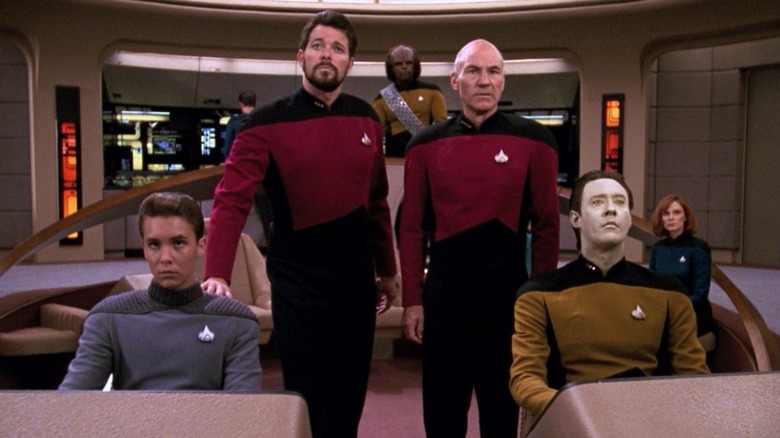
For stalwart Trekkies, it's easy to compile lists of the best episodes of "Star Trek: The Next Generation," and many of us agree about which ones they are. Every Trekkie's top-ten list may fluctuate a little, but there are always going to be some ringers that are constants. "The Best of Both Worlds," for instance, the two-part episode in which Captain Picard (Patrick Stewart) was assimilated by the Borg, is often considered the best. Many can also agree on episodes like "Tapestry" and "The Inner Light" as well. Even Stewart loves "The Inner Light."
But "Star Trek: The Next Generation" ran for seven seasons and 174 episodes. With such a massive volume, there are going to be many episodes that people dismiss or merely forget when rifling through their mental Rolodex. It's not that these episodes are bad (and "Next Generation" had plenty of bad episodes too), it's just that they're overshadowed by the "grand champions," as it were. The quality of "NextGen" is evident in the fact that even the common, middle-of-the-road "filler" episodes can still contain interesting concepts, Trek-like utopian idealism, and rich supporting characters.
So let's look at some of the parts of "Star Trek: The Next Generation" that too often get flipped past. Let's remark on the episodes that too many Trekkies might consider to be unremarkable. Because some of the following episodes can stand as prime examples as to why "Next Generation" was a TV series for the ages. If it were a bad show with a few good episodes, we wouldn't still be talking about it today. It's a good show, because even the forgotten episodes are worth remembering.
Symbiosis (season 1, episode 22)
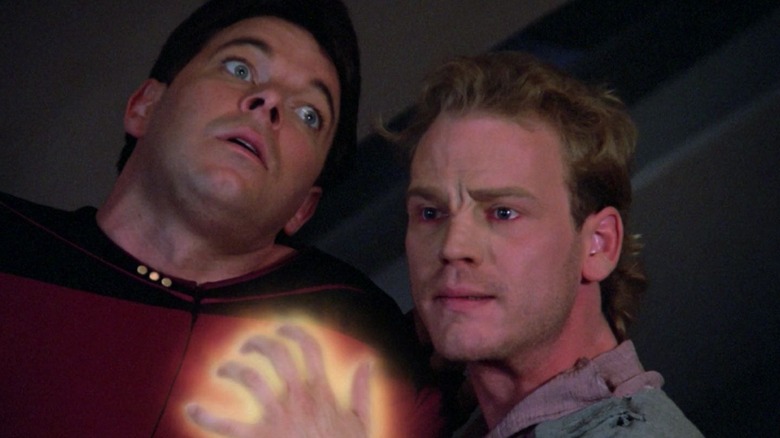
Most Trekkies will tell you that the first season of "Next Generation" is its weakest. The season did a good job of establishing the general premise, setting, and characters, but it lacked on the storytelling front, with a lot of old, dated ideas worming their way into the fabric of the series. No one (not even Jonathan Frakes) liked the racism of "Code of Honor," for instance.
Many may even come down hard on the first-season episode "Symbiosis" as being a pat, preachy, anti-drug episode better suited for classrooms than primetime. Mostly, Trekkies remember an embarrassing scene wherein the goody-goody teen Wesley Crusher (Wil Wheaton) asks innocently why anyone anywhere would want to do drugs. Tasha Yar (Denise Crosby) explains what drugs are and how they work. Anyone watching will roll their eyes like a blitzed-out teenager at a high school D.A.R.E. assembly.
But "Symbiosis" is actually a solid episode. It involves the relationship between two species, the Onarans and the Brekkans. The Onarans suffer from a rare plague, and the Brekkan homeworld is the only place where the cure can be manufactured. Both worlds' entire economic systems are devoted to making and distributing the medicine. Dr. Crusher (Gates McFadden), however, finds that there is no plague, and that the "medicine" is actually a narcotic that the Onarans are addicted to. The Brekkans have been happy to exploit the addicted Onarans for generations.
Captain Picard woefully admits that the Prime Directive prevents him from interfering with this arrangement, as the two worlds aren't members of the Federation. But, he cleverly adds, when their supply ships break down, he's also under no obligation to help. It's a clever story with a clever ending, and is much more than its anti-drug PSA scene.
"Star Trek: Lower Decks" finally put out a sequel to "Symbiosis" in 2022.
Loud as a Whisper (season 2, episode 5)
One of the most exciting aspects of "Star Trek: The Next Generation" — of all "Star Trek," really — is its ability to invent speculative cultures. What if, for instance, there was a species like the Vulcans that devoted its entire existence to logic? What if a society was constructed around unchecked capitalism like that of the Ferengi? And what if a species like the Tamarians spoke entirely in metaphors for their own cultural myths?
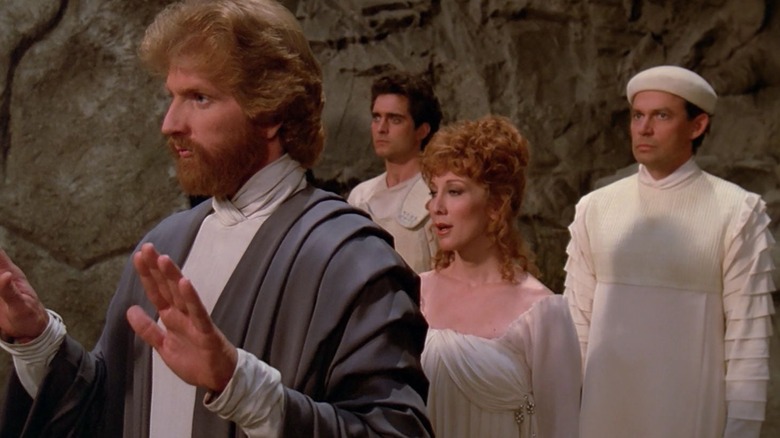
"Loud as a Whisper" introduces an interesting communication technique thanks to the character of Riva (Howie Seago), a star diplomat. Riva has been on an extended mission to the planet Soalis V to negotiate the end of a centuries-old war between two factions. He is charming, handsome, and an effective negotiator. It's thanks to people like Riva that pacifism undergirds everything in the "Star Trek" universe. Riva was born deaf, and communicates through a "chorus" (Marnie Mosiman, Thomas Oglesby, Leo Damian) that follows him everywhere. He projects his thoughts to them telepathically, and they speak his intentions aloud. One is the "scholar," one is the "warrior," and one is "the thing that binds them." Mind, body, and soul, essentially. You can intuit the tone of Riva's intentions through which one of his chorus members speaks.
Naturally, something terrible happens to the chorus during a particularly heated debate between the Soalians, leaving Riva in a tight spot. He begins to feel that his talents as a diplomat are useless. Eventually, the Enterprise staff reminds him that learning to communicate is his forte, and learning sign language will bring the warring factions together. The ending may be a little corny, but it's disarmingly optimistic. Maybe all we need is gentleness and a common language.
The Survivors (season 3, episode 3)
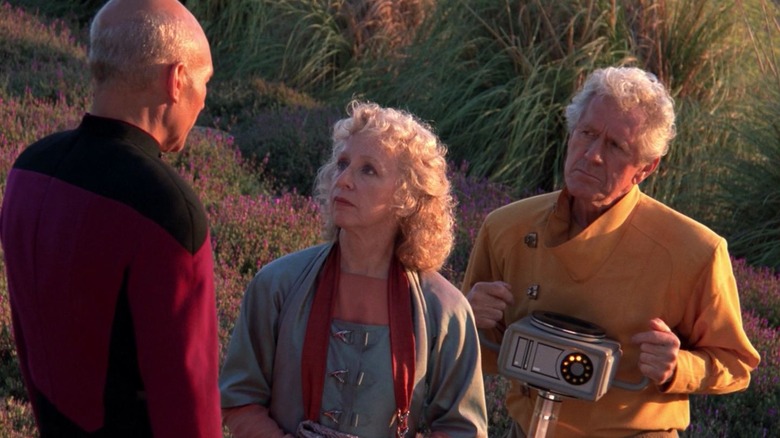
Initially, "The Survivors" is presented as a mystery. The USS Enterprise arrives at the planet Delta Rana IV responding to a distress signal, only to find the planet completely devoid of life. Well, almost. There is a single house left on the entire planet. It's large, well-maintained, and even has a thriving, verdant garden. When Commander Riker (Jonathan Frakes) beams down with an away team, he meets a septuagenarian married couple named Kevin and Rishon Uxbridge (John Anderson and Anne Haney). They bring people in for tea.
They are sus. Counselor Troi (Marina Sirtis), for instance, is unable to psychically read them, and she begins to hear an incessant music box in her head. Also, a mysterious warship periodically appears in the sky to chase away the Enterprise. It's almost as if the universe is conspiring to make sure the Uxbridges are left alone.
It's eventually revealed that Kevin is not a human, but an all-powerful godlike being called a Douwd. He fell in love with Rishon and took the form of a human to live with her in connubial bliss. The attack on the Uxbridge's colony did happen, perpetrated by the mysterious Husnock, but in reality, Rishon died. The woman the Enterprise crew had been talking to was a psychic simulation.
Kevin was so horrified by Rishon's death that he lost control of his powers and killed the Husnock. Like, all of them. Everywhere in the galaxy. He committed genocide.
In a bleak realization, Picard realizes he has no means to punish Kevin for his crimes. They have no prison to house a god, and no law on the books to match the magnitude of his crimes. They leave Kevin to stew in his guilt, as it's their only recourse. What a sad, bleak, marvelous episode.
The Hunted (season 3, episode 11)
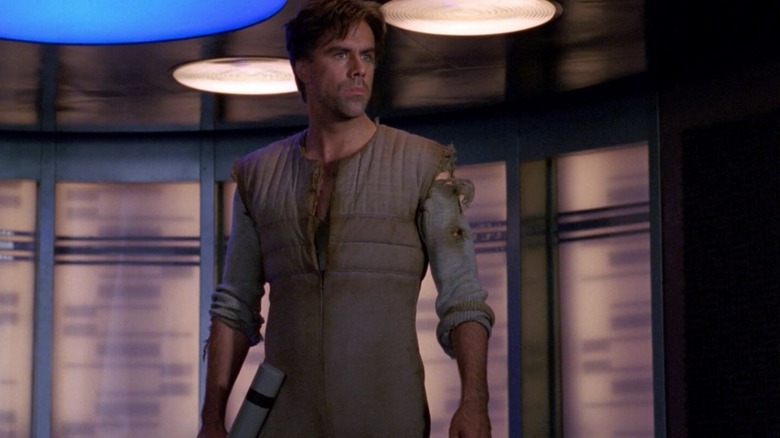
If we're to accept that "Star Trek" is predicated on pacifism, then "The Hunted," from the show's third season, is a key episode. It features several key social issues, including the treatment of prisoners, and, most notably, the treatment of war veterans as tools of a violent state.
The Enterprise is asked by the Prime Minister of Angosia III (James Cromwell) to apprehend a fleeing prisoner. Angosia III isn't part of the Federation yet, but is angling to be. The prisoner in question is Roga Danar (Jeff McCarthy), who seems incredibly adept at evading capture. The Enterprise manages to capture him, and he reveals the truth: He is actually not a convict, but a genetically enhanced soldier. He is part of an army constructed and conditioned by the Angosians to be their elite fighting force. When the war ended, however, the Angosians didn't bother deprogramming them, choosing instead to hide them in a miserable prison. Danar isn't actually angry or violent, but he does "activate" when in a violent situation.
"The Hunted" has a few cool escape sequences, and McCarthy gives a great performance. He's like John Rambo in "First Blood" – gentle and maybe even sad at heart, and his wartime capabilities make him a tragic figure.
Naturally, the squirreling away of an entire army of mistreated veterans will keep Angosia out of the Federation; it's the kind of a-hole maneuver that reveals how unready you are to be part of the "Star Trek" community. The Angosians will have to settle their matter internally and learn how to give care, therapy, and reparations to their abused veterans. Take that story and apply it to the way unhoused veterans are treated in the real world, and "The Hunted" suddenly becomes universally salient.
Clues (season 4, episode 14)
Some of the best episodes of "Star Trek: The Next Generation" are the ones where everyone has something do to. It's refreshing to watch the entire cast working together to solve a problem. Some examples of this dynamic can be seen in episodes like "Cause and Effect" (the time-loop episode) and "Disaster" (the "Poseidon Adventure" episode).
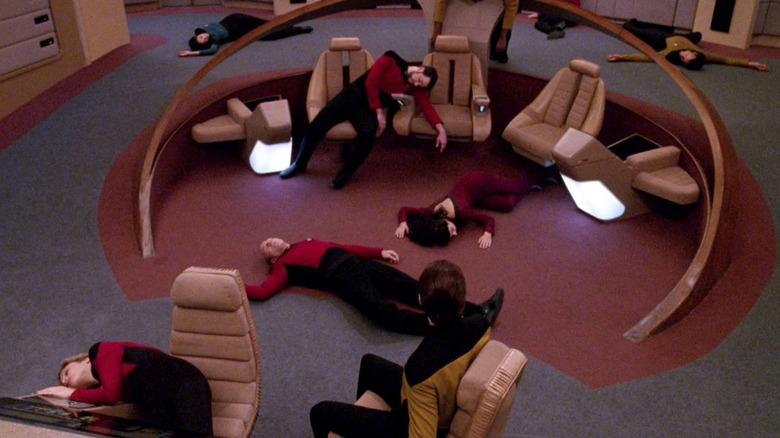
Often overlooked is "Clues," a mystery episode about a shared alien experience. The Enterprise encounters a colossal negative space wedgie that mysteriously causes everyone on board to fall unconscious at the same time. The only one unaffected is the android, Data (Brent Spiner). Data awakens them, saying they were all unconscious for 30 seconds. As they investigate the cause of their unconsciousness, however, some things don't begin to add up. A plant in Dr. Crusher's lab, for instance, seems to have grown for a full day. Worf (Michael Dorn) has evidence of an injury he didn't remember sustaining.
Creepily, Troi begins having waking terrors, wherein she senses an eerie presence when she looks in the mirror. Did a day pass? Okay, what's going on?
Picard begins to suspect that Data is hiding something, but Data maintains his story. This is very strange, given that Data is an android who has to follow orders and who is incapable of lying. There is an eventual revelation as to what really happened during the "missing time," and it's a fun ending involving xenophobic, noncorporeal aliens. The "missing time" mystery predates "The X-Files" (which wouldn't debut for two more years) and other "real world" alien lore that was in the pop consciousness at the time. Everyone has ideas to contribute, and the mystery is delicious.