

Monarch Season 2's Creepiest Storyline Pays Homage To One Of The Scariest Stories Ever
This article contains spoilers for "Monarch" season 2, episode 2.
Movies and shows about giant monsters exist in an interestingly unique place, genre-wise. As recent examples such as "Godzilla Minus One" and "Godzilla x Kong: The New Empire" prove, they can be everything from highly emotional action-dramas to Saturday morning cartoon-style blockbusters, and more. Even though they concern giant monsters like Godzilla and Kong, they often aren't thought of as horror movies in the way that most audiences generally think of horror these days. Yet these characters and their subgenre absolutely belong to the horror pedigree. For example, the original 1954 "Godzilla" was Japan's answer to the American B-movie trend of atomic age giant monster threats, films like "The Beast from 20,000 Fathoms" and "Them!" The original 1933 "King Kong" continued the tradition of stories about humans encountering dangerous wild animals in exotic foreign lands and did them one better, making the creature as large as he was untamed.
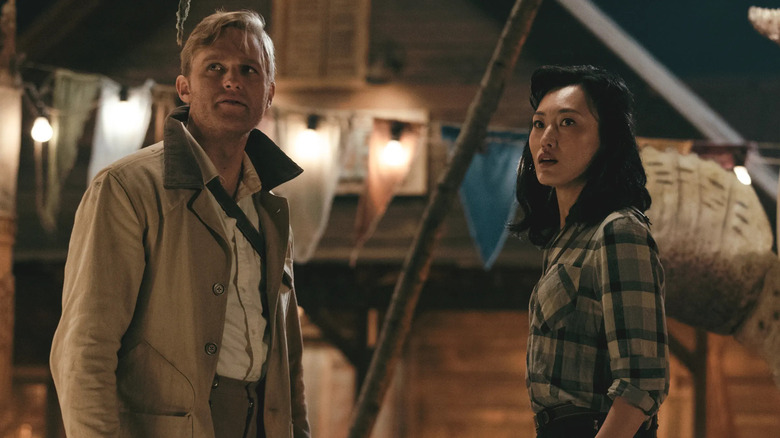
So, while giant monster media generally treats these characters with a more maximalist tone (there's just no running and hiding from Godzilla, for instance), there's still a good deal of horror heritage mixed in with them. Apple TV's "Monarch: Legacy of Monsters" knows this very well. In fact, its latest episode, "Resonance," continues the second season's creepiest storyline, in which Lee Shaw (Wyatt Russell), Bill Randa (Anders Holm), and Keiko Miura (Mari Yamamoto) investigate a mysterious remote village on the island of Santa Soledad in Chile in the year 1957.
As they discover more about what's going on with the villagers in this episode, it seems that the series is paying homage to one of the scariest stories ever written: H.P. Lovecraft's 1931 novella "The Shadow over Innsmouth." It's a pretty neat horror tribute to see in what is otherwise a largely sci-fi/action series.
The secrets of the island villagers in Monarch recall Lovecraft's Innsmouth
In H.P. Lovecraft's "The Shadow over Innsmouth," an unnamed narrator (which is a hallmark of Lovecraft's work) investigates the titular Massachusetts town, which is a once-thriving seaport that has fallen on hard times. Shortly after arriving, the narrator discovers that the town is now mostly populated by strange, shambling humanoids. Eventually, the narrator learns the place's disturbing history, starting with how a local merchant named Obed Marsh came upon a Kanak tribe in the islands of Pohnpei during his travels. It turns out that this tribe offered up human sacrifices to a race of immortal fish-human hybrids known as the Deep Ones. Marsh formed a cult and began culling the favor of the Deep Ones to help himself and his followers in Innsmouth, only for he and his cult to be arrested and the town to be invaded by the fish-men.
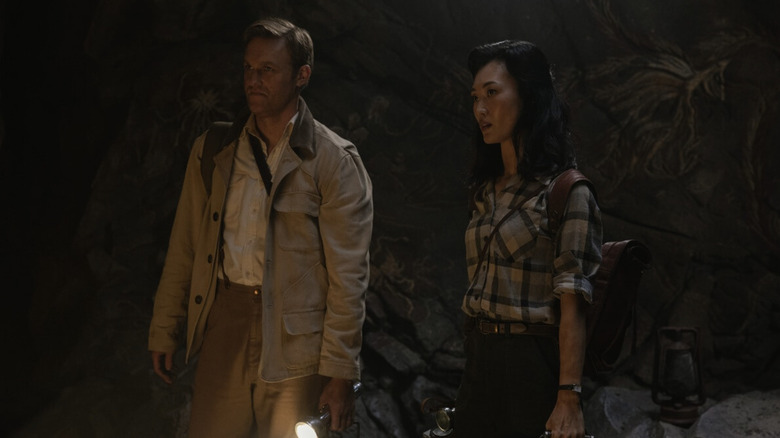
The narrator's plight only gets worse and more disturbing from there, but it's this aspect of Lovecraft's story that "Monarch" pays homage to. Lee picks up on the Santa Soledad villagers being hostile toward outsiders almost immediately upon his, Bill's, and Keiko's arrival, something which the two scientists overlook, given how certain they are that a Titan resides nearby. In "Resonance," Lee and Keiko discover evidence that the villagers indeed make up a cult who worship the Titan, which periodically lives near their shores: Titan X. The villagers refer to Titan X as "The Great God of the Sea," and ominously invite Lee and Keiko to their annual party celebrating their relationship to the creature. This ceremony (with its sacrifice-like vibes), the villagers' behavior toward outsiders, and the drugging of Lee and Keiko before Titan X's attack are all heavily Lovecraftian and add to the episode's tension.
The episode is not the first time Titan-worshipping humans have appeared in the MonsterVerse
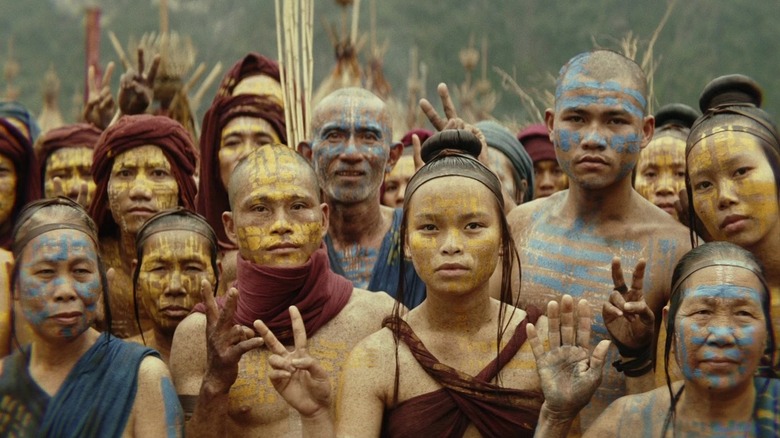
The writer and director of "Resonance," Dan Dworkin and Lawrence Trilling, undoubtedly were intentionally referencing "The Shadow over Innsmouth" with the 1957 subplot, or at least were aiming to create a Lovecraftian atmosphere in general. However, the island villagers are not the first group of humans in the MonsterVerse to worship a Titan. That honor goes to the Iwi tribe, first seen in 2017's "Kong: Skull Island." The inclusion of such a tribe is part of the legacy of Kong as a character. In fact, the original 1933 "King Kong," being a contemporary piece of fiction with H.P. Lovecraft's story, also involves a native tribe that regularly makes human sacrifices to a monster. The Iwi's in "Skull Island" aren't barbaric, however, and seem to live with Kong in harmony and respect. That attitude remains intact when we finally get to meet the modern-day Iwi tribe members in 2024's "Godzilla x Kong: The New Empire."
All of this begs the question: are the Santa Soledad villagers in "Monarch" a neat little riff on Lovecraft and a sly tip of the hat to the heritage of Titan worshippers in the MonsterVerse? After all, this second season marks a return to Skull Island, so the inclusion of some sort of native people feels thematically appropriate. Or do these villagers represent another faction of people whose relationship to the Titans is not as harmonious or non-violent as the Iwi's is?
Could descendants of the villagers turn up in a future episode of "Monarch" or a MonsterVerse film? If so, let's hope it turns out better for Lee, Keiko, and everyone else than it does for Lovecraft's poor, doomed narrator.