

10 Worst Star Trek Ship Designs, Ranked
The "Star Trek" franchise has been entertaining and inspiring audiences for decades with its expansive and inclusively idealistic science fiction future. At the forefront of these stories are a line of starships that cruise the cosmos, exploring the unknown at velocities far faster than the speed of light. In addition to the main armada serving the interstellar alliance Starfleet and the United Federation of Planets, many of the best "Star Trek" alien races have their own distinct starships. Along with their unique hull and interior layout, each of these ships come with their own special features installed suiting various spacefaring purposes.
Of course, we're not here to talk about the best "Star Trek" ship designs this time.
While many of the ships in the wider "Star Trek" franchise have strikingly imaginative designs, not every starship has been received positively. There are some garish design decisions that have left audiences scratching their heads at their presentation. This trend extends beyond the lesser Starfleet vessels, with several alien ships featuring obtuse designs (some, presumably, on purpose given the respective story). Here are the 10 worst "Star Trek" ship designs ranked across the franchise's movies and television shows.
10. USS Pasteur
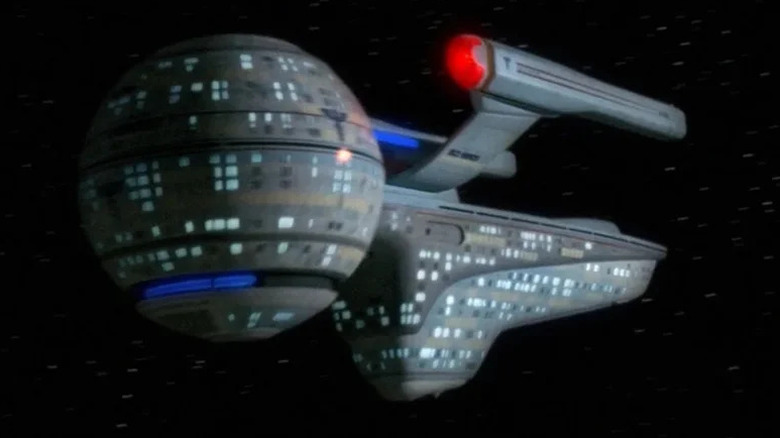
Though "Star Trek: The Next Generation" had the best series finales in the "Star Trek" franchise, the sequences that take place decades into its future are its most uneven. The episode "All Good Things..." depicts a possible future timeline for the main characters after Jean-Luc Picard (Patrick Stewart) has retired from Starfleet. One of the big changes in this alternate future is that Beverly Crusher (Gates McFadden) is now the captain of a Starfleet medical vessel, the USS Pasteur. Picard reunites with Crusher, revealed to be his ex-wife in this timeline, with the two using the Pasteur to investigate a spatial anomaly.
One of the weaker elements in "All Good Things..." is that it tries a bit too hard to differentiate its future timeline beyond the routine aging makeup. This extends to starship designs and certainly applies to the USS Pasteur and its vaguely phallic structure, complete with its protruding tip. The other confounding element of the starship is the sheer number of windows seen across its hull, including from its bulbous end. The interior of the ship isn't all that impressive, either, brightly and a bit more coldly lit in comparison to the warmer lighting in the Enterprise-D.
9. USS Prometheus
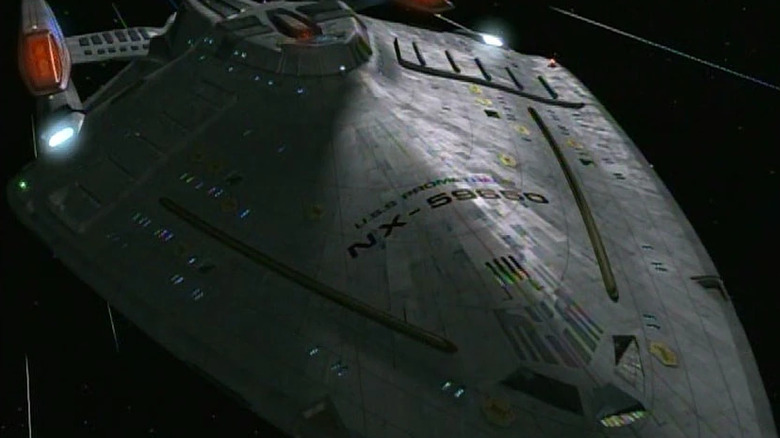
By the fourth season of "Star Trek: Voyager," the titular starship manages to locate and contact Starfleet vessels in the Alpha Quadrant with its upgraded sensors. In the episode "Message in a Bottle," the Voyager's holographic Doctor (Robert Picardo) is transported to the USS Prometheus. An experimental vessel, the starship has since been taken over by the Romulans as the Doctor quickly discovers. The Doctor works to not only liberate the starship from the Romulans but relay Voyager's status to Starfleet for the first time in three years.
With its long, pointed saucer section, the USS Prometheus strongly resembles a hand shovel rather than an advanced Starfleet vessel. The ship can also be divided into three sections, with its divided components making no aerospace sense. That the vessel was then ambushed and taken over by the Romulans speaks little to its vaunted tactical advantage. A rare glimpse into the Alpha Quadrant in "Voyager" produced one of Starfleet's most confusingly designed ships.
8. Kazon Predator
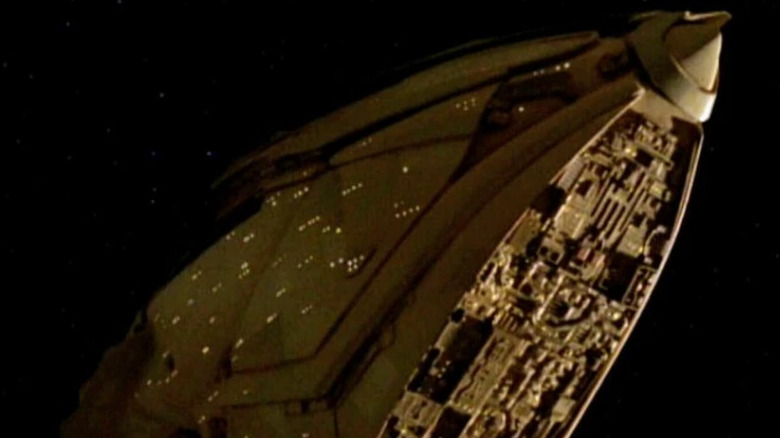
One of the earliest recurring enemies in "Voyager" was the Kazon, a race native to the Delta Quadrant in constant pursuit of the USS Voyager. Though the Starfleet vessel boasted noticeably superior technology than the Kazon starships, Voyager's weakened state and the Kazon's numerical advantage put the lost ship on the defensive. The Kazon's primary starships are known as raiders and feature a copper-colored hull, while the race's larger ships are known as predators. It's the overall shape of the Kazon predators that makes them stand out, albeit in all the wrong ways, possessing an obtusely blocky design.
The Kazon are among the worst "Star Trek" villains ever, so it's only fitting they'd also rely on the franchise's worst starships. The predators are just grotesquely designed ships, presumably intentionally designed this way to reflect the Kazon's more relatively primitive technology. But these ugly ships underscore why fans never saw the Kazon as a legitimate threat, even when attacking in force. A weak ship befitting a scavenger enemy with barbaric design sensibilities, the Kazon predators are as forgettable as the race they're associated with.
7. Scimitar
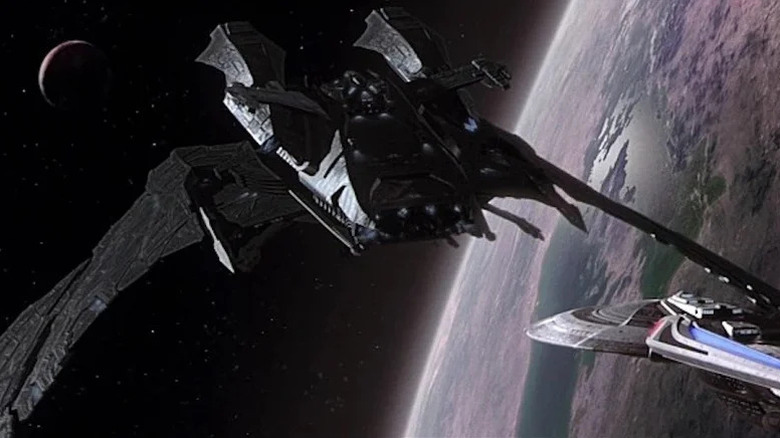
The fourth and final "Star Trek" movie to star the "Next Generation" cast was 2002's "Star Trek: Nemesis." The movie opens with Shinzon (Tom Hardy), an evil clone of Picard usurping power to seize control of the Romulan Empire. Luring the USS Enterprise-E to Romulan territory, Shinzon confronts the Starfleet vessel with the Scimitar, the most formidable starship in the Romulan armada. The Scimitar boasts a devastating arsenal while also possessing a powerful cloaking device and weapon emitting lethal levels of thalaron radiation.
For all of its bluster, though, the Scimitar is functionally just an overgrown Romulan bird of prey with a special, plot-driven weapon. Despite its fearsome reputation, the Enterprise, along with the aid of sympathetic Romulan starships, are able to stop the Scimitar. Positioned as a weapon intended to destroy both itself and the Enterprise, the thalaron device is a knock-off of the Genesis device in "Star Trek II: The Wrath of Khan," but without Genesis' life-giving capabilities. There's a lot that went wrong with "Star Trek: Nemesis," and its villainous vessel never lived up to the menace it tried to project.
6. USS Dauntless
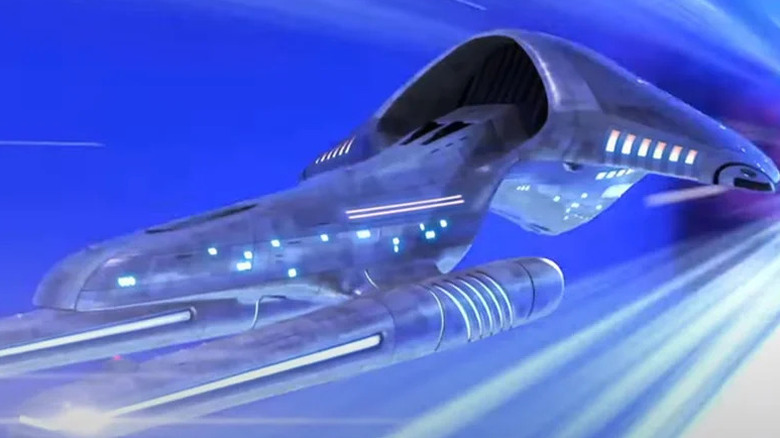
Set several years after the conclusion of "Star Trek: Voyager," the animated series "Star Trek: Prodigy" featured several highly advanced Starfleet vessels. This includes the show's main ship, the USS Protostar, which, true to its name, is powered by a protostar in its core. Less memorable is the USS Dauntless, a starship commanded by Vice Admiral Kathryn Janeway (Kate Mulgrew) at the start of the series. Janeway eventually moves into the Delta Quadrant with the Dauntless to search for the missing Protostar, which was captained by her old friend Chakotay (Robert Beltran).
"Star Trek: Prodigy" was a lovely series skewed to a new generation, but the Dauntless was definitely not a series highlight. The starship looks like a futuristic shoe, with an elongated and bulbous main section ahead of a slender body and two warp nacelles. That these other components are positioned directly behind the main section makes its shoe-like design more apparent. The USS Dauntless was never intended to be cooler than the Protostar, but its oddly streamlined design makes it look like a metallic slipper.
5. Alternate future USS Enterprise-D
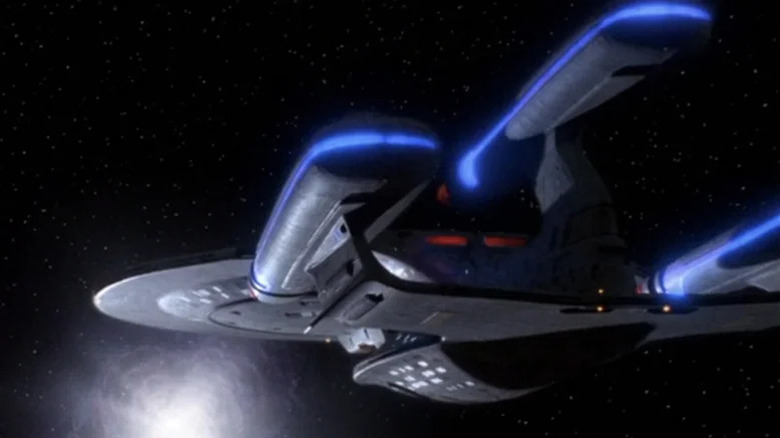
One more lackluster starship design from "All Good Things..." is the refitted Enterprise-D itself, captained by Will Riker (Jonathan Frakes) in this alternate future. Not much of this version of the starship is seen in the episode since Picard isn't on this modified version of his old starship all that long. Rescued by Riker after the USS Pasteur is destroyed by Klingon warships, Picard and his familiar, but older, crew continue their investigation of an unstable spatial anomaly. This results in the refitted Enterprise-D being destroyed in an effort to stop the rift from spreading.
The alternate future Enterprise-D is so wholly forgettable in its redesign that it technically shouldn't even be ranked alongside other versions of the Enterprise. In an attempt to distinguish this more futuristic version of the Enterprise from its main "TNG" counterpart, the starship has been fitted with a third warp nacelle. In addition to being awkwardly positioned between the other nacelles, this redesign feels a bit slapdash in trying to produce a more advanced version of the starship. A forced attempt to make a unique Enterprise for this timeline, the refitted Enterprise-D is best left in an averted future.
4. USS Vengeance
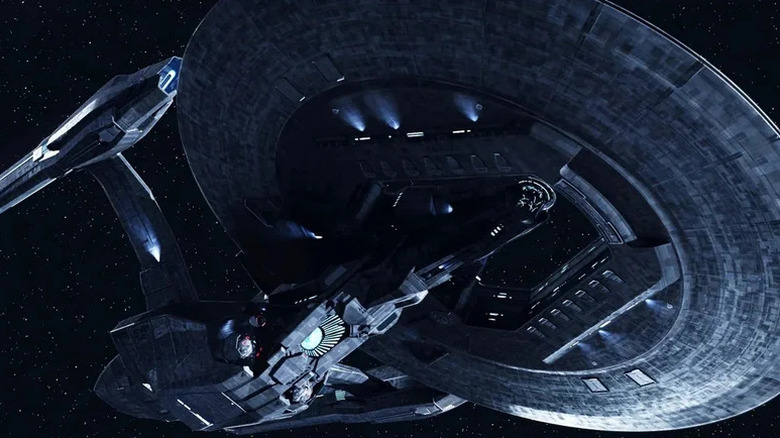
While 2013's "Star Trek Into Darkness" had the characters of the now-defunct "Star Trek" Kelvin timeline face Klingons and a reimagined Khan Noonien Singh (Benedict Cumberbatch), its initial big bad was internal. The divergent timeline James Kirk (Chris Pine) and his crew faced off against rogue Admiral Alexander Marcus (Peter Weller), who attacked them in the USS Vengeance. A top-secret vessel fitted with the latest weapons technology produced by Starfleet, the Vengeance easily outmatches the Enterprise both in terms of speed and power.
For all intents and purposes, however, the USS Vengeance is just a larger, darker colored, and more heavily armed variant of the Enterprise. There are some more pointed design changes in comparing the two starships, but Marcus' vessel is just a bigger, meaner twist on the classic ship. For all of its apparent experimental tech, there isn't anything all that remarkable about it outside of being able to use its weapons while at full warp speed. There are several things that bothered fans about "Star Trek Into Darkness," and its uninspired villainous starship design should be one of them.
3. Mondor
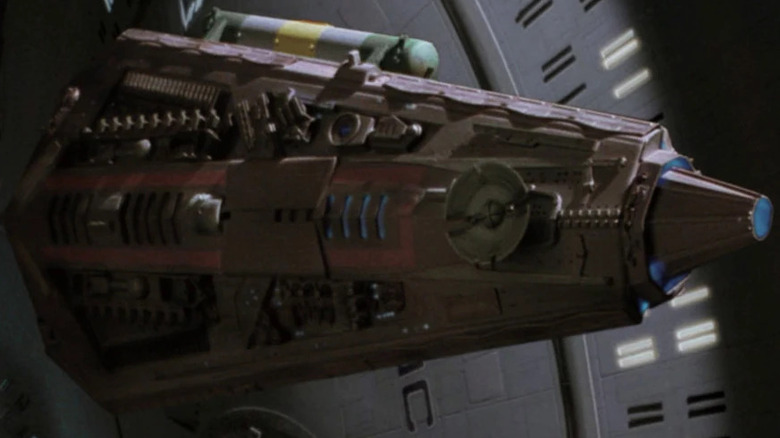
One of the least memorable alien races in "Star Trek" are the Pakleds, a deliberately incompetent spacefaring species. The Pakleds make their debut in the second season "The Next Generation" episode "Samaritan Snare," tricking Geordi La Forge (LeVar Burton) into boarding their vessel before kidnapping him. They also approach the Enterprise in a ship named the Mondor, claiming that it's in need of repairs to lull Riker and the Starfleet crew. Fortunately, given the Pakleds' overall ineptitude, Riker and La Forge are able to outsmart the would-be kidnappers.
The Pakleds are the most clownish antagonists that the Enterprise-D encounters, and that extends to their dumpy ship. But even a starship intended to look unimpressive is still shoddy as a final result, whether that was the intent all along or not. The Mondor resembles little more than a triangular piece of metal, glorified scrap that somehow gained interstellar travel capability. When the Pakleds resurfaced in "Star Trek: Lower Decks," they were no smarter than they were in "TNG," but they did have slightly better spacecrafts.
2. USS Yeager
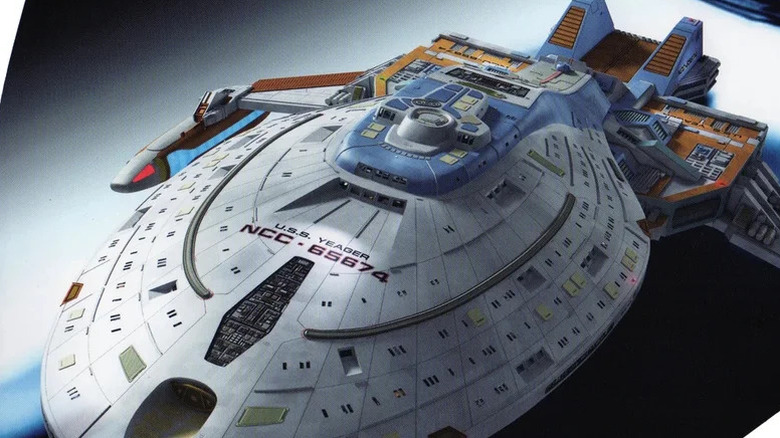
When "Star Trek: Deep Space Nine" began its tense Dominion Wars storyline, the titular space station became a hub for Starfleet vessels and their allies. This includes the USS Yeager, which is first seen in the background in the season 5 episode "Doctor Bashir, I Presume?." The starship resurfaces several times over the remainder of the series, usually in the background as Starfleet vessels rally to drive back the Dominion. The USS Yeager features a large saucer section, with a longer and wider body, while its warp nacelles are more positioned towards the sides of the ship.
The USS Yeager is just a bad-looking ship, awkwardly disjointed and visibly crudely constructed, like a collection of spare parts. Being stuck in the background proved to be a blessing for this Starfleet-produced eyesore, though it still garishly stands out for eagle-eyed viewers. In fairness, many of the Starfleet vessels in "DS9" are forgettable, with the exception of the USS Defiant, but the USS Yeager is a clear cut below the rest. Forgettable at best, the Yeager is a horrendous hodgepodge of Starfleet starship designs clumsily thrown together.
1. Narada
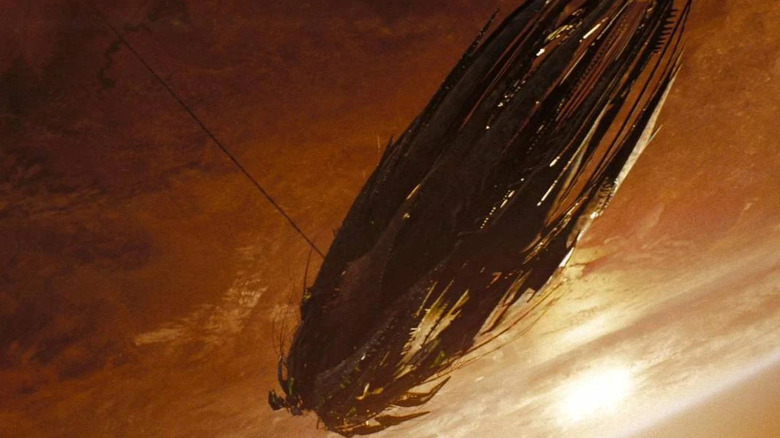
Honestly, all the antagonistic starships in the "Star Trek" Kelvin timeline movies are lackluster as a general rule, and that started with the Narada. The main villain's ship in the 2009 "Star Trek" film reboot, the Narada is a 24th century Romulan mining vessel transported over a century into the past. With its advanced technology, the Narada is capable of wiping out an entire Starfleet armada single-handedly before moving to destroy the planet Vulcan. It's only through the use of an experimental ship belonging to Spock (Leonard Nimoy) from the prime timeline that the Narada is ultimately destroyed.
Nothing about the Narada's design particularly makes sense other than its orbital laser drill, with the rest feeling like an attempt to be edgy and intimidating. The ship is a mess of jagged spikes, and its interior layout is increasingly nonsensical the more one thinks about it. But for all its future technology and superior firepower, the ship is also disabled by having a single significantly smaller starship ram into it in the movie's prologue. The 2009 "Star Trek" reinvigorated the franchise, but that rebirth had little to do with the movie's villainous starship.