

Genosha's Genocide In X-Men '97 Was Much More Than Just A Shocking Plot Turn
We may receive a commission on purchases made from links.
"X-Men '97" episode 5, "Remember It," cemented that first season as something special. The opening episodes were good-to-excellent, but "Remember It" went where the original "X-Men" cartoon never could: showing mutant genocide, onscreen, that even claims the life of an X-Man, Gambit (A.J. LoCascio).
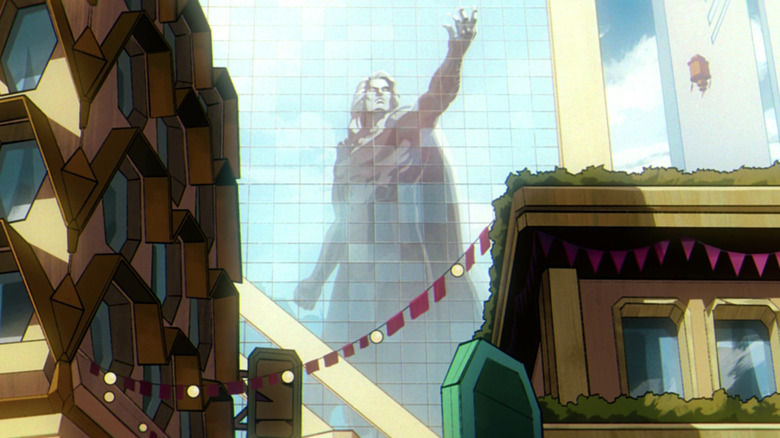
By "X-Men '97," the island nation Genosha has truly become the mutant safe haven it was advertised as back in "X-Men" season 1. (In reality, that was a ploy to capture mutants for use as enslaved labor.) The first half of "Remember It" spotlights the Genoshan capital city, where mutant culture and commerce is flourishing.
As episode director Emmett Yonemura noted in making-of book "X-Men '97: The Art and Making of the Animated Series," cameos from non-passing mutants like Pixie and Glob Herman aren't just Easter eggs. They show even the "freakish" mutants live in Genosha free of fear.
But not for long. A "Godzilla Sentinel" crashes the party for an extermination campaign. The fireworks presage deadlier explosions, as the sound of celebratory music gives way to screams. In the previous episode, "Motendo," Jubilee (Holly Chau) realized you can't stay in a cycle of nostalgia forever. "Remember It" teaches that to the audience, shifting the show from a playful romp into a darker and higher-stakes story.
Still, "X-Men" had given '90s kids appropriate frameworks to think about sensitive topics, like religion in the episode "Nightcrawler." Yonemura wanted "X-Men '97" to push further and explore collective grief after a mass tragedy, showing "the different ways that are perfectly human and normal to react to such a horrible event. I think for me it is a great opportunity to show, especially kids, that there are different coping mechanisms and ways to move on and ways to also fight back."
Animating the terror of Genosha in X-Men '97
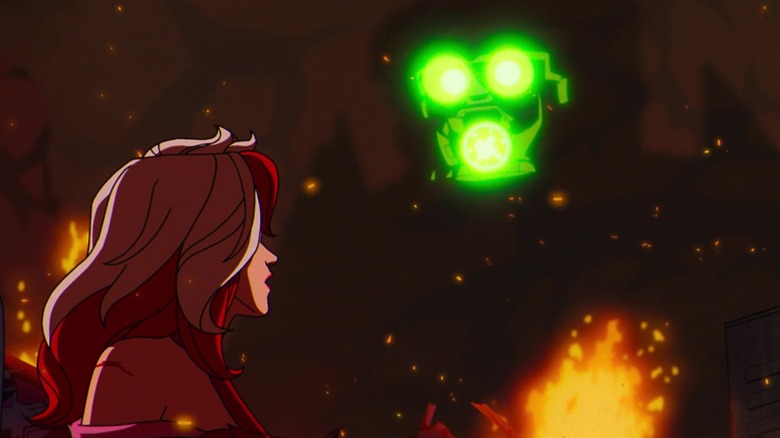
The Sentinels' destruction of Genosha comes from Grant Morrison and Frank Quitely's "X-Men" comic story, "E is for Extinction." But there, the genocide unfolds across a few pages. "Remember It" draws out the horror and puts Gambit, Rogue (Lenore Zann), and Magneto (Matthew Waterson) on the ground to experience it. The entire sequence takes on a fiery hue, as the sky over Genosha turns as red as the blood being spilled.
Eventually, a skewered Gambit sacrifices his life to destroy the metal monstrosity with his biggest kinetic energy charge ever. The original "X-Men" definitely never had an ending like this, with Rogue sobbing and cradling Gambit's bloody corpse. In "The Art and Making of the Animated Series," Emmett Yonemura said the main inspiration for the carnage was "War of the Worlds," where people are vaporized by skyscraper-sized alien tripods.
"We always wanted to stay at ground level, never up above because then you would start to feel kind of separate from all the victims," Yonemura said. When Rogue and Magneto first come to, the Sentinel's glowing green eyes peer through smoke at the upper right section of the frame, instantly conveying this scale.
While the "X-Men '97" team had "War of the Worlds" on the mind, one of Magneto's lines recalls another Steven Spielberg movie: "Schindler's List." As the X-Men try to save the Morlocks, Magneto declares: "We shall not live our days wondering if we could have saved more." Wondering if he could have saved more is just what Liam Neeson's Oskar Schindler, who saved 1,200 Jewish people from Nazi extermination, did at the end of that movie.
Remember, Magneto has (since 1981) been written as a Holocaust survivor. Magneto "really genuinely believes 'never again,'" said Yonemura. "And here he's failed."
Genosha suggests Magneto was right after all
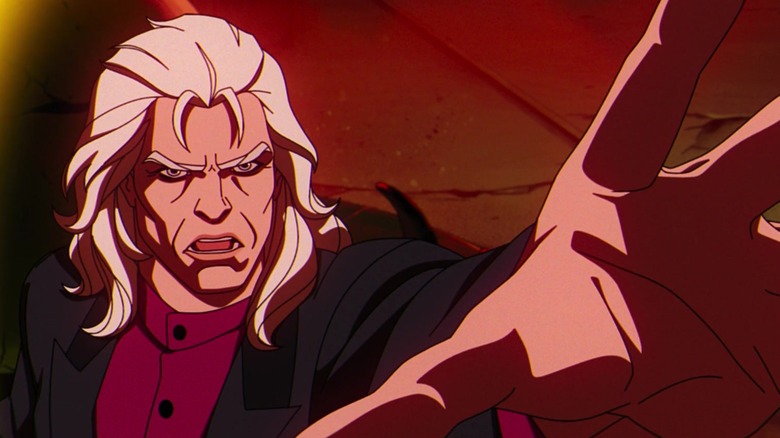
The original "X-Men" kept Magneto's backstory vague, but "X-Men '97" did not shy away from alluding directly to the Holocaust. As Magneto takes in the horror around him, the scene flashes to images of dead mutants across Genosha. The final frame shows Magneto's childhood: People trapped behind barbed wire in a concentration camp.
When Magneto is (seemingly) vaporized by the Sentinel alongside the Morlocks, Magneto reassures the young mutant Leech: "Habe keine angst." (German for "Don't be afraid.") In what he believes is his last moments, Magneto reverts to the language of his childhood. This was all about "[putting Magneto] back to that mentality" of the Holocaust, Emmett Yonemura said.
Before the destruction, Genosha has two prominent statues of Magneto and Professor X, mutantkind's advocates, standing side-by-side. During the fight, the Sentinel knocks Magneto into the Professor X statue, which then crushes several mutants. Trying to follow Xavier's dream of peace doomed those mutants — at least, that's what Magneto must be thinking.
"Remember It" sets up Magneto's comics-accurate antagonistic turn for the rest of the season. "We have gotten here by walking [Xavier's] path!" Magneto proclaims to the X-Men in season finale, "Tolerance is Extinction." Genosha was such a cataclysm that even a normal human takes Magneto's side — specifically, United Nations representative Valerie Cooper (Catherine Disher), who's on the ground in Genosha. Though not targeted by the Sentinels, she experiences the pandemonium firsthand and sees mutants vaporized in front of her. In "Tolerance is Extinction," she proclaims that the only thing someone can think after that is "Magneto was right."
Watching "X-Men '97," especially "Remember It," you suspect that the show itself agrees.