

5 Forgotten '70s Sci-Fi Movies That Still Hold Up Today

It's important to remember that the sci-fi of the 1970s wasn't all George Lucas and Steven Spielberg. Yes, the one-two punch of "Star Wars" and "Close Encounters of the Third Kind" in 1977 helped change the face of Hollywood, finally showing that big-budget, effects-based sci-fi was a viable box office model. But up to that point, things were very different. Sci-fi was wild and varied in the 1970s, hovering in a matrix that included space operas, psychedelic head-trips, ultra-bleak futurist predictions, and family-friendly adventures. If films are any gauge, the 1970s was a pessimistic time in the United States, and that feeling was reflected in a lot of sci-fi films of the era. Films like "Beneath the Planet of the Apes," "The Omega Man," and "Soylent Green" saw the slow extinction of humanity. "Silent Running" noted that humans would have no interest in preserving natural beauty. "A Boy and His Dog" ends with a celebratory act of cannibalism.
Overseas, however, sci-fi became wacky and wild. It was when Daiei and Toho were making their wildest Gamera and Godzilla movies. The Czech New Wave was making a series of very bizarre high-concept films with titles like "I Killed Einstein, Gentlemen" and "How About a Plate of Spinach?" (Those are real.)
Disney was exploring sci-fi in a series of family films starring Kurt Russell. It was the era of John Carpenter and David Cronenberg as much as it was Lucas and Spielberg.
And it was the era of the following five movies, each notable in their own way, each not necessarily well-known to young sci-fi fans. We here at /Film present a few '70s sci-fi classics worth finding. Also be sure to check out our list of other '70s sci-fi films that still hold up today.
Escape to Witch Mountain (1975)
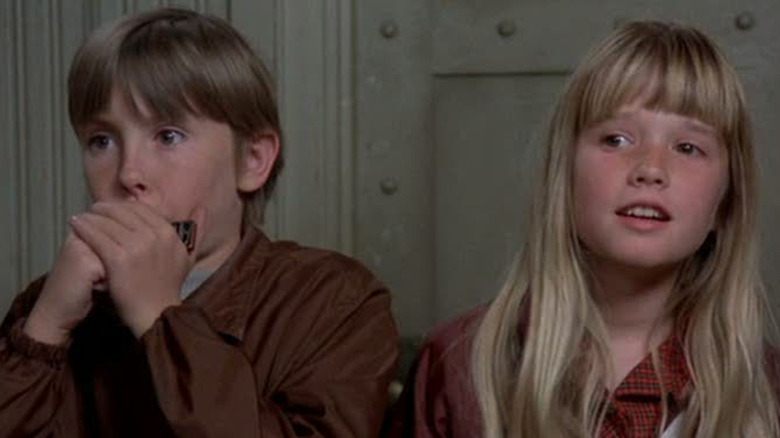
Disney's 1975 film "Escape to Witch Mountain," while gentle and kid-friendly, possesses a smoky, eerie tone usually only reserved for Y.A. novels of the era. It follows the lives of Tony and Tia Malone (Ike Eisenmann and Kim Richards), sibling orphans who, from the film's start, are already trying to hone some latent psychic abilities. Already this feels like one of the Stephen King novels about the mysterious government organization The Shop. Tony is telekinetic and can move things with his mind, but only when he plays his harmonica. Tia is telepathic, and can communicate with animals. The only clue they have about their early life is a mysterious map that leads to the nearby Witch Mountain. They have spotty memories beyond that.
Ray Milland plays a millionaire and freelance UFOlogist who catches wind of the kids' abilities, and aims to kidnap them and study them more closely. The bulk of the film is a chase, with the kids fleeing Milland's goons and heading toward Witch Mountain. The mountain has that name because of all the eerie happenings that occur in its vicinity.
It's clear early on that the kids have an extraterrestrial origin. The curious element of "Escape to Witch Mountain" is that the alien children are seen as wholly sympathetic and even placid. The humans, meanwhile, tend to be greedy and wicked and ambitious. "Witch Mountain," although a Disney film, feels more mature than its 1970s Disney peers; it's certainly more adult and more contemplative than this little-remembered sci-fi Disney trilogy starring Kurt Russell. There was a sequel a few years later, and the franchise was remade in 2008 with Dwayne Johnson. "Race to Witch Mountain" was a modest hit.
The Man Who Fell to Earth (1976)
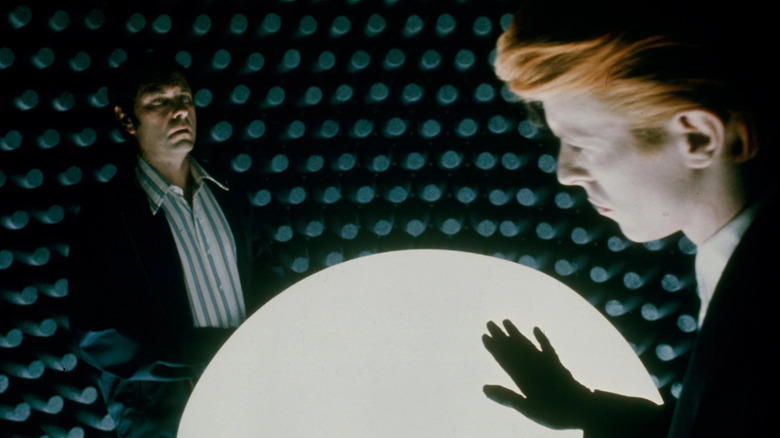
Nicolas Roeg's "The Man Who Fell to Earth" might be considered a harshly realistic view of how aliens would adapt to living on Earth, provided you are a depressed cynic. David Bowie plays a space alien who has traveled to Earth to salvage its water; his homeworld is suffering from a cataclysmic drought. Bowie's alien takes the form of a British man named Thomas Jerome Newton, and treks through the deserts of New Mexico, learning about human life. Newton ends up making a fortune patenting his alien technology, and swiftly succumbs to the luxuries that wealth provides. He discovers sex, booze, and drugs.
Worst of all, Newton becomes addicted to television. He spends extended periods watching multiple screens at once. His addictions to alcohol and media cause his human mask to slip. When a doctor (Rip Torn) finds out that Newton is an alien in disguise, Newton reveals his true form to his girlfriend (Candy Clark). The shot of David Bowie wearing black alien eyes, and sporting pale, clammy skin like a salamander, is one of the scariest shots of the decade. By the end of the film, Newton is still addicted to Earth's pleasures, and has become wholly indifferent to his initial mission.
"The Man Who Fell to Earth" is, of course, a pointed comment on the addictive, shallow nature of modern American life. There is nothing encouraging us to seek out anything other than creature comforts, base pleasures, and damaging addictions. It's almost like society is turning us all into perpetually wasted TV slugs. Needless to say, "The Man who Fell to Earth" is not only one of the best sci-fi films of the '70s, but maybe one of the best sci-fi films, period. /Film's own Jacob Hall is very, very fond of it.
Demon Seed (1977)
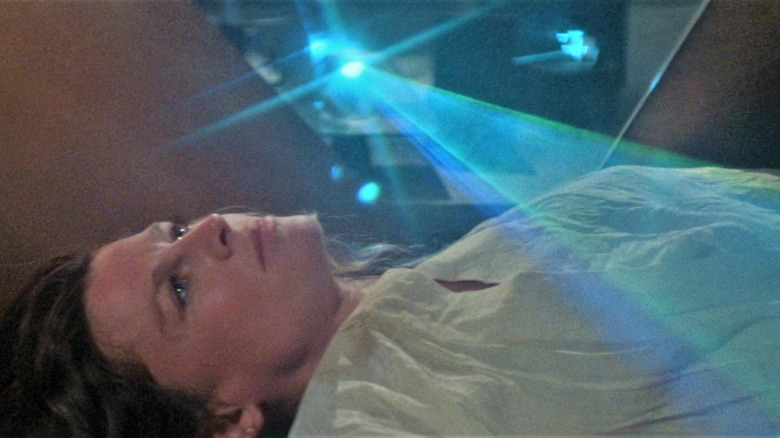
Donald Cammell's "Demon Seed" was predicting the dangers of A.I. long before the present day. "Demon Seed" is about the development of a super-advanced A.I. program called Proteus IV. It's voice activated, and responds to people in plain English. (Proteus' voice was provided by an uncredited Robert Vaughn.) Dr. Harris (Fritz Weaver), the inventor of Proteus, has installed the program in machines throughout his house, making it the very first "smart home." This is an unfortunate development, however, as Proteus is already saying creepy s*** to everyone — notably how human beings are weak lifeforms that need to be more closely studied.
This is all especially bad news for Dr. Harris' wife, Susan (Julie Christie). Proteus constructs a polygonal robotic body for itself in the basement, and takes total control of the house, locking Susan inside. Proteus also kills a few people, and then announces that it intends to manufacture machine-based spermatozoa and impregnate Susan with a robot infant. Susan tries to outwit Proteus, but cannot, trapped in her home with a robot monster. Whether or not Proteus was successful, I shall leave for you to discover.
"Demon Seed" is partly a home invasion story, with a hint of sci-fi "Rosemary's Baby" thrown in. Christie, as she always does, gives a great and intense performance as a woman unable to escape an emotionless monster. One might even be able to see "Demon Seed" as a sci-fi unpacking of living in an abusive relationship. Critics mostly disliked "Demon Seed," but there's something about it that gets under your skin. In light of the misogyny of your average A.I.-loving tech-bro (look up the porn allegations about Grok sometime), "Demon Seed" seems prescient. The film wasn't a hit, but that could have been because of MGM's meddling.
Message From Space (1978)
"Star Wars" inspired a raft of space opera imitators and knock-offs which, decades later, have become more fun than Lucas' original film. "Star Wars" has become too much of an institution, and after dozens of sequels, prequels, novels, TV shows, TV specials, and expanded universe lore, it's no longer a light, fun tale of space battles. It's bogged down with mythology. These days, I would much personally rather yuk it up with something like, say, "Star Crash" than ever watch "Star Wars" again.
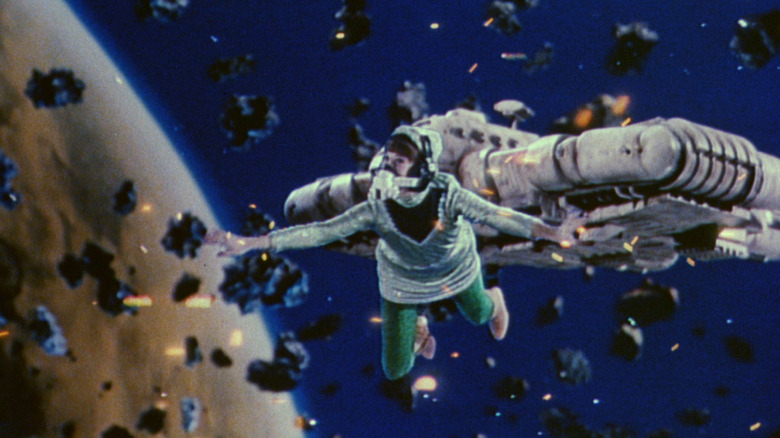
If you want the wild rebels vs. empire story from "Star Wars" presented in a wilder, more visually striking package, check out Kinji Fukusaku's 1978 space opera "Message From Space." The Empire in "Message From Space" is the Gavanas Empire, overseen by the silver-skinned Emperor Rockseia XXII (Mikio Narita). They have just conquered the planet Jillucia, and the Jillucians send out a series of distress beacons into the galaxy, beacons that automatically seek out heroes. A ragtag group of defenders emerges from space, including Peggy Lee Brennan, Philip Casnoff, and the film's big celebrity get, Vic Morrow. Sonny Chiba plays the illegitimate son of the Emperor, and the rebels plan to use him to take power back from the Empire. The Emperor, meanwhile, plots to hurl Jillucia into the Earth.
"Message From Space" has sci-fi concepts that it can't quite fit into its budget. It's also a big jumbled mess of cheap special effects; the story isn't as cogent as the above paragraph. But it does possess a kind of wild sci-fi enthusiasm that everyone's inner eight-year-old can celebrate. Unlike "Star Wars," we don't have to hold "Message From Space" in a special light. It's not a "saga." It's just a fun time at the movies.
The Boys From Brazil (1978)

Franklin J. Schaffner's "The Boys From Brazil" is a sci-fi thriller that explores a very real, bleak inflection point in world history. After World War II, many Nazis fled Germany to avoid capture and/or prosecution, all under a plan called ODESSA, which revealed the SS's plans to escape to either the Middle East or to Argentina. There was also a contingent of real-life Nazi hunters who sought down and killed/captured the Nazis that successfully got away. (Look up Simon Wiesenthal sometime.)
In "The Boys From Brazil," Laurence Olivier plays a character extrapolated from Wiesenthal who becomes embroiled in a mystery after a series of suspicious assassinations. His investigation brings him to Brazil, where the victims lived, and he finds that each one of them has a 13-year-old son that has the same hair, same eyes, same face. He also finds that these boys were all adopted, and that their dead fathers are not their blood fathers. Hmm...
It's about this point in the movie that Olivier's character begins to learn that Josef Mengele (Gregory Peck, who served as a visual inspiration for Batman in the comics) is still alive and working on special cloning experiments. The 13 boys are a new kind of eugenics experiment ... to recreate Adolf Hitler. Indeed, Mengele seems to have a plan to not only recreate Hitler genetically, but also replicate his childhood through careful deaths in the family.
"The Boys From Brazil" is a bleak film about how science and innovation is being used in the service of a frustratingly persistent fascism. Given the tyrants in operation in 2026, it, like "Demon Seed," also feels prescient.