

A Knight Of The Seven Kingdoms Finally Does What House Of The Dragon Couldn't
Ever since "Game of Thrones" gave us one of the most controversial TV show endings of all time, the HBO franchise has been on a comeback tour. First, there was "House of the Dragon," a series that managed to capture the political intrigue and backstabbing that made audiences fall in love with "Game of Thrones" in the first place.
Now comes "A Knight of the Seven Kingdoms," the second "Game of Thrones" prequel/spin-off. Based on George R. R. Martin's novella "The Hedge Knight," one of three short stories published in his "Tales of Dunk and Egg" series, it's a truly special show. In his "A Knight of the Seven Kingdoms" review, our own Jeremy Mathai described the series as a palate-cleansing, "humble, wholesome, and very welcome return to Westeros."
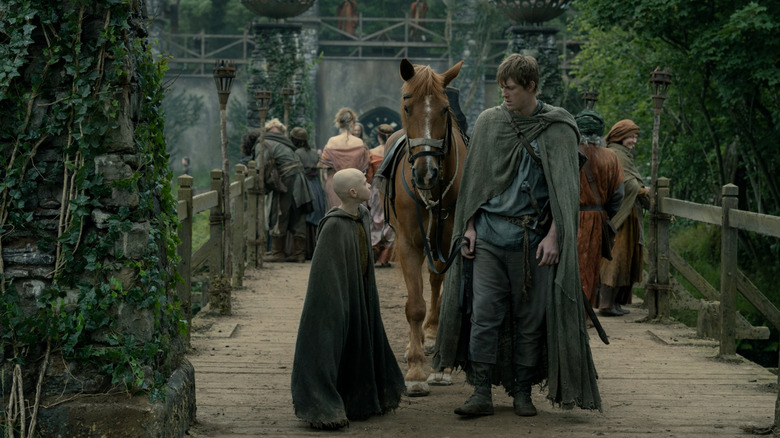
While there's still plenty of royal drama and treachery happening when "A Knight of the Seven Kingdoms" begins, the show isn't really interested in that. Instead, the main thrust of the plot concerns Dunk (Peter Claffey), a nobody hedge knight hoping to make a name for himself at an upcoming tournament. This is still the same cruel, violent, unforgiving Westeros we know, yet it's immediately apparent that "A Knight of the Seven Kingdoms" is looking for the heart and the humor in this setting. It's to "Game of Thrones" what "The Hobbit" is to "Lord of the Rings" (J.R.R. Tolkien's original books, that is); it's part of the same recognizable world, and it's full of familiar character types, but the tone and scope is vastly different.
Indeed, it takes but a few minutes for "A Knight of the Seven Kingdoms" to establish itself as a brand new day for Westeros and do what "House of the Dragon" has not done: open the door to all kinds of "Game of Thrones" stories.
A Knight of the Seven Kingdoms proves there's room for hope in the Game of Thrones universe
It only takes a few seconds for "A Knight of the Seven Kingdoms" to clearly and loudly announce itself as a different kind of Westerosi story. As Dunk decides he's going to become a famous knight in the series premiere, Ramin Djawadi's famous "Game of Thrones" theme starts playing ... only for the episode to abruptly jump to our hero emptying his bowels on the side of a road. This show isn't a parody or entirely unserious, mind you, but this cut is nevertheless a strong tone-setter.
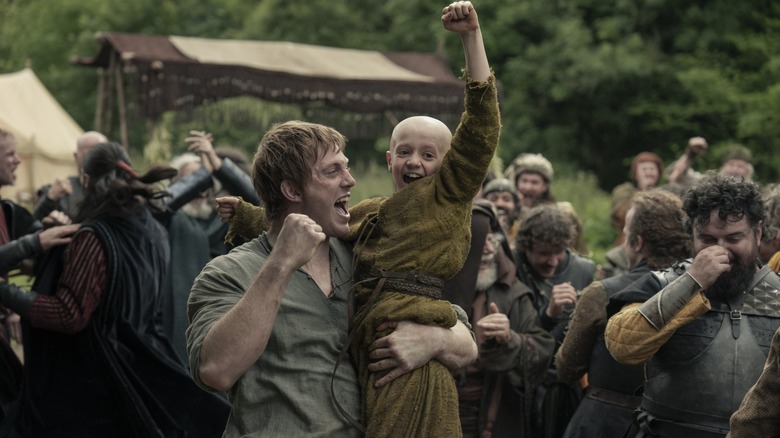
No, what really makes "A Knight of the Seven Kingdoms" special is how much heart it has. It's a funny series, yes, but the humor comes from its protagonist simply being a good, kind-hearted, and sincere would-be knight in a world as cruel as Westeros. The show very much banks on viewers knowing what tends to happen to decent people in this world, be they Ned Stark (Sean Bean) or, honestly, most of the Starks in general. Showrunner Ira Parker and his creative team then use this knowledge to generate comedy centered around Dunk's total and utter lack of awareness and strong sense of goodness and honor.
George R. R. Martin approved the changes that "A Knight of the Seven Kingdoms" makes to his source material, and you can see why, as the heart and soul of his writing is otherwise present. There's even the sense of yearning for adventure and wonder for the world that was present for a while in "Game of Thrones" (before its heroes were punished for their naivety, anyway). By presenting such a different outlook on Westeros, this show proves the franchise can support more than one type of story.
The Game of Thrones universe may yet become a sandbox for different stories
Many spin-offs, at least on TV, simply center on fan-favorite side characters. (Think "Joey" or "Angel.") And sure, this has sometimes led to spin-offs that are better than the original series, but it's also why spin-offs are rarely different from their predecessors. HBO, for its part, is similarly trying to develop a "Game of Thrones" spin-off centered on a fan-favorite character from the franchise's parent show, but to limit this universe to just a small set of individuals would be a real waste of potential. After all, George R.R. Martin's original stories aren't about their characters as much as they are the larger world they inhabit.
"Star Wars" is a good example of this. When we started getting "Star Wars" shows, they were (for the most part) vastly different in tone and approach. "The Clone Wars" was a war epic while "Rebels" focused on a small ragtag group. Likewise, "The Mandalorian" was a big hit early on because it didn't include any Jedi (that didn't last long) and explored a previously unseen section of the "Star Wars" universe. Meanwhile, "Skeleton Crew" and "Andor" couldn't be more different, which allowed them to complement each other and expand what "Star Wars" can be.
Now, thanks to "A Knight of the Seven Kingdoms," the small screen version of Martin's fantasy world is becoming a sandbox that can support vastly different stories as well. The show excels at standing apart from its predecessors while still feeling like it belongs to the same universe, which will allow the greater franchise to keep growing. And because of this, the "Games of Thrones" property need no longer be defined by any single entry.
"A Knight of the Seven Kingdoms" is streaming on HBO Max.