

X-Men: The Animated Series Used Nightcrawler To Cross A Line Superhero Cartoons Avoided
We may receive a commission on purchases made from links.
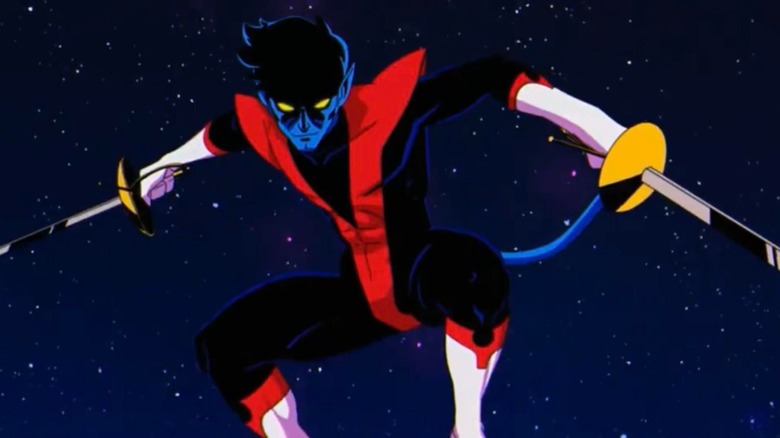
The X-Men fight against not just super-villains, but also spiritual evils like bigotry. The mutant most liable to suffer hate and fear is the blue-skinned Bavarian Kurt Wagner/Nightcrawler, who doesn't pass for human the way most of his comrades do.
Nightcrawler's first appearance in Len Wein and Dave Cockrum's 1975 "Giant-Size X-Men" #1 saw Professor X rescue him from a pitchfork-and-torches mob. Yet, Nightcrawler is the kindest X-Man of all. As Kurt's teammate Kitty Pryde has attested, Nightcrawler had "every excuse to become as much of a demon inside and out, but he decided he'd rather learn to laugh instead!"
Though excluded from the main cast of the 1992 "X-Men" cartoon (until revival "X-Men '97"), Nightcrawler made a memorable guest appearance in an eponymous episode. "Nightcrawler" directly centered on the defining irony of Nightcrawler: his Catholicism. He's a man of God even though he looks like he was made in Satan's image. His teleportation power even leaves behind smoke that smells of hellish brimstone!
The animated Nightcrawler lives in a monastery in the Swiss Alps. Even if his neighbors hate him, Nightcrawler (Adrian Hough) forgives them their trespasses and keeps his faith. His belief even inspires Wolverine (Cal Dodd) to consider prayer. Religion — an obviously delicate subject — was taboo to discuss in '90s superhero cartoons, especially having superheroes directly debate the existence of God. But the "X-Men" team broke this barrier with "Nightcrawler."
As a Catholic schoolboy, Nightcrawler was always my favorite X-Man behind Wolverine. Heck, the story that made me a Marvel fan for life when I read it at 13 — "X-Men: God Loves, Man Kills" by Chris Claremont and Brent Anderson — explores how bigots twist religion to justify hatred. If the young audience of "X-Men" was mature enough to learn about racism, they could learn about faith.
'Nightcrawler' was one of the most carefully made X-Men episodes
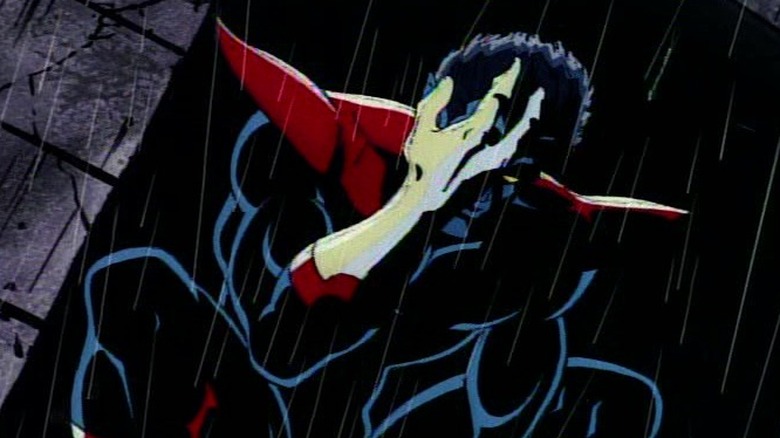
The production of "Nightcrawler" takes up a whole chapter of showrunner Eric Lewald's behind-the-scenes book "Previously on X-Men," because he's just that proud of it. "Considering that we're talking about people in spandex and capes, you're not going to be able to have an in-depth theological discussion. But within the confines of our melodrama, I think ['Nightcrawler'] was successful," Lewald wrote.
Unlike the accidental feminism of "X-Men" having a gender-balanced cast, "Nightcrawler" was an episode made with intentionality. Lewald writes that to adapt Nightcrawler in a character-centered show, they had to use what set him apart: "No other mutant was a creature of faith." (Indeed, the episode leaves out comic Kurt's fun-loving, swashbuckling side to emphasize his religiosity and tormented otherness — you can practically draw a line to the more morose, self-flagellating Nightcrawler played by Alan Cumming in "X2.")
While "X-Men" was going where no cartoon had gone (faith-based/church-sponsored productions aside), producer Sidney Iwanter gave the episode his full backing: "Don't beat around the bush. I want to hear about a loving, giving God." After episode writer Len Uhley submitted his two-page premise sheet, Iwanter actually pushed for more religion and less action. To ensure the episode couldn't get killed last minute, Lewald, Iwanter, and co. involved standards & practices executive Avery Cobern from the outset.
Cobern had some "light" notes on the episode outline, such as concerns over Nightcrawler's devilish appearance and Logan being a non-believer, but ultimately came around. There was also an edict to keep the religion non-denominational: no crucifixes or stained glass depicting scenes from the New Testament (though a tapestry of Adam & Eve appears in the final episode). Yet even that choice has a silver lining; it makes for a more universal story.
Wolverine has a crisis of faith in 'Nightcrawler'
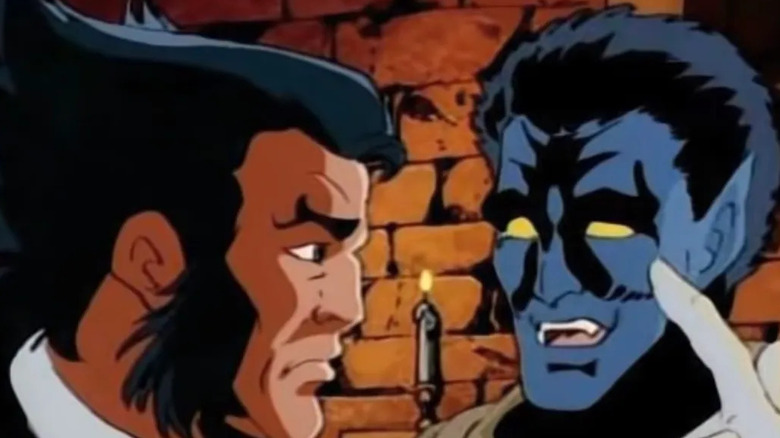
"Nightcrawler" features only a fraction of the X-Men for tighter focus: Wolverine, Rogue (Lenore Zann), and Gambit (Chris Potter) meet Nightcrawler while on vacation in the Alps. Wolverine, the oldest, angriest, and worldliest of the X-Men, was chosen to be Nightcrawler's foil, the doubter most baffled by Kurt's faith; how can someone believe in a divine plan when it has delivered them such a bad hand? Wolverine has had a hard life, comparable to Nightcrawler being shunned for his appearance. Logan even says in "Nightcrawler" that he's tried to find peace in faith, but couldn't reconcile stories of God's love with his own suffering (and suffering he's paid unto others). Unsheathing his claws, Logan asks Nightcrawler: "What kind of God would let men do this to me?!"
Marvel's then-Editor-in-Chief Bob Harras (credited as a "story consultant" on the episode) objected to these beats. He disliked both the casualness of the X-Men being on vacation and the episode suggesting that Wolverine, who'd spent years living in Japan, would be so opposed to spiritualism. Lewald, who wasn't required to take Harras' notes but preferred to keep him on board, wrote a letter (printed in full in the book) explaining his viewpoints:
"We must have Wolverine wrestling with religious questions — angry, wondering, questioning — or we have no emotional story. Yes, Wolverine is intensely, seriously searching for peace. But the Wolverine I have come to know hasn't come close to achieving it."
As for the vacation setting, the "X-Men" team wanted to mix it up: "After 52 episodes where the X-Men almost always rush out to deal with a detected crisis or presence, this provides us variety," Lewald wrote. As Rogue also cracks early on in the episode, "We could use time off."
Nightcrawler brought religion to X-Men
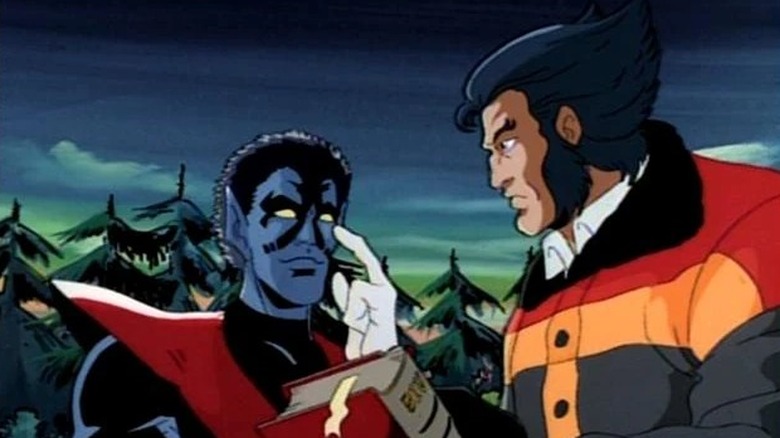
"Nightcrawler" begins on a dark and stormy night in a provincial village right out of the Universal "Frankenstein" films (showing "the intolerant side of religion," Lewald wrote). A mob assembles in fear of a "demon" hiding in the shadows and attacks him. Viewers might assume Nightcrawler is the episode's villain — until he laments, "They know not what they do." Even one of Nightcrawler's "brother" monks, Reinhard, seeks to expel him. But if there's one principle Christianity is supposed to teach, it's forgiveness. When the monastery catches fire, Reinhard sees his hatred has pushed him too far.
The essence of Nightcrawler's final scene in the episode stayed the same from outline to script: Logan questions how Nightcrawler can find reason to be thankful even with the monastery destroyed. Nightcrawler counters that Reinhard and the villagers have repented for their ignorance, and a mere building is no reason to shed tears: "The foundation that God has built in our hearts can never be destroyed."
By the episode's end, the three X-Men have all reached different conclusions from their encounter with Nightcrawler. Wolverine is giving faith another chance, while Gambit is still the "flippant" nonbeliever. Rogue is unsure; she ponders if Gambit is right and there's "nothing else" before she spots Wolverine reading the Bible that Kurt gave him in a church. She leaves, tears in her eyes, without a word to Logan.
When I was a kid in Catholic school, I thought it was a happy ending because Logan had accepted God. Seeing it now with older (and lapsed) eyes, I still appreciate it showing how faith can be a tool for personal healing. A church that keeps its doors open to prodigal children is one worth appreciating, even when you can't cross that threshold yourself.