

Robert Picardo Explains Why The Doctor Looks Different (But Acts The Same) In Star Trek: Starfleet Academy [Exclusive]

Even if a young adult-flavored "Star Trek" show isn't exactly your bag, "Starfleet Academy" co-showrunners Noga Landau and Alex Kurtzman have a significant secret weapon up their sleeves. See, this upcoming series isn't merely a "Discovery" sequel/spin-off, but a long-awaited reunion with one of the best characters of "Star Trek: Voyager." Robert Picardo's Emergency Medical Hologram (EMH, for short) was never given a name, embarked on some of the most entertaining subplots, and even courted several love interests over the course of that earlier show. Despite seemingly reaching the conclusion of his story when the USS Voyager finally made it back home to Earth, the fan-favorite Doctor will instead continue to serve Starfleet as a member of the rebuilt Academy nearly a millennia after we last saw him.
Of course, that massive timescale presents certain issues — namely, how has he changed in the intervening centuries? As a hologram, he could've easily chosen to remain exactly the same age as he presented himself to be in "Voyager." Instead, he's exactly the frown-faced, music-loving, crotchety man we remember him to be ... though slightly older in appearance. In a recent interview with /Film's Jacob Hall, the actor spoke about what went into this choice and whether the show's canonical explanation made sense to him:
"I did ask questions like that. I said, 'Holograms are not supposed to age. How do we explain that?' The de-aging technologies are way advanced beyond the old [method of] just paint out the wrinkles and have a bloated, featureless character. But they said he would've added a slow-aging program to his matrix, which makes complete sense because when you're 800 years of organics, growing old and dying around you, it's got to creep them out a little bit that you never change."
Why The Doctor in Starfleet Academy behaves exactly as he did in Voyager
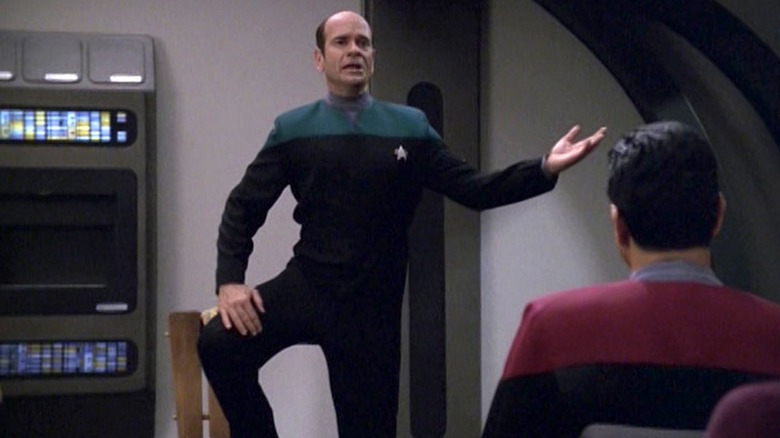
Still, a lot can change in 800 years. As "Discovery" showed in its not-quite-proper finale, the future of the "Trek"-verse feels quite alien compared to the supposed utopia that it resembles in much of the official canon. The galaxy-wide destruction caused by the so-called Burn effectively spelled the end of Starfleet and its vast fleet of interstellar starships, plunging countless worlds into chaos and disorder. By the time "Starfleet Academy" kicks off, the Federation is ready to open its doors to a new generation of Starfleet officers. While entire novels and comic books could be filled with what the Doctor was up to during all that time, the hologram we catch up with in the premiere is virtually indistinguishable from the one that (endearingly) terrorized the USS Voyager's sickbay.
To Robert Picardo, that wasn't an obstacle whatsoever when it came time to consider embodying the character again after so long — even if the logic of a centuries-old hologram aging precisely the same few decades as Picardo himself has doesn't entirely check out. As he told /Film:
"Now, yes, if you dig deeply and you go, 'Well, in 800 years, he only looks 30 years older,' I can't answer that right now, but I'm thinking about it. But mostly it's that I wanted to have the same pace and energy, the same sense of humor, the same 'I'm the smartest mind in the room' arrogance, occasionally. But also the breathless enthusiasm, the childlike enthusiasm when he is onto something, when he's excited about something, because that enthusiasm can annoy others, which is fun."
As anyone who's slogged their way through "Voyager" can attest to, the Doctor's most off-putting quirks were frequently a highlight of that show.
Starfleet Academy provides the perfect setting to reintroduce the Doctor
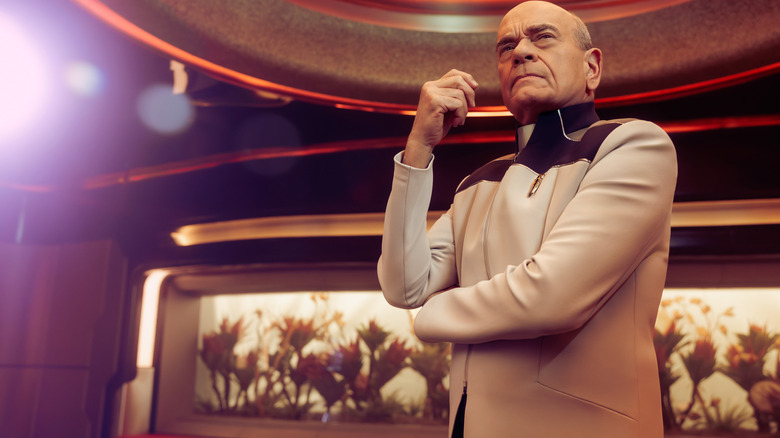
So why bring back the Doctor now, of all times? The endless possibilities of the "Star Trek" universe means that almost any show could've conceivably made room for an older and wiser (and grumpier) EMH, but the crew behind "Starfleet Academy" had this particular one earmarked for his grand return. As it turns out, that had everything to do with which setting would pose the most irritation for the famously fastidious Doctor. Throwing him right up against a young class of young, over-eager Starfleet cadets? Yeah, that'll do it. According to Robert Picardo:
"But also, when he's not enthusiastic, then [the Doctor] can be annoyed by the enthusiasm of the young cadets. So the comic possibilities of the character are still completely intact, in my opinion. I just learn my lines so well that I can say them as quickly as possible. My mantra has always been: [in] science fiction, say it fast. Unless it's an emotional scene, but especially if it's techno-babble, just get it over with."
Pretty much any given scene featuring the Doctor in "Voyager" proves the wisdom behind Picardo's words, as the character's rapid-fire delivery feels just as integral to his personality as his love of opera (which certainly hasn't abated by the time of "Starfleet Academy") or his passion for the nerdiest and most teachable moments of science. Taken as a whole, is bringing the Doctor back after so much time has passed mostly just an excuse to get away with a little bit of fan-service? Perhaps. Does it also enhance everything that "Starfleet Academy" is attempting to pull off? You bet, and we wouldn't have it any other way.
The first two episodes of "Starfleet Academy" premiere on Paramount+ January 15, 2026.