

One Of The Best Sci-Fi Movies Of The 2010s Is Set In 2026
We may receive a commission on purchases made from links.
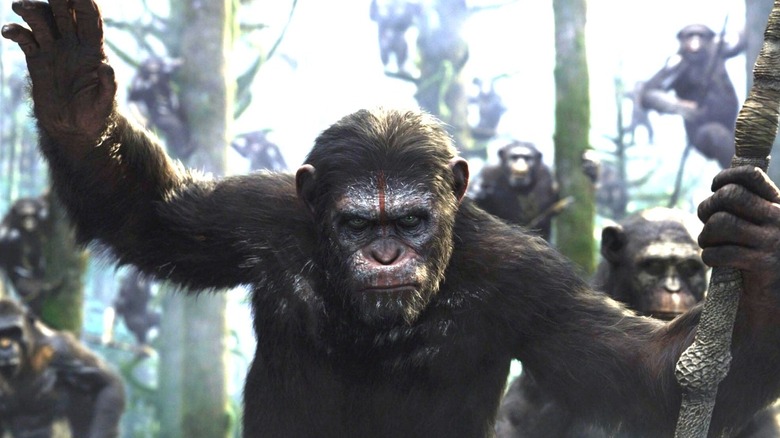
When you label a science-fiction story's future setting with a specific date, then eventually the world will catch up to that date. Since the fictional world (probably) won't resemble the real world, this can lessen the movie's impact or simply show its age. As of this new year, one movie in that category is "Dawn of the Planet of the Apes," released in 2014 and set in 2026.
"Dawn" was set 10 years after "Rise of the Planet of the Apes," which ended with a virus that kills humans but boosts ape intelligence spreading across the globe. During that decade human civilization has collapsed into refugee colonies while Caesar's (Andy Serkis) apes have built a primitive society. Unless I missed some important news, the world does not look like that right now (but it's got a whole year to catch up).
Now, "Dawn" is not alone in its poor future predictions. Take "Star Trek." The classic episode "Space Seed" said that in the 1990s, Earth would be embroiled in a "Eugenics Wars" where genetically-engineered superhumans tried to take over. The 1990s came and went, and nothing like that happened. "Star Trek: Strange New Worlds" season 2 rewrote the timeline to move the Eugenics Wars up to the mid 21st century, but that's just forestalling; once we get to 2050, the same problem will return.
Another, more minor example is "Star Trek: The Next Generation" predicting that Irish Unification would happen in 2024, which ultimately didn't come to pass. Other sci-fi movies once set in a possible future, but now in the past, include "Escape from New York" (made in 1981, set in 1997), "Blade Runner" (made in 1982, set in 2019), and even the original, fiercely underrated "Conquest of the Planet of the Apes" (made in 1972, set in 1991).
Dawn of the Planet of the Apes is set in an alternate 2026

"Rise of the Planet of the Apes" released in 2011, and nothing suggested that the movie wasn't set in the contemporary world. However, it also spanned several years, following Caesar's growth from infancy to adulthood. Neither "Rise" nor "Dawn" give exact dates, but in an interview with Empire Magazine (for its August 2011 edition), "Rise" director Rupert Wyatt suggested the movie took place between 2010 and 2016.
Thus, "Dawn," set 10 years later, takes place in 2026, which was the date given on the now-defunct promotional website for "Dawn." (It seems that not everyone got the memo, since the "Dawn of the Planet of the Apes" novelization by Alex Irvine claimed the "Simian Flu" started spreading in 2012, which would suggest "Dawn" happens in 2022.)
While the exact future suggested in "Dawn of the Planet of the Apes" hasn't come to pass, the movie's cultural commentary has aged well. "Planet of the Apes" is the most politically charged blockbuster franchise we have. Take the original's Rod Serling-penned twist ending showing the Statue of Liberty, the symbol of all that is good in America, standing broken like the colossal wreck Percy Bysshe Shelley described in his poem "Ozymandias."
The conclusion in "Planet of the Apes" is that man destroyed himself in nuclear war, which tapped into the existential fears of 1968. The world's superpowers were in a Cold War that had almost turned hot in 1962 with the Cuban Missile Crisis. When Lyndon Johnson triumphed in the 1964 U.S. presidential election, he did it with some help from an incendiary ad ("Daisy") suggesting his opponent Barry Goldwater would start a nuclear war if elected.
"Dawn" honors the political legacy of "Apes" but hones in on smaller weapons: guns.
Dawn of the Planet of the Apes remains vital a decade later

Contemporary critics (such as Vanity Fair's Katey Rich) argued that "Dawn of the Planet of the Apes" was a pro-gun control message picture. Whenever the conflict between the humans and the apes escalates in the movie, a gun is at the center of miscommunication and violence.
The point of no return is when human-hating ape Koba (Toby Kebbell) steals an assault rifle and murders two humans with it. Koba then uses the gun to frame the humans for attempting an assassination of Caesar and then takes over the apes, leading them on a bullet-fueled warpath while Caesar is incapacitated. By mastering man's greatest death-dealing invention, the apes have truly become no different from us.
When "Dawn" was made and released in the early 2010s, two mass shootings in 2012 — the July shooting at the Century 16 movie theater in Aurora, Colorado, and the December shooting at Sandy Hook Elementary School in Newtown Connecticut — were much fresher memories. Those moments are symptoms of public inertia; the U.S. didn't implement any restrictive gun control, and deadly shootings became a repeated event in America. (See data compiled by The Gun Violence Archive.)
"Dawn of the Planet of the Apes" opens with a montage of newsreel images played over a background of the globe, showing the Simian Flu spreading until all lights across the globe go out. This was already chilling in 2014, and is even more so now that we've lived through the Covid-19 global pandemic (thankfully a much less lethal plague than the Simian Flu). In its depiction of guns as a root of violence, "Dawn" shows another epidemic gone untreated in 2014 and still not addressed in 2026.