

James Cameron's Avatar: Fire And Ash Has A Perfect Stanley Kubrick Homage

This article contains spoilers for "Avatar: Fire and Ash."
Is Stanley Kubrick's "2001: A Space Odyssey" the single most influential science-fiction film ever made? That's a debatable topic, of course, yet each passing year offers more evidence to support the claim. Leaving such hyperbolic statements aside, though, there's no doubt that the influence of "2001" is still deeply felt 57 years after its release. It's not just seen within sci-fi and genre movies, either. Earlier this year, in fact, Celine Song's romantic dramedy "Materialists" contained a sly homage to Kubrick's film. Perhaps this is because "2001" isn't actually a fantasy or Western adventure in disguise à la "Star Wars." Instead, the movie was co-written by an unabashed sci-fi author in Arthur C. Clarke, thus making it one of the first works of cinematic science fiction that was as expansive in concept and scope as science fiction literature.
While the "Avatar" movies exhibit a wide range of influences that include everything from other action blockbusters to ancient myths, they're also aesthetically some of the most brazenly sci-fi movies ever made. Ever since directing the first "Avatar," franchise architect James Cameron has taken a particular interest in expanding the property's setting of Pandora as much as possible from all angles: culturally, scientifically, and visually. One character (if you will) that we never saw in the first two "Avatar" films was the Na'vi goddess known as Eywa, and this absence tracks with most stories not actually depicting deities. That changes with "Avatar: Fire and Ash," which contains a scene in which several individuals speak directly to — and catch a glimpse of — Eywa herself. And the way she's presented happens to be highly reminiscent of the famous final image of, you guessed it, Kubrick's "2001," and this is very likely no coincidence on Cameron's part.
James Cameron makes Eywa his own version of the Star Child
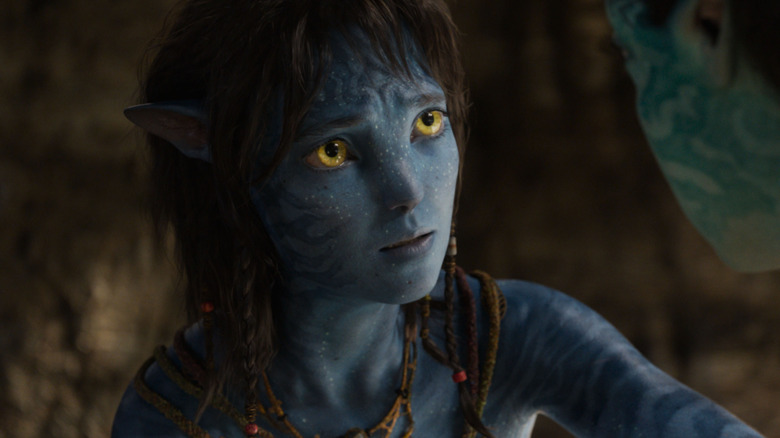
During "Fire and Ash," Kiri (Sigourney Weaver) is struggling with her mysterious connection to Pandora, as she seems to have environmental powers over most of its creatures. Yet, Eywa refuses to communicate with her, to a degree that whenever she tries to join with the deity via her queue, she suffers from life-threatening seizures. Finally, during the climactic battle between the Na'vi clans and the RDA, Kiri is compelled to plead for Eywa's help once she sees the Na'vi forces become overwhelmed. Joining with a root underwater, Kiri calls upon "the warrior mother" and is assisted in her quest by both Tuk (Trinity Bliss) and Spider (Jack Champion), who is himself a human transformed by Kiri into a hybrid being.
While the sequence within the joining realm could've simply depicted this quest without revealing Eywa, Cameron and company go the extra mile by actually showing her. Though it's just a glimpse in profile, Eywa appears as a giant child in the sky. It's an image which is deliberately reminiscent of the ending of "2001," in which astronaut Dave Bowman (Keir Dullea) is returned to Earth from Jupiter, having been reincarnated as the Star Child, aka a new evolutionary leap for humanity who appears as a floating baby above the planet. It's a psychedelic concept that feels totally of a piece with the "Avatar" films' aesthetic, and it raises even more fascinating questions about the more metaphysical elements of the franchise's universe.
Cameron's 2001 homage is as heartfelt as it is bold
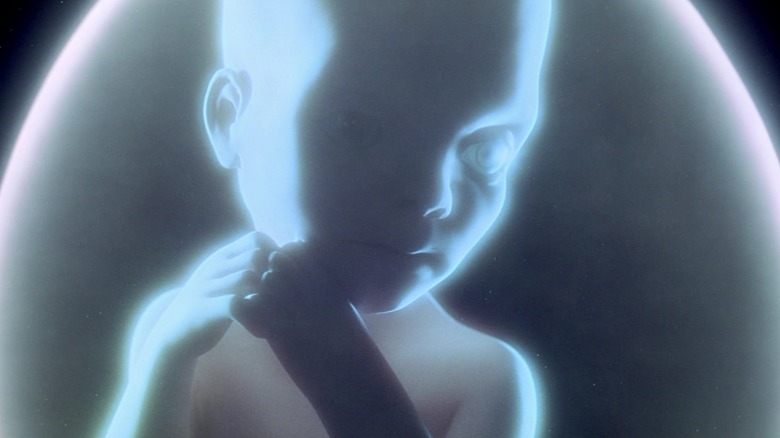
While another filmmaker making use of such an image in their movie could be called coincidental or even incidental, there's no question that Eywa in "Fire and Ash" is a deliberate nod by Cameron toward Kubrick's film. It isn't just Cameron being bold and engaging in some friendly oneupmanship with the revered director, either. As Cameron revealed in 2018 on the occasion of the 50th anniversary of "2001," he holds the movie in high esteem. Sure, he has some criticisms of it, but he told The Star that it "had an enormous, enormous impact" on him in his youth. For him, it's one of those films where he remembers exactly where he was when he first saw it, having seen the movie at a Toronto theater when he was 13 years old.
Given this, it's very telling (and very Cameron) that the director's "2001" reference isn't as tiny as a movie poster as set decoration or takes the form of an oblique line of dialogue. Instead, it's a major reveal of a key element of his film's mythology. Is Eywa intended to be thought of as a (relatively) young being, or is this just a projection of an otherwise unknowable, imperceivable entity? Like Bowman in "2001," was Eywa once a Na'vi or human who evolved beyond such a form, or is she something else? Now that Kiri (along with Spider and Tuk, by extension) has established a relationship with her, it's a good bet that we'll be seeing more of Eywa in future "Avatar" films. So, while we can't predict what these appearances will look like, it's a good bet that the "Avatar" franchise's "2001" homages have only just begun.
"Avatar: Fire and Ash" is now playing in theaters.