

It: Welcome To Derry's Pennywise Is Not A Time Traveler - It's Way More Complicated
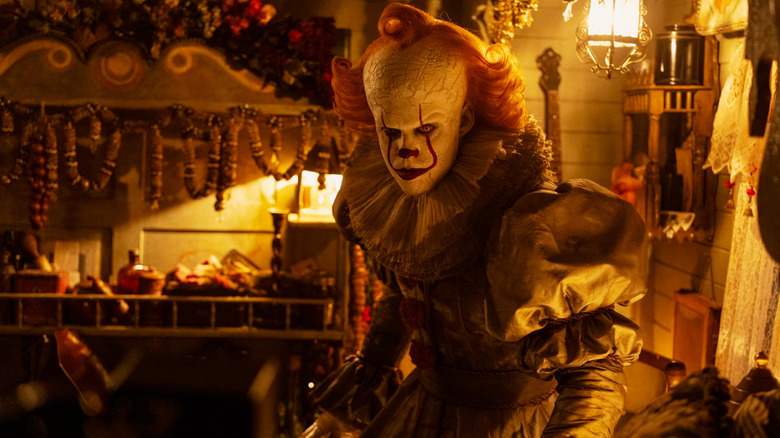
With its tumultuous season 1 finale (which was still far superior to "It Chapter Two"), "It: Welcome to Derry" seems to have suggested that we've been watching a time travel show all along. Has the evil entity that animates Bill Skarsgård's Pennywise been trying to change the course of history to prevent his eventual death? Well, things are more complicated than that, as It is a force that, rather than traveling through time, is actually capable of seeing all time as one continuum.
In the "Welcome to Derry" season 1 finale, 'Winter Fire," Pennywise reveals to Matilda Lawler's Marge Truman that her future son, Richie Tozier (played by Finn Wolfhard in 2017's "It" and Bill Hader in 2019's "It Chapter Two") will one day contribute to his death. "The seed of your stinking loins and his filthy friends bring me my death," as the "clown" puts it. That appears to indicate that "Welcome to Derry" is a time travel story wherein the titular entity is aware of its ultimate demise and traveling backwards each season to try to change the course of history and prevent his destruction — kind of like the horror version of Skynet from the equally confusing "Terminator" timeline.
That concept is seemingly confirmed by Marge later in the episode when she asks her friend, Lilly Bainbridge (Clara Stack), "What if [It] can go backwards?" before adding, "I know it sounds crazy, but what if he tries to go back and kill someone from the time before we were born, like our parents?" Honestly, that doesn't sound all that absurd, given that the show creators have already confirmed their ambitious trilogy plans for "Welcome to Derry," which will see the next two seasons take place in 1935 and 1908. But there's more to this story than that.
What is It and where does it actually exist?
"It: Welcome to Derry" is a prequel series to 2017's "It" and 2019's "It Chapter Two." But unlike those movies, which were based on Stephen King's original 1986 "It" novel, the show loosely adapts three short interludes from the book that refer to previous events in the town of Derry. As such, co-creators Jason Fuchs and Andy and Barbara Muschietti have more creative freedom with the HBO series. Now, with season 1, they've provided a complex and fantastical but mostly satisfying origin story for the titular entity.
As Andy Muschietti has confirmed, the show is designed to answer three key questions: "What is It? What does It want? And why is It in this plane of existence?" That last question is the most interesting since it gets to the real origins of the evil force. Thanks to season 1, we know it crash-landed on Earth centuries ago and was penned in by local Indigenous people using shards of the casing that carried it to our planet in the first place. But the actual entity that animates It's physical form exists outside the physical realm in the sphere known as the Todash Space, the area between all universes in the Stephen King macroverse.
In the "It" novel, the Losers Club faces It in its true form: a giant female spider. But this is merely the only comprehensible physical form the entity can take for humans, as it's actual true form is beyond our capability to understand. So, when the Losers defeat It in the book, they are merely severing It's link to the physical world. The actual entity still exists in the macroverse, but it's unable to continue its murderous Earthly exploits. This is where that whole time travel question comes in.
Can It actually time travel?
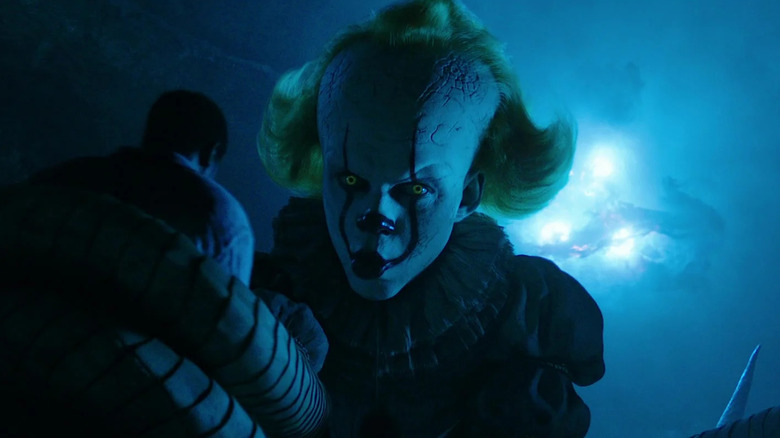
It is not a time traveler as we might think of it. Instead, the entity experiences all of time simultaneously. It's like how "eternal" doesn't refer to something that lasts forever, it refers to something that's infinite and outside of time itself. That's It — It lives outside of time and can see it all as one continuum. But it can't "travel" back in time. Instead, it's simply aware of its future demise, which is why It's physical form targets the Losers Club's ancestors in "Welcome to Derry" and why Pennywise is obsessed with Will Hanlon (Blake Cameron James).
One more element to consider (just to make things extra confusing) are the pillars. The shards that keep Pennywise locked in Derry may also prevent him from using his ability to know the future. In 'Winter Fire," Pennywise says "Tomorrow, yesterday, it's all the same for little Pennywise. But it's not always easy, no. Being caged up in one place, one time." Was It's ability to see all of time impeded by being caged in Derry? Well, recall that Pennywise previously told Will he'll "burn too," suggesting It was aware of the future Black Spot fire. Perhaps, then, the shards trap It within a set time period, i.e. from when it was first caged to when it died, which would mean the "one time" to which Pennywise refers is that multi-century time period.
While the specifics of how and when the Earthly form of It becomes aware of the future and past remain unclear, it's fairly safe to say that It is not actually time traveling in the way we usually use that term. Rather, it's taking specific actions based on its knowledge of the time continuum.
"It: Welcome to Derry" is now streaming on HBO Max.