

Frankenstein Originally Inspired Marvel's First Anti-Hero
We may receive a commission on purchases made from links.
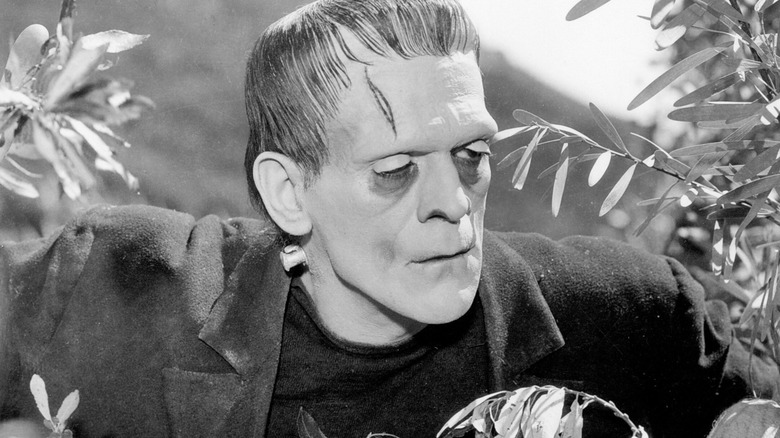
Guillermo del Toro's exemplary "Frankenstein" uses the Creature's (Jacob Elordi) titanic strength for some serious action spectacle. In the film's opening, he storms iceberg-lodged ship the Horisont searching for his creator (Oscar Isaac). Then as the film ends, he pushes the Horisont single-handedly free from its icy prison, a heroic feat that frames the Creature as a Superman-like savior ... or, on his best days, Marvel Comics' the Hulk.
Marvel Comics as we know it began in 1960 when Stan Lee and Jack Kirby introduced the Fantastic Four. Striking gold with a team of superheroes who spent a lot of time squabbling, Lee & Kirby went even more unconventional with their next creation: the Hulk, hated and feared by humans and who hated their weakness in turn. The cover of "Incredible Hulk" #1 asks: "Is he man or monster or... is he both?"
"Frankenstein" poses the same question about the Creature, implicitly, and Marvel's "Incredible Hulk" pays homage to this. In 2003's "Hulk: The Incredible Guide" by Tom DeFalco, Lee wrote in a foreword that he was drawing on James Whale's 1931 "Frankenstein" movie, as well as "The Strange Case of Dr. Jekyll and Mr. Hyde," for the Hulk:
"['Frankenstein'] first gave me the idea of creating a heroic monster, a creature who was basically good at heart but who would be continually hunted and hounded by society. The Incredible Hulk was my own personal homage to 'Frankenstein.'"
Granted, Lee embellished quite a bit about his time as Marvel editor-in-chief. Since Kirby also cited "Frankenstein" as inspiring the Hulk (in an interview with the Comics Journal), though, this particular myth seems to check out. A villain in "Incredible Hulk" issue #1 is even a Russian spy named Igor, à la Bela Lugosi's character in "Son of Frankenstein."
Frankenstein's Creature and the Hulk are both man and monster
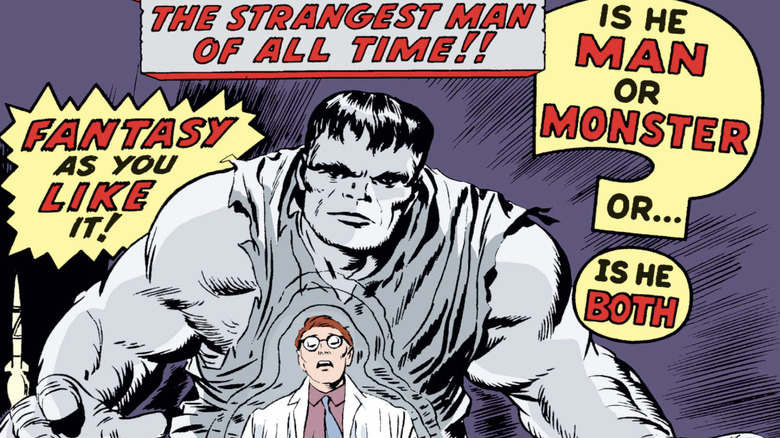
"Frankenstein" and "Jekyll & Hyde" are early science-fiction tales, packed with fears that man's quest for progress may destroy him. The Hulk, created by the power of a "gamma bomb," brought fear from the industrial revolution into the atomic age.
The Jekyll & Hyde influence manifests in the Hulk's duality. Mild-mannered scientist Henry Jekyll/Bruce Banner's Id is unleashed when he transforms into Mr. Hyde/the Hulk. In the original "Jekyll & Hyde" novel by Robert Louis Stevenson, Jekyll says of his physical transformation that: "Evil [...] had left on that body an imprint of deformity and decay." That too is true of the Hulk, who goes from a normal-looking man to a brutish mountain of muscle.
The "ugliness" of the Hulk, though, suggests "Frankenstein" more than Mr. Hyde. Kirby's Hulk illustrations resemble actor Boris Karloff as Frankenstein's Monster: a square head, large brow, cropped black hair, even the same sunken eyes and cheeks as Karloff:
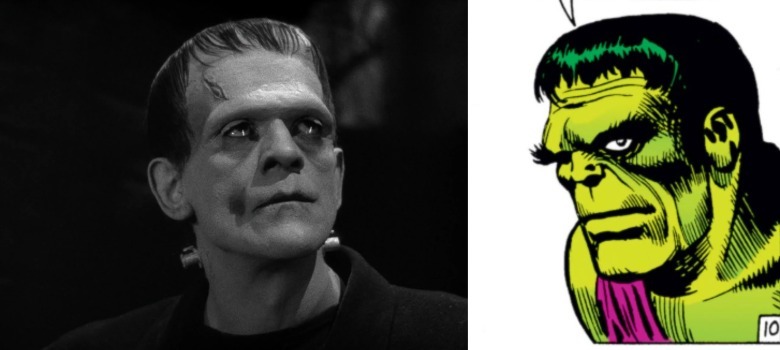 Universal Pictures/Marvel Comics
The Hulk is best known as having green skin, but in "Incredible Hulk" #1, his skin was colored gray. According to Lee, printing errors resulted in inconsistent coloring for the Hulk, so Kirby recolored him green. A similar color mix-up can be seen with Karloff's Monster. While the Creature is often shown with green skin in modern illustrations, the "Frankenstein" movies were filmed in black-and-white. So, audiences saw the Monster rendered in a ghostly gray.
Kirby's colleague and biographer Gregory Theakston speculated that the Hulk's initial gray color was an attempt to echo the eeriness of Universal Horror. Per Marvel Comics Editor Tom Brevoort: "I don't know that there was any deep thought given to the Hulk's color, but that's as good a theory as any."
The Hulk's evolution in Marvel Comics
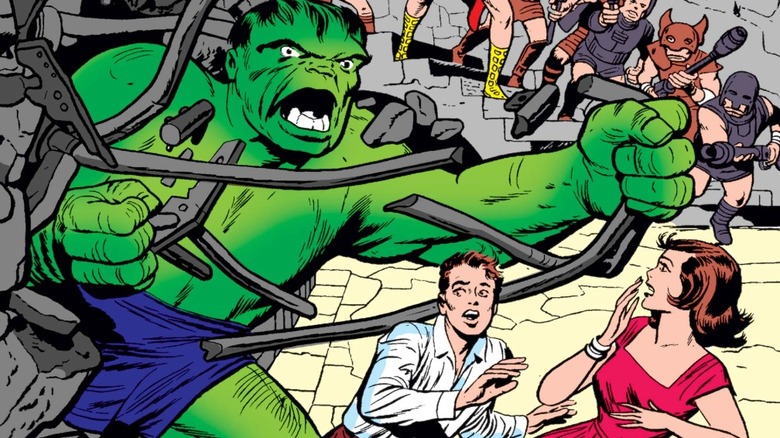
The Hulk's personality shifted alongside his color scheme. Modern interpretations of the Hulk lose Banner's genius brain and talk in broken English. Think his catchphrase: "Hulk smash!" These stories (including Ang Lee's 2003 "Hulk" movie) have defined the Hulk as embodying Banner's repressed trauma of an abusive childhood. Hulk has a child's mercurial temper, but also childlike innocence.
Karloff's Monster growls and roars, but as scary as he looks, he's not malicious per se. He doesn't understand his surroundings and so sometimes destroys them. As Lee wrote in "The Incredible Guide" foreword: "[The Monster] didn't want to hurt anyone until those brainless townspeople kept chasing him with their guns and torches and he finally lashed out in panic and confusion."
Yet, the Hulk's original personality wasn't like Karloff's Monster. In the Lee/Kirby stories, the Hulk could speak in full sentences, and resented humanity for hunting him.
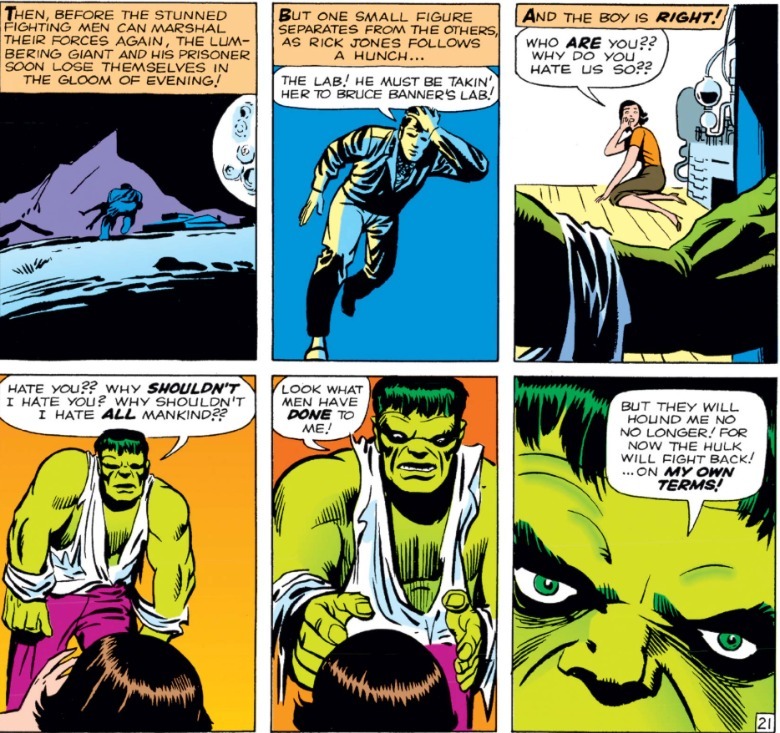 Marvel Comics
In "Incredible Hulk" #2, when Toad Men aliens invade, Hulk ponders using their ship to destroy humanity. This makes the initial Hulk closer to Frankenstein's Monster as first written by Mary Shelley, who speaks like a man but performs vengeance and murder with true ill intent. Karloff's Creature drowns a little girl accidentally, whereas in the novel he strangles Frankenstein's little brother William purposefully. Both the Creature's and the Hulk's intelligence followed a similar path of being dumbed down across iterations.
While Frankenstein's Monster was doomed to loneliness, the Hulk had a friend in teenage runaway Rick Jones, who helped Banner conceal his other self. "The Incredible Hulk" is a story that believes people are ultimately good, while "Frankenstein" condemns all of our worst shared impulses: wrath, pride, and bigotry. These flaws are man's, and any monster made in our image will share them.