

Blade Runner 2099 Revives A Major Element From Philip K. Dick's Original Novel
Any fan of "Blade Runner" knows that the source material for the film, Philip K. Dick's novel "Do Androids Dream of Electric Sheep?," didn't exactly make it to the big screen fully intact. As influential and unique as it is, Dick's work proved too unwieldy for filmmakers to adapt wholesale. Instead, Hollywood took Dick's themes and concepts and heavily rewrote his stories for the screen. That trend began with "Blade Runner," as original screenwriter Hampton Fancher took the neo-noir concept from Dick's trippy, weird 1968 novel of a human hunting down illegal androids and pretty much discarded the rest. The relationship between "Androids" and "Blade Runner" can be succinctly summed up by the fact that Fancher and director Ridley Scott didn't use Dick's title for the film, eventually going so far as to borrow the title from a completely different novel by William S. Burroughs.
To be fair, "Blade Runner" retains a surprising amount of Dick's novel, with whole swathes of dialogue making it all the way from the author's page to the screen. Yet numerous other plot elements and characters were either altered or omitted altogether. One element in "Androids" which is very important to Dick's worldbuilding is the concept of Mercerism, a religion in which devotees share a looping, pre-programmed experience via a virtual reality machine called an empathy box.
This idea didn't make it to "Blade Runner" in any shape or form, however it does appear (and largely intact, too) in this month's "Blade Runner 2099" sequel series. The use of Mercerism in the Prime Video show is a great example of showrunner Silka Luisa and her writers knowing Dick and "Blade Runner" well. In fact, the inclusion of a missing element of Dick's novel in a "Blade Runner" sequel is a bit of a franchise tradition.
Mercerism appears in Blade Runner 2099 in a big way
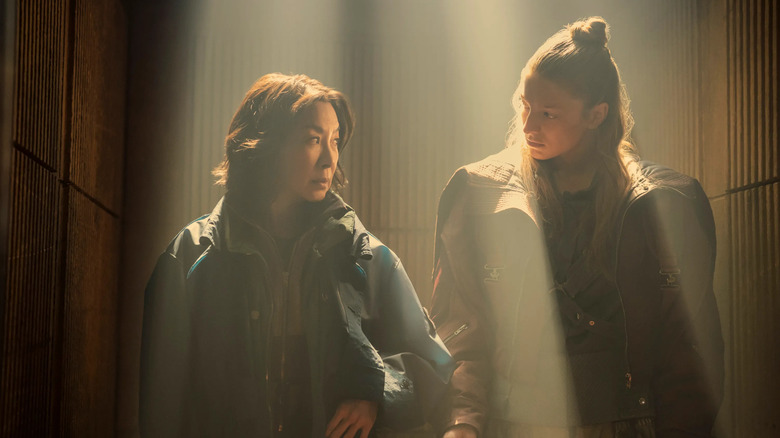
In "Blade Runner 2099," it initially seems that Silka Luisa and company have included Mercerism as a little Easter egg, as a couple of animated billboards in Los Angeles advertise it. Yet this isn't a winking reference to Philip K. Dick's novel, but is instead foreshadowing. In Episode 6, entitled "Kill the Killers," Cora (Hunter Schafer) and Olwen (Michelle Yeoh) travel to a hideaway where Cora and her brother grew up. It turns out this hideaway is a defunct Mercer Monastery, a place where those who worship the man could come to and use an empathy box or interact with automated priest-like programs (shades of George Lucas' "THX 1138" there).
Mercerism, as detailed in Dick's "Androids," is a religion based around the idea of increasing empathy, since the future of the novel has become so dystopian and isolating that people need to be reminded to have empathy for others (sound familiar?). This is done through the empathy box, which allows users to experience a moment from the life of Wilbur Mercer, apparently some kind of martyr. In the box, Mercer endlessly climbs up a hill while being pelted with rocks, and the "empathy" the user experiences is holding onto sensors which deliver increasingly harsher shocks, sometimes resulting in death.
The idea was first introduced by Dick in a short story in 1964 entitled "The Little Black Box," and then re-used in "Androids." The ironic twist in "Androids" is that Mercerism is revealed to be a total sham, with the video loop having been shot on a soundstage with an actor. Though this isn't addressed in "2099," the obvious decline in Mercerites and decay of the monastery implies that the religion isn't as popular as it once was.
Blade Runner 2099 isn't the first sequel to incorporate an element from the novel
Even though Mercerism didn't make it into a previous iteration of "Blade Runner," the themes behind it are so integral to the story of "Do Androids Dream of Electric Sheep?" and its world that its inclusion feels natural. "Blade Runner 2099" smoothly weaves it into its storyline, using it as an allegory for its doomed principal characters as well as its apocalyptic vision of Earth in general. It's used in the show in much the same way Dick uses it in "Androids," as a satiric commentary on how what was initially intended as an aspirational endeavor has devolved into something more pathetic than never believing in it in the first place.
Ironically, Mercerism is not the first element in "Androids" that was left out of "Blade Runner" but made a return appearance in a sequel story to Ridley Scott's film. In "Androids," the character of John R. Isidore (or J.R. Isidore) was reconceived and rewritten as J.F. Sebastian for "Blade Runner," and he was killed during the events of the film. However, when Dick's friend K.W. Jeter wrote the 1995 novel "Blade Runner 2: The Edge of Human," Jeter brought J.R. Isidore back into the story. It's not entirely clear if Jeter intends his Isidore to be the literal same character, or if he's "borrowing" the character in the same manner as Dick borrowed Mercerism from his short story for "Androids." Either way, it established a neat little tradition for the franchise, in which anything or anyone could come back, and perhaps come back different. For a series infamous for characters not ever fully knowing their true identity and heritage, the tradition feels rather poignant.
"Blade Runner 2099" is now streaming on Prime Video.