

Gregory Peck's '50s Dystopian Sci-Fi Flop Is Worth Revisiting
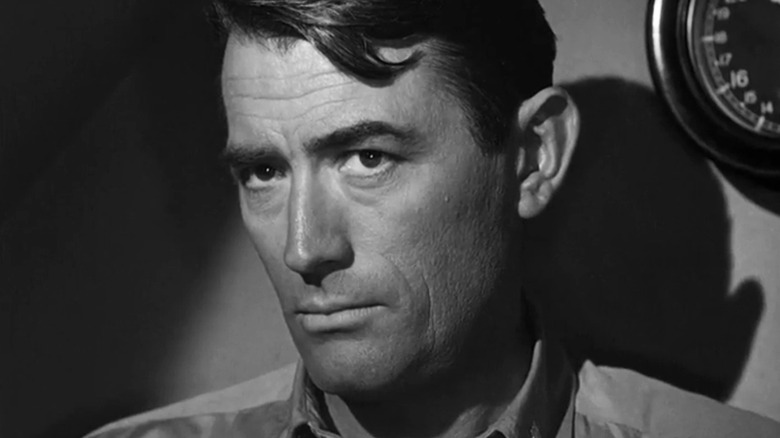
In 1959, Gregory Peck starred in a surprisingly bleak dystopian sci-fi movie about the end of the world. Perhaps unsurprisingly, given its subject matter, "On the Beach" was a box office disappointment, despite the fact it also starred Ava Gardner, Fred Astaire, and a pre-"Psycho" Anthony Perkins. But as Turner Classic Movies notes, "the film struck a chord with the public and for decades remained the definitive dramatic portrayal of the aftermath of a nuclear attack."
Peck made his film debut in 1944's "Days of Glory" and, amazingly, earned an Oscar nomination for his work in John M. Stahl's "The Keys of the Kingdom" that same year. While that film proved to be his breakthrough, it wasn't until the 1950s that he truly ascended to megastardom, becoming one of the biggest leading men in Hollywood. He started the decade by irritating 20th Century Fox chief Darryl F. Zanuck, who wanted Peck to shave his mustache for the 1950 Western "The Gunfighter," before going on to star alongside Audrey Hepburn in the romance classic and one of the best movies of the '50s, "Roman Holiday."
He also appeared alongside Ava Gardner in 1952's "The Snows of Kilimanjaro," before reuniting with her for 1959's "On the Beach." While their prior collaboration had been a romantic adventure outing, "On the Beach" was a decidedly more gloomy affair in which humanity was wiped out almost entirely, while the survivors waited to be killed off by radioactive winds. Not exactly, "Roman Holiday," then. Still, the film has its share of romance and adventure, even if it does end on a fairly dreary note.
Gregory Peck escapes nuclear fallout to fall in love with Ava Gardner in On the Beach
"On the Beach" isn't always cited as one of the best Gregory Peck movies, and is a bit of an underrated entry in his filmography that deserves more attention. For one thing, the film is directed by Stanley Kramer, the legendary filmmaker who also oversaw "The Defiant Ones," "Guess Who's Coming to Dinner," and "It's a Mad, Mad, Mad, Mad World." All of Kramer's movies tackled social issues, and with "On the Beach" the issue was nuclear war. The film arrived in an era in which such a thing was an ever-present threat and like many other filmmakers after him, Kramer wanted to hammer home the absurdity, horror, and tragedy of it all.
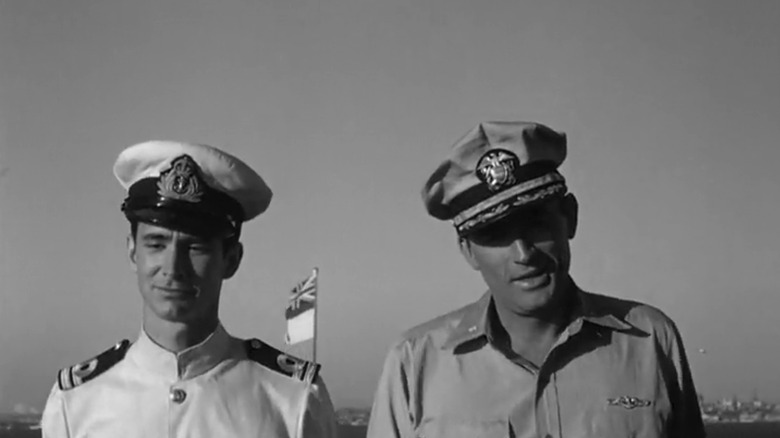
He did so by adapting Nevil Shute's 1957 novel "On the Beach," in which nuclear war erupts, wiping out most of the major nations and leaving clouds of radiation across the northern hemisphere, which begin to drift South towards Australia. Kramer's movie version uses the same premise, though unlike in the book, we never learn who actually dropped the bombs that wiped out life in the Northern hemisphere. Instead, we simply learn that Gregory Peck's Capt. Dwight Towers and the crew of his American nuclear submarine USS Sawfish are arriving in Melbourne to escape the nuclear fallout in their homeland.
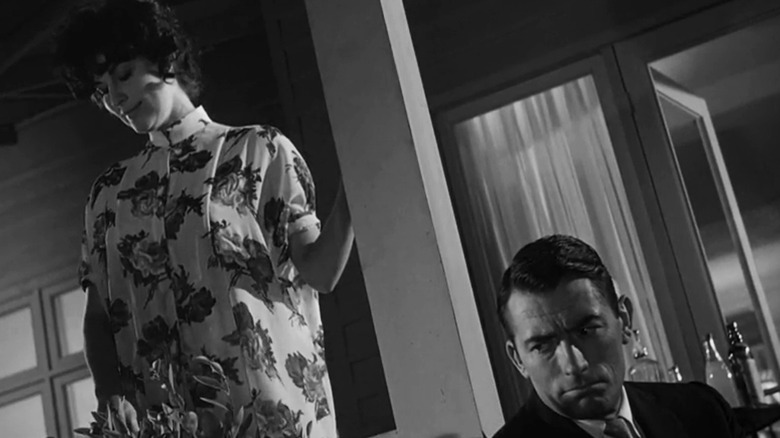
Towers is greeted by Australian naval officer Peter Holmes (Anthony Perkins), who invites him to a party. There, Towers meets regretful nuclear scientist Julian Osborn (Fred Astaire) and Ava Gardner's Moira Davidson, with whom Towers falls in love. Soon, it transpires that the nuclear fallout everyone expected to float down to Australia might not make it that far south, and Towers sets out with his submarine crew to investigate.
On the Beach deserves more recognition today
Without giving away the ending, "On the Beach" doesn't wrap up on all that happy a note. Stanley Kramer remind viewers that there's "still time" via a banner that literally says as much. But it happens to be flapping away in a deserted Melbourne in a way that calls to mind the end of "Oppenheimer," in which the titular scientist ponders how the nuclear destruction of our species is inevitable regardless of how long we stave it off.
That might have something to do with the film's disappointing box office. After all, it couldn't have been a lack of star power. "On the Beach" was also shot on-location in Melbourne and was, as The Sydney Morning Herald noted in 2019, "the biggest film ever made" in the city. Stanley Kramer, meanwhile, was on a roll following the success of 1958's "The Defiant Ones," and "On the Beach" earned positive reviews. It should have been a bigger hit and should definitely be more widely remembered than it is today.
Many films designed to remind audiences of the devastating threat posed by nuclear weapons have come in the wake of "On the Beach." In 1966, the BBC released the horrific mockumentary "The War Game," which was summarily banned by the Government of the United Kingdom for its disturbing depiction of nuclear attack and the ensuing fallout. Then there was 1983's "The Day After" and 1984's "Threads," the apocalyptic TV movie that shook Britain to its core. More recently we've seen movies like "House of Dynamite" provide a realistic look at how a nuclear attack might unfold. But Gregory Peck's 1959 film was one of the first to really deal head-on with the threat of nuclear annihilation and deserves to be remembered for it.