

The Hunger Games: Sunrise On The Reaping's Katniss And Peeta Scene Explained

This article contains discussions of addiction.
Don't go to the old reaping site with your buddies and reminisce if you haven't seen "The Hunger Games: Sunrise on the Reaping." Spoilers ahead!
We've known, for quite some time now, that Jennifer Lawrence's Katniss Everdeen and Josh Hutcherson's Peeta Mellark would return in the highly anticipated big-screen prequel "The Hunger Games: Sunrise on the Reaping." If you've read the book, you know that they come back for an epilogue, and in late October 2026 — just about a month before the film's release — Lawrence opened up about the experience and confirmed that Woody Harrelson, who plays the older version of "Sunrise's" protagonist Haymitch Abernathy in the original Hunger Games films, is also part of the scene. So ... what happens?
There are some differences between the epilogue in the book and the film adaptation helmed by Francis Lawrence, but the gist is the same — and I'll return to those differences later on. After we see how Haymitch wins his games and how the Capitol punishes him for attempting to destroy the 50th Games arena — Haymitch attempts to blow up a water tank and essentially drown the machine, but safeguards stop his plan from going through, and his family and loved ones are killed upon his return to District 12 — we see Harrelson's Haymitch approach an ivy-covered structure that's the old site of the annual reaping that chose one boy and one girl to compete in the deadly Games. He's joined by Katniss and Peeta, who wish him a happy birthday; it's a major plot point in "Sunrise" that reaping day always falls on Haymitch's birthdays. They thank him for everything, and Haymitch says "Nevermore" before departing.
The bond between Haymitch, Katniss, and Peeta is nearly unbreakable throughout The Hunger Games
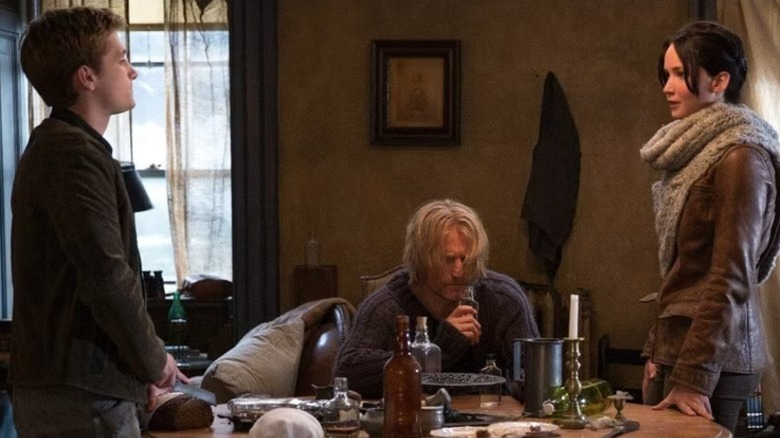
Putting the prequel "The Ballad of Songbirds and Snakes" aside — because none of the characters I'm talking about were alive during that story — it makes complete sense for Katniss and Peeta to show up to close out Haymitch's standalone movie. The three are, for all intents and purposes during the original Hunger Games timeline, a package deal. We see, at the end of "Sunrise on the Reaping," that Haymitch arrives home in District 12 and sees the coffins of his fellow tributes, and we also see a montage of Joseph Zada's younger take on the character overseeing the delivery of coffins that are clearly tributes he was forced to mentor as a former victor.
By the time we get to the 74th Games, Haymitch is constantly drunk and imbibes to survive, telling his tributes his only advice is that they stay alive. When he and Katniss click, though, he starts to wonder if these tributes have what it takes ... and thanks to a plot conceived by him and Peeta that presents Katniss and Peeta as star-crossed lovers forced to compete, they get to jointly win the Games.
That next year, only previous victors can be reaped, and Katniss and Peeta go back in to fight, though Haymitch hatches a plan with other rebels to break them out of the arena. Though Peeta is kidnapped, tortured, and brainwashed by the Capitol, they eventually rescue him and take down the Capitol, ultimately returning to District 12 to live out the rest of their days together.
The on-screen ending between Haymitch, Katniss, and Peeta in Sunrise on the Reaping is more hopeful than in the novel

In "The Hunger Games: Sunrise on the Reaping," this ending for Haymitch, Katniss, and Peeta feels hopeful and optimistic. Suzanne Collins, the author of the franchise, takes a darker approach in the literary epilogues for both "Mockingjay" and "Sunrise on the Reaping." In "Mockingjay," Katniss notes that both she and Peeta have post-traumatic stress disorder and still suffer greatly, experiencing night terrors and other symptoms. In the book version of "Sunrise," Haymitch speaks directly to the reader about how he didn't even want to care about his two tributes initially because he felt too broken, but he was worn down. "I didn't want to let them in, her and Peeta, but the walls of a person's heart are not impregnable, not if they have ever known love," he muses before mourning his one true love, Lenore Dove Baird (Whitney Peak in the film), who was poisoned by Capitol forces when Haymitch initially returned to District 12 as a victor.
Beyond that, Haymitch is blunt about the way that chronic drinking has affected his body. "I'm not sure I'll be here in the old therebefore much longer. My liver's wrecked and I only dry out when the train's late," he says. "I drink differently these days, though, less to forget, more out of habit. When my time comes, it comes, but I've no idea when that will be." Still, Haymitch gets a relatively happy ending with Katniss and Peeta.
"The Hunger Games: Sunrise on the Reaping" is in theaters.
If you or anyone you know needs help with addiction issues, help is available. Visit the Substance Abuse and Mental Health Services Administration website or contact SAMHSA's National Helpline at 1-800-662-HELP (4357).