

Patrick Stewart's Greatest Star Trek Episode Proves Why He Was A Sci-Fi Legend
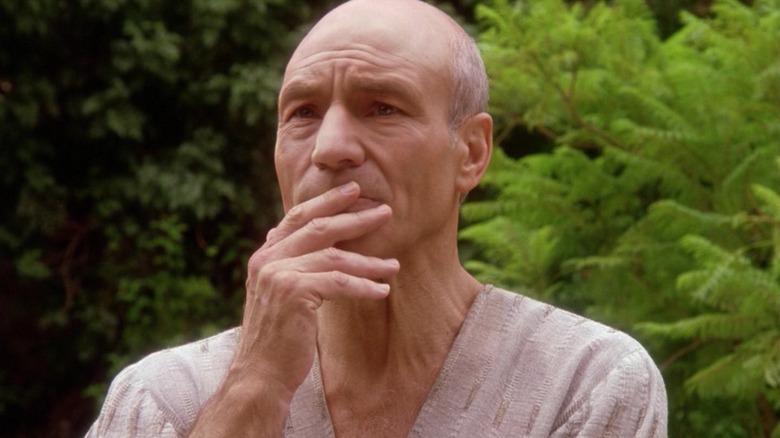
The late, great Patrick Stewart consistently turned in great performances on the hit series "Star Trek: The Next Generation," infusing his character, Captain Jean-Luc Picard, with authority, dignity, and confidence. Stewart played the character like the college professor you are terrified of letting down, as a man with impeccable standards. When Captain Picard broke down, you knew that things had gotten very bad indeed for him. Many might recall Stewart's performances in "NextGen" episodes like "Chain of Command," "The Inner Light," or "Sarek" as notable emotional highlights for the actor, and particularly harsh struggles for his character.
I would say that Stewart's best "NextGen" performance came in the episode "Family," the second episode of the show's fourth season, and the first after "The Best of Both Worlds," the show's most famous episode and, infamously, one that was painful for Stewart.
The action of "Family" takes place shortly after Picard had been assimilated by the Borg. The USS Enterprise is undergoing repairs near Earth, and Picard is going to take some shore leave. He claims that he has healed from the trauma of being mentally and bodily violated by the Borg, saying to Counselor Troi (Marina Sirtis) that his nightmares have stopped and that he's strong again.
Troi knows right away, though, that Picard has not healed all the way. She is also curious as to why Picard has chosen to return to his home village of La Barre, France, when previously he didn't like to go on vacations at all. Stewart is masterly in these early scenes, communicating his denial and lingering trauma with a recognizable human arrogance.
When Picard goes home, we'll see cracks begin to form. The stagey resolve on display at the episode's beginning fades when he faces his estranged brother, Robert (Jeremy Kemp).
Patrick Stewart's best Star Trek: The Next Generation performance came in the episode Family
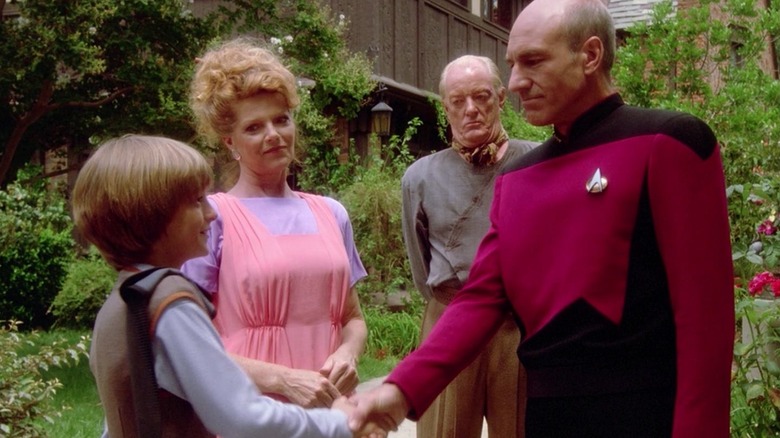
In the first three seasons of "Star Trek: The Next Generation," we saw Captain Picard as a character chock full of resolve. He was a stern but fair managerial figure capable of making good decisions in a flash, but also careful to consider the opinions of his crew. When we see Picard back at his old stamping grounds, all that resolve evaporates. Robert has no respect for Picard's position in Starfleet, feeling that galavanting around space is less important than taking care of the family vineyard. Robert comments that real wine is better than any futuristic replica Picard might be drinking.
"Family" opens up a new panoply of emotions for Picard. We get to see him be defensive, wounded, less than confident. We get to see he and his brother get annoyed with one another. And, we see that Picard, after his experience with the Borg, might even be toying with the idea of retiring from space travel. Picard's friend Louis (Dennis Creaghan) is the supervisor of a deep-sea study called the Atlantis Project, and his bosses have been looking for someone to take over for him soon.
Picard is tempted. He expresses genuine interest. He even gets enthused about the prospect, excited that he can still change careers. Picard, however, is still very clearly in denial, and his enthusiasm for the ocean floors is masking a much deeper fear of the terrors he encountered up in the cosmos. What greater way to avoid the dangers in space than to take a job at the lowest point on the Earth?
Something has to give, and Stewart has been playing Picard's denials and gradual bubbling-up anxieties perfectly.
Picard breaks down in a shattering Star Trek moment
"Family" was an unusual episode of "Star Trek" at the time, as it was one of the very few episodes that was almost wholly character-based and didn't involve many sci-fi concepts at all. After the horrors of "The Best of Both Worlds," the entire series was allowed one episode to take a breather, maybe recover, and really examine the trauma visited upon Picard. We once called it one of the 10 best Picard-based episodes.
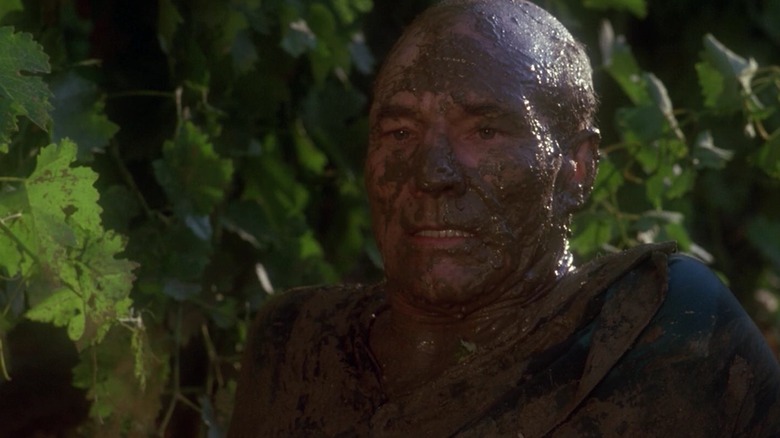
The episode's climax involves a bitter and emotional confrontation between Robert and Jean-Luc. Robert accuses his brother of ego, enjoying his vaunted status as a "heroic" starship captain. Robert feels that Jean-Luc could use a little humility in his life, and mockingly posits that the Borg's trauma might have been just what Jean-Luc needed. In a shocking turn, Picard and Robert begin physically fighting, falling into the mud of the vineyard, wrathfully grappling.
Patrick Stewart's most impressive moment occurs next. Breaking down crying, covered with mud, Picard wails that the Borg, having taken possession of his body, forced him to commit unspeakable acts of violence and murder. He feels guilty, feeling he was not good enough nor strong enough to resist. Robert has never seen Jean-Luc this vulnerable ... and neither have we. Robert notes that Jean-Luc is human after all. The two then bond over a bottle of wine. The episode ends with a sense of bitter relief. There is more healing to be done, but admitting it helps.
"Family" features the deepest we ever went with Picard, seeing just how hurt he was, and how emotionally fragile he could be. The stalwart captain of the USS Enterprise is just as human as we, and still struggles with pain and trauma like the rest of us.
It's Stewart's best "Star Trek" performance. R.I.P.