

TV Legend Ed Asner Appeared In This Classic '60s John Wayne Western
We may receive a commission on purchases made from links.
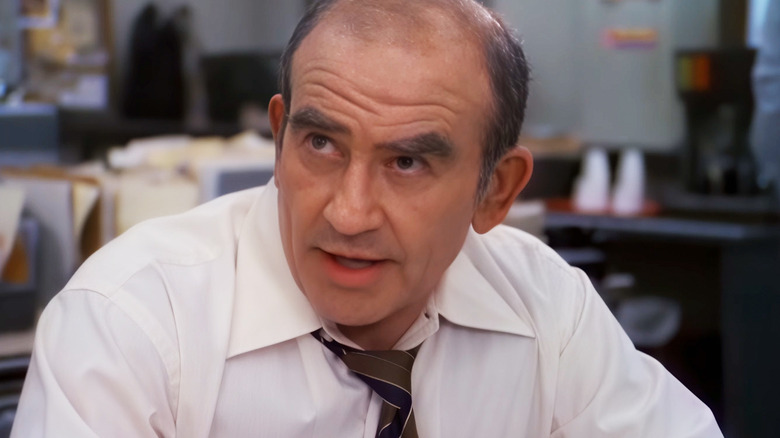
In 1966, John Wayne visited Vietnam and began formulating one of his biggest on-screen blunders, "The Green Berets." Before he could get around to making the one John Wayne film that Roger Ebert called "cruel and dishonest," however, he had another couple Westerns to get through. "El Dorado" was the first. It premiered in the United States in June 1967, exactly one year after Wayne made the rounds in IndoChina. At the time, the Duke was becoming increasingly irrelevant as the Western genre began its shift into the revisionist age. Nonetheless, "El Dorado," which saw Wayne reunited with his frequent directorial collaborator Howard Hawks, became a success. It also remains the only film to feature Wayne and Ed Asner, who at the time was just three years away from debuting in his best-known role as Lou Grant on "The Mary Tyler Moore Show."
Asner began acting in the mid-1950s. He made his TV debut in 1957 on "Studio One" and his film debut in 1962, appearing alongside Elvis Presley in "Kid Galahad." Oddly enough, he didn't appear in a Western film until 1966 when he joined Wayne in "El Dorado," which considering any working actor of the 1960s was bound to wind up in a Western at some point is surprising.
Asner did, however, appear in some classic Western TV shows, guesting on "Outlaws" in 1962 and "The Virginian" the following year. He also appeared in two episodes of "Gunsmoke" and in 1965 joined Robert Horton for a single installment of "A Man Called Shenandoah." When he set foot on the "El Dorado" set, then, while he hadn't yet appeared in a big screen Western, he was well acquainted with Hollywood's vision of the Old West. Now all he had to do was face down John Wayne.
El Dorado was essentially a remake of Rio Bravo
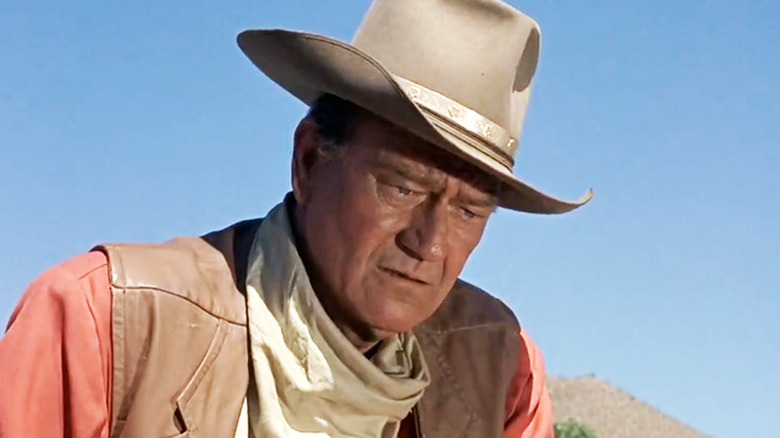
"El Dorado" is directed and produced by Howard Hawks. His frequent collaborator Leigh Brackett wrote the script, which she considered to be her finest work. In Todd McCarthy's "Howard Hawks: The Grey Fox of Hollywood," Brackett is quoted as having said, "I wrote the best script I have ever written and Howard liked it, the studio liked it, Wayne liked it, and I was delighted." Unfortunately for her, Hawks wanted to play things a little safer by essentially remaking "Rio Bravo," the 1959 John Wayne-led Western that launched an unofficial trilogy.
"Rio Bravo" was the result of Hawks and Wayne's hatred for "High Noon," which featured a sheriff too scared to confront the antagonists alone. Hawks and Wayne's retort featured a more muscular hero who had no problem facing evil solo. It proved so successful and seemingly suited Hawks' sensibility so well he essentially remade it twice, once with "El Dorado" and again with 1970's "Rio Lobo" — both of which starred the Duke. The former was a more lighthearted movie, however, with James Caan as John Wayne's sidekick providing much of the comic relief due to his poor aim.
Otherwise, "El Dorado" starred Robert Mitchum, the film noir legend who was also no stranger to the Western, as the alcoholic sheriff of the titular town, J.P. Harrah. His old pal, gunfighter Cole Thornton (Wayne), arrives in El Dorado after being been hired by local tycoon Bart Jason (Ed Asner) to drive the poor MacDonald family off their land so he can claim it for himself. After talking to Harrah, however, Thornton refuses Jason's offer, and things don't exactly go smoothly.
Ed Asner was intimidated to go up against John Wayne in El Dorado
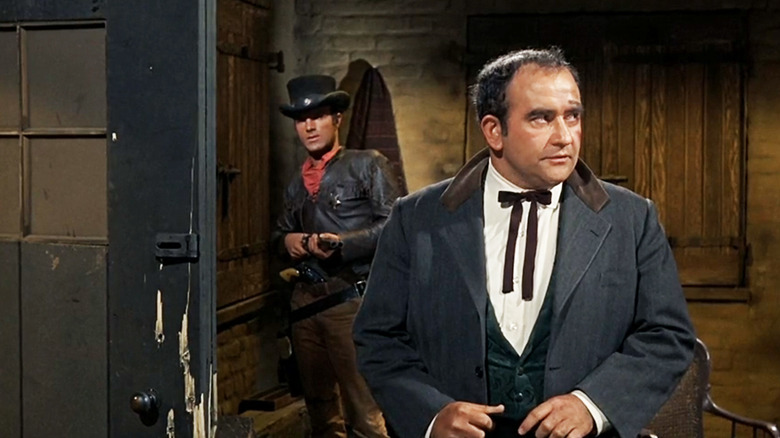
Ed Asner — who passed away in 2021 at the age of 91 — played the villain of "El Dorado." It must have been intimidating for the early-career Asner, then in his mid-30s, to have to square up to John Wayne. "I found myself going into uncharted territory," he told Jake's Takes in 2021. "I regarded myself as a big liberal. I hadn't been proved yet as a liberal, but a big liberal, and here I was going against one of the biggest reactionaries of the times. I didn't know how I'd be treated." According to Asner he was "roasted on the first day" but "passed the roast test" and ultimately found the Duke to be "a nice reasonable fellow."
It probably helped that "El Dorado" was a success. Roger Ebert called it "the most entertaining Western to turn up this year" and according to "Howard Hawks: The Grey Fox of Hollywood," the film did "outstanding business" following its 1966 debut in Japan. It then went on to generate "rentals of $6 million on box office receipts of $12 million," which ultimately made it the 12th biggest picture of 1967. Not bad for Asner's first big screen Western.
Ironically, considering his initial collaboration with Wayne was so amiable, the very series that made Asner a star, "The Mary Tyler Moore Show," came to represent a form of TV entertainment that heralded the end of the TV Western as a result of the "rural purge." Not that Wayne himself was affected, but the more urban-focused TV slate of the 1970s was one major signifier that the world was moving on from the days when Wayne and his fellow Western heroes proudly rode the plains.