

This Controversial (And Underseen) '60s Western Is One Of The Best Movies In The Genre
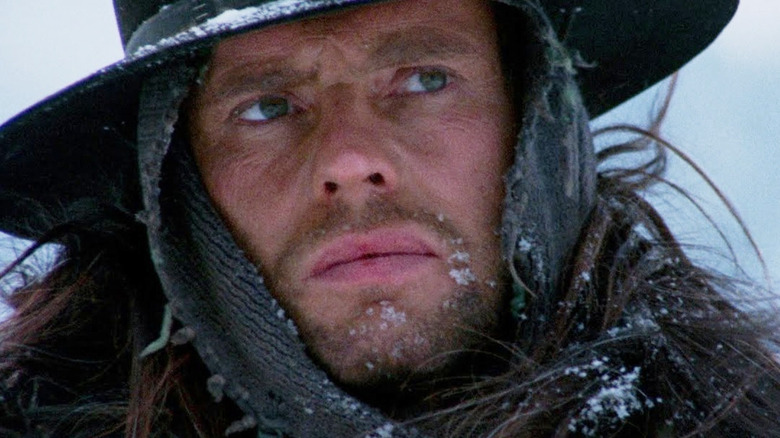
In Western films, actions — especially those carried out with a gun — speak louder than words. That's especially true in 1968's "The Great Silence" ("Il grande silenzio"), helmed by "Django" director Sergio Corbucci. The film's lead gunslinger (Jean-Louis Trintignant) is known only as "Silence" because, due to a childhood injury, he can't speak a word. The man's name carries a double meaning because his quick gunslinging leaves the silence of death whenever he duels. If the title "The Great Silence" seems ominous as well, it should.
"The Great Silence" is a Spaghetti Western, the same category of European-made, U.S.-set Westerns as the Clint Eastwood-led "Dollars" trilogy. Like those three movies, "The Great Silence" is scored by the late legendary Italian composer Ennio Morricone. The usual process for making Spaghetti Westerns is that actors, assembled from across Europe and the U.S., would speak their native tongue on set and be dubbed over later. That resulted in rather low quality English dubs for U.S. releases. ("The Great Silence" has an Italian-language version as well as an English dub.)
Depending on the source, the French Trintignant couldn't speak either English or Italian. That language gap inspired Corbucci to get around later dubbing entirely by having a non-speaking hero.
The textual reason for that silence is appropriately harrowing: Bounty hunters killed Silence's father and then cut his throat so he couldn't talk. In the present, one of those former killers, Henry Pollicut (Luigi Pistilli), is now a judicial officer and hires more bounty hunters — led by the monstrous Loco (Klaus Kinski) — to kill thieves stealing food to survive the harsh winter.
Filmmakers, critics, and academics generally love "The Great Silence," but it's remained underseen for its history. It didn't even come to U.S. theaters until 2018 for a 50th anniversary run.
The black hats win in The Great Silence
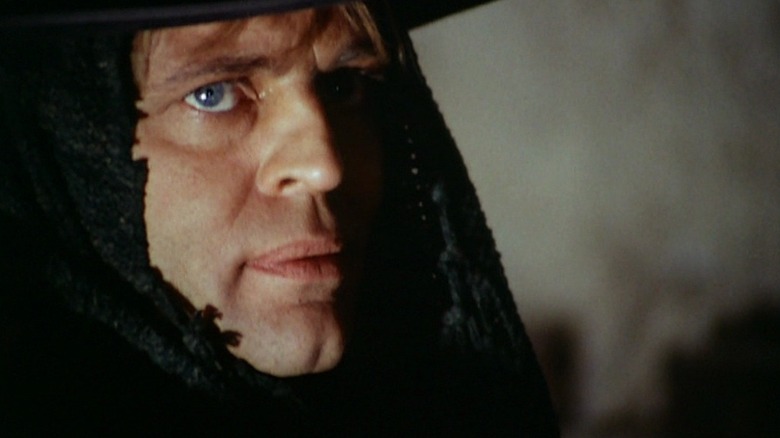
British filmmaker Alex Cox is a superfan of "The Great Silence." While working as host of the BBC film series "Moviedrome" in 1990, he programmed the movie under an alternative, translated title: "The Big Silence.". Cox has called the movie both "the greatest spaghetti Western ever made" as well as "the most pessimistic Western of all time." Those qualities are inseparable.
Let's cut straight to the ending, because "The Great Silence" has one of the bleakest in movie history. (Spoilers, naturally.) The bad guys win, no two ways about it. Loco murders both Silence and his love interest Pauline (Vonetta McGee), who'd hired Silence to avenge Loco's murder of her husband. Loco's bounty hunters massacre the outlaws and ride off victorious. The ending even lingers on Loco taking Silence's signature Mauser C96 pistol as a trophy. Silence's weapon will now be used to kill many other innocents.
Cox claims that Sergio Corbucci, a political leftist, was inspired by his own grief over the then-recent murders of U.S. civil rights leader Malcolm X and Cuban revolutionary Che Guevara. He wanted the film to end in a way reflecting his own grief about the world's unjustness. Leading up to that downer ending, "The Great Silence" subversively reframes the moral conflict of other Spaghetti Westerns. Instead of the wandering bounty hunter as a hero like in Clint Eastwood and Sergio Leone's Western films, bounty hunters are agents of unjust authorities, and the outlaws are just trying to get by.
Corbucci, evidently aware distributors wouldn't all be keen on his preferred ending, filmed two alternate ones. One has Silence outright win, the other is a toned down take on the theatrical version (Loco wins the duel but departs instead of massacring the saloon).
The legacy of The Great Silence
Sergio Corbucci's fears about the ending's reception bore out. 20th Century Fox President Darryl F. Zanuck was reportedly so aghast by "The Great Silence" that he refused to let Fox distribute the film in the U.S. and plans for an English-language remake starring Clint Eastwood didn't pan out. But "The Great Silence" has found its audience in decades since, and while casual movie fans may not recognize its title like they would "The Good, The Bad, and the Ugly," Western experts revere it.
Corbucci is a favorite filmmaker of Quentin Tarantino, who of course titled his 2012 revisionist Western "Django Unchained" after Corbucci's "Django." Tarantino also pulls from "The Great Silence" for "Django Unchained," specifically for a handful of scenes set around snowy mountains. That environmental setting is a key part of "The Great Silence" and what makes it stand out within its genre.
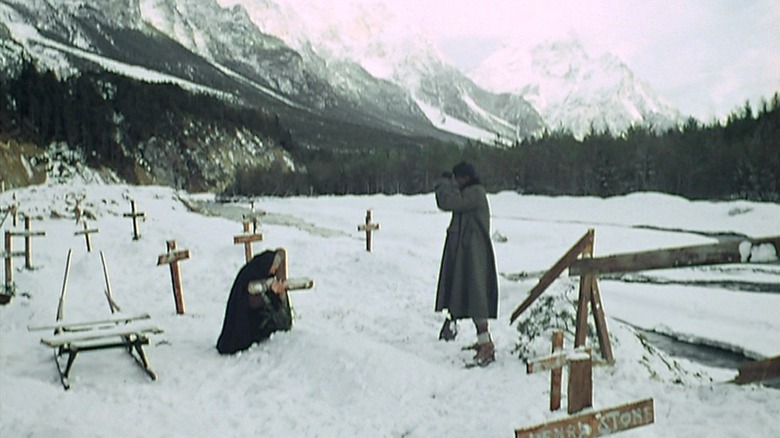
Most Westerns are set in dry plains with the sun blaring down on the leads. Think of all the John Ford-directed, John Wayne-starring Westerns set in the arid Monument Valley. "The Great Silence" — set in Utah during 1898 but filmed near Italy's Dolomite mountain range — takes place in the depths of a blizzard. It's a cold world, literally and spiritually, in "The Great Silence."
The wintery setting was an even stronger influence on Tarantino's next Western, "The Hateful Eight," which is all about a frontier lodge full of, well, hateful people trapped together during a blizzard. "The Hateful Eight" cinematographer Robert Richardson, speaking to Variety in 2015, said that Tarantino "turned [him] on to ['The Great Silence'], and I love the cinematic nature of that, in the snow." Silence's legend ended at Loco's hands, but that brutal ending is what ensured people who saw "The Great Silence" never forgot it.