

5 Best Sci-Fi Movies Where The Hero Dies
Needless to say, this article will be full of spoilers.
There are many things the "Star Trek" and "Star Wars" franchises have in common, not the least of which is hope. The former is set in a utopian future wherein human prejudice, capitalism, and war have all been dispensed with in favor of a society built on diplomacy, peace, and sharing. Similarly, all "Star Wars" stories posit that fascism is an impermanent state that's constantly being batted back down by the forces of good, no matter how often it tries to reassert itself. Heck, the first "Star Wars" movie was subtitled "A New Hope," showing the cycle at work.
But for every "Star Trek" and "Star Wars" film, there are lots of other science fiction movies that end on notes of sacrifice, death, or despair. In our darker moods, we humans often don't feel very good about the future, and that hopelessness can be reflected in our sci-fi tales. For every utopia, there is a dystopia. For every instance of humankind uniting to save their planet, there is a tale of humanity failing to stop its own self-destruction.
Indeed, the following five sci-fi movies feature protagonists who die. Some of the deaths are tragically noble. Others, however, are wasteful and harrowing, providing lessons for audiences about the dangers of various sins. All of them leave viewers in a poignant state, though, so let's look into the shadows of what is to come.
Beneath the Planet of the Apes (1970)
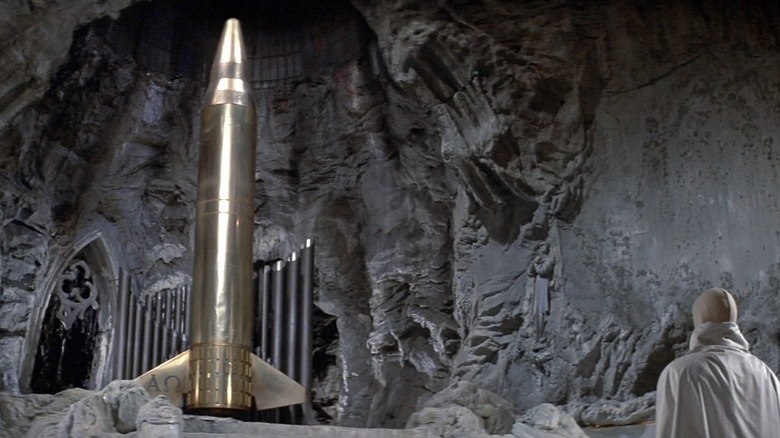
Ted Post's "Beneath the Planet of the Apes" was the first follow-up to Franklin J. Schaffner's 1968 classic "Planet of the Apes." If the original film is an on-the-nose satire of human interaction (transposing apes and humans in the planetary pecking order), then "Beneath" just pushes things into more obvious territory. The movie stars James Franciscus as Brent, a human astronaut who, as part of a rescue mission, somehow ends up on the same distant-future Earth that Taylor (Charlton Heston) did in "Planet of the Apes." Once there, Brent discovers that the apes are gearing up to take over the Forbidden Zone under the command of the gorilla Ursus (James Gregory), which Dr. Zaius (Maurice Evans) objects to.
In "Planet of the Apes," all the humans of the future appear to be mute and feral. Its sequel, on the other hand, reveals there is a subterranean enclave of surviving, ghoul-like humans who've developed psychic powers. The human psychics also worship an unexploded nuclear bomb, admiring its power. Taylor and Brent eventually meet up, but Taylor is naturally terrified when he sees the bomb's Alpha Omega markings, knowing that this particular bomb is capable of, just by itself, ending all life on the planet.
As it so happens, this is Chekhov's doomsday bomb. Once the bomb is introduced, we know that "Beneath the Planet of the Apes" can't possibly end well. Sure enough, when Taylor is mortally wounded at the end of the film, he curses and collapses on the bomb's detonation switch. In this case, the hero dies, along with everyone else on Earth. It's one of the bleakest endings in sci-fi history.
Silent Running (1972)
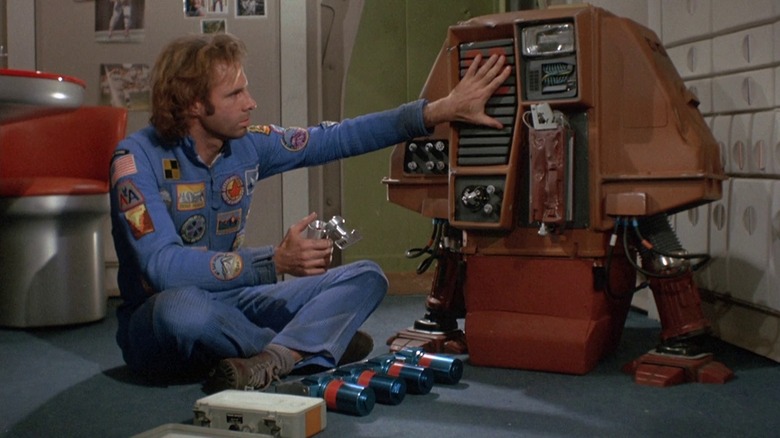
Douglas Trumbull's 1972 film "Silent Running" is so good that it made /Film's Jeremy Smith a lifelong sci-fi fan. More specifically, it's something of a dystopian movie and shows what happens when an idealist with principles butts heads with an uncaring, commercialized future that doesn't care about the calm, complexity, and beauty of the natural world. Everyone ought to watch this one, especially if you liked "Project Hail Mary" (and I know you did).
In the dystopian future of "Silent Running," humans have ruined Earth to the point of killing all its forests. Specimens of many planet species have been kept alive on spacebound repositories, which exist in giant greenhouse-like geodesic domes. Bruce Dern plays Freeman Lowell, a botanist who has been tasked with looking after the samples on a ship called the Valley Forge. The Valley Forge is owned by American Airlines.
When the ship is ordered to jettison its plants and head back to Earth (as it's needed for commercial purposes), Freeman turns on his corporate bosses and proves that he's willing to kill his human crew mates to protect the forest domes. Shockingly, he actually manages to escape with one of the domes, although he loses others in the process. By the end of the movie, Freeman even makes the ultimate sacrifice to keep the forest protected.
Of course, "Silent Running" is a commentary on modern-day environmentalism and how horrible commercialism always seems to outweigh the needs of our planet. Is "Silent Running" preachy? Yes. Is it tragic and great? Also yes.
They Live (1988)
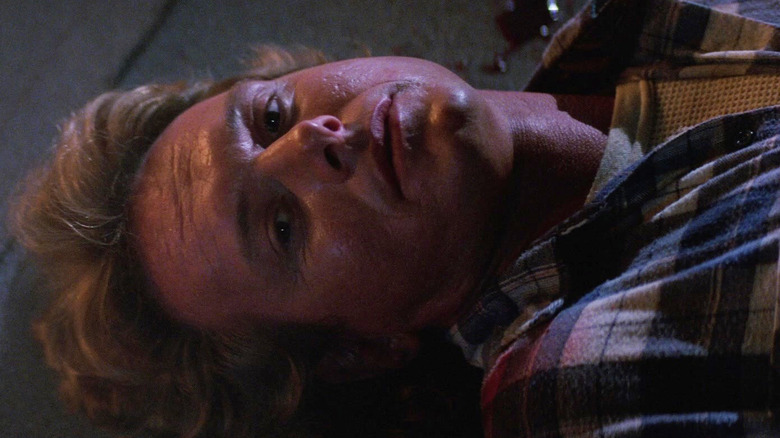
John Carpenter's 1988 film "They Live" stands as a vital criticism of the United States under Ronald Reagan. In the film, the nameless protagonist, "Nada" (Roddy Piper), finds a pair of alien-constructed sunglasses that allow him to see through all the secret alien disguises on Earth. Certain citizens are revealed to be creepy aliens in disguise, but more so, billboards, magazines, and advertisements are shown to be masking subliminal messages that make human consumers more complacent by ordering them to "OBEY," "STAY ASLEEP," or "CONSUME."
Nada is hardly the best person to make this alien discovery. He's a blue-collar drifter without the means to handle this weird revelation, and when he tries to tell someone else about it, they end up fighting for a really, really, really long time. That's not a joke, either, as Piper and his co-star Keith David beat the hell out of each other for what feels like 20 minutes.
Luckily, Nada has connections within the local shanty town. There, he learns the aliens have been mingling with Earth's wealthy and using brain-scrambling signals to keep the impoverished docile. "They Live" then ends with a raid on the alien compound with Nada, David's Frank Armitage, and a few others trying to shut down the alien signal once and for all.
Although a sci-fi movie, it's easy to believe that "They Live" might very well be a documentary. The ultra-wealthy, we seem to inherently understand, are deliberately controlling us through media and money. It felt true in 1988, and it definitely feels true now. Nada ends up taking care of business, but not before being mortally wounded. In the film's most inspiring scene, his final act on this planet is to flip the middle finger to the aliens, spitting his last breath at them.
Melancholia (2011)
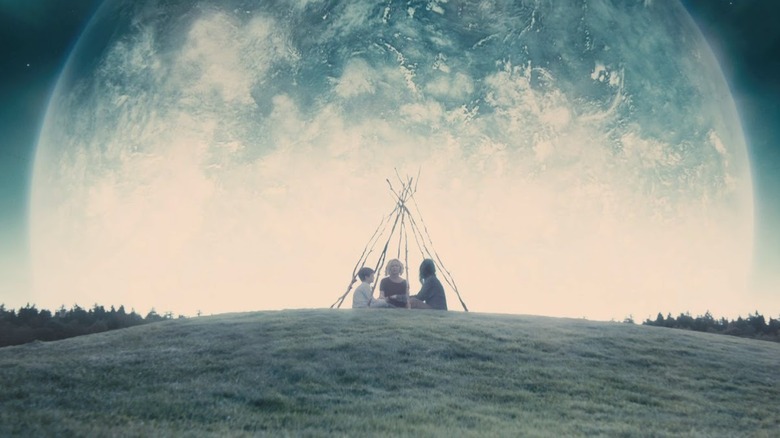
In 2011, Lars von Trier released the second entry in what might be considered his "Depression Trilogy," a series of movies that began with 2009's "Antichrist" and ended with 2013's "Nymphomaniac." The second film, "Melancholia," is just as much a metaphor for depression as it is a sci-fi apocalypse flick. "Melancholia" takes place in a world where a rogue planet, known as Melancholia, is going to slingshot around Earth before looping back in space and colliding with it, ending all life. The gravitational loops are a little dance of death, a preview of the apocalypse.
With this impending doom looming in the background, the movie centers on Justine (Kirsren Dunst), a newly-married woman who finds herself sliding back into the depression she has long fought off. When she learns that all life on Earth will end, Justine finds herself grimly pleased. She asserts that all life on Earth is evil, there is no other life in the universe, and that human extinction would be a blessing. Death cannot be stopped, and its coming is a release. Meanwhile, eerie things start to happen as Melancholia approaches. Electricity begins behaving weirdly. Certain characters flee, but where should they go? Justine doesn't panic. She's apathetic.
In the end, no one in the film lives. "Melancholia" is a beautiful, harrowing, and shockingly accurate portrait of a depressed mind. Justine has simply stopped caring about anything because it feels like there is no escape. Because, in the mind of Lars von Trier, there isn't.
You already know if "Melancholia" is your kind of movie. Just be sure to follow it with something more optimistic, like "Apocalypse Now."
The Substance (2024)

Coralie Fargeat's 2024 horror hit "The Substance" is hardly subtle. Demi Moore stars as Elisabeth Sparkle, a celebrated actor who's recently made her living by hosting a TV workout program. Her disgusting boss (Dennis Quaid) fires her early in the film, all but saying out loud that she's too old to be a heartthrob anymore. From there, Elisabeth is put in contact with a shadowy pharmaceutical company that mails her doses of "The Substance," which promises to make her young again ... in a sense.
Sure enough, when Elisabeth injects herself with The Substance, she passes out, her back splits open like a cocoon, and a younger woman (Margaret Qualley) crawls out. These two women are the same person, but the younger one decides to take the name Sue. According to the rules of The Substance, Elisabeth and Sue have to take turns being conscious, one week each, with Sue feeding off Elisabeth's spinal fluids. Naturally, though, "Sue" doesn't want to go back to being the "old" Elisabeth she resents, and the consequences of what happens when the rules of The Substance are broken are quickly made horrifically clear.
By the end of the movie, Elisabeth has become a literal puddle of dead puffy flesh on the Hollywood Walk of Fame. "The Substance" is openly about the callowness of Hollywood and its dogged tendency to cast aside women "of a certain age" in favor of youthful ingénues. It should be recalled that Moore was nominated for an Oscar for Best Actress for "The Substance" but lost to a youthful ingénue, Mikey Madison. The message of "The Substance" played out in real life. How darkly poetic.