

The Sci-Fi Movie Every Project Hail Mary Fan Needs To See
Phil Lord's and Christopher Miller's 2026 sci-fi film "Project Hail Mary," based on the novel by Andy Weir, is one of the best films of the year, exemplifying the sci-fi genre in ways that are too rarely explored in modern cinema. Like Ridley Scott's 2015 film "The Martian," also based on a Weir novel, "Project Hail Mary" is about the power of intelligence and the importance of remaining learned in the ways of science. Both films also explore the power of good humor, as the beleaguered protagonists manage to survive by keeping their morale up with jokes and flippant attitudes.
The good humor is needed because in both cases, the protagonists are in dire straits. In "Project Hail Mary," Dr. Ryland Grace (Ryan Gosling) is on a mission to study a distant star to figure out why it's not being extinguished like Earth's sun. In "The Martian," Dr. Mark Watney (Matt Damon) is stranded on the surface of Mars for several years, and has to find ways to produce food and air to survive. Space missions, Andy Weir is sure to tell us, are complex, dangerous, and hardly guaranteed to work.
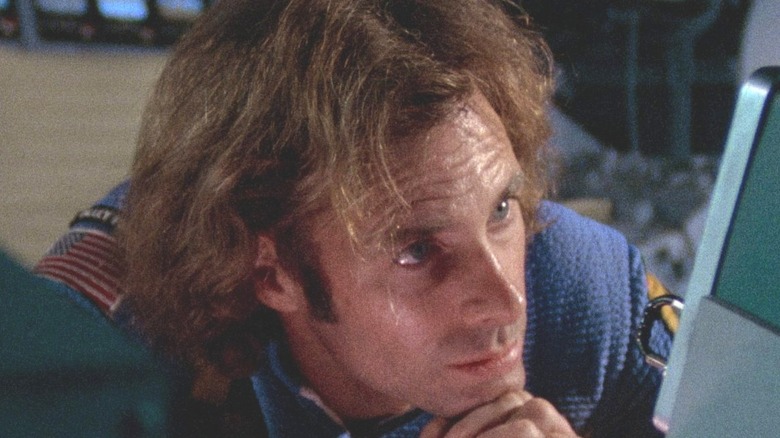
If dire space missions are your bag, then allow me to recommend Douglas Trumbull's 1972 film "Silent Running," a film that is more melancholic in its attitude, but equally desperate in its mission. Bruce Dern plays Freeman Lowell, one of four astronauts on board the space ship Valley Forge. Like Damon's character, Lowell is a botanist, and it's his job to look after the various verdant artificial biomes on the Valley Forge while Earthlings below figure out their environmental crisis that nearly led to the plants' death.
The film doesn't end very happily.
Silent Running is a bleak story about environmental distaster
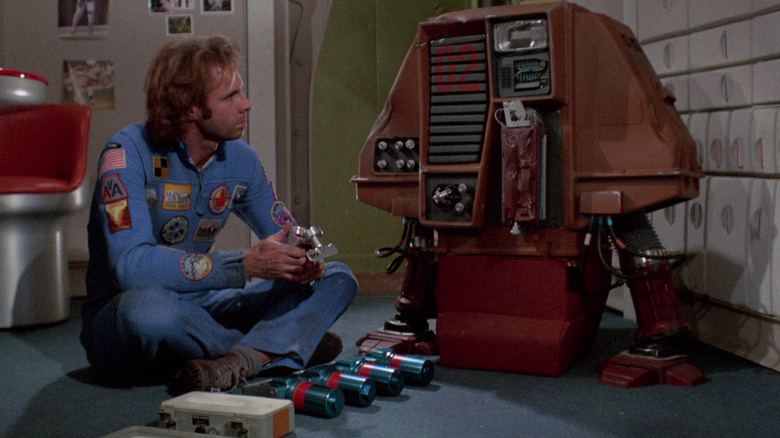
"Silent Running" takes place in the distant future after all of Earth's forests have been wiped out by casual human pollution and clear-cutting. The last few remnants of plant life were loaded onto the starship Valley Forge and launched into space, tended to by Lowell, the compassionate botanist. The plants remain alive in dome-shaped greenhouses that are attached to massive cargo supply cores. Only four astronauts look after the Valley Forge (the other crewmates are played by Ron Rifkin, Cliff Potts, and Jesse Vint), and it's sponsored by American Airlines, so the specter of corporate capriciousness hangs over the entire mission. The ship remains safely out of harm's way, orbiting Saturn.
Lowell is something of a misanthrope, caring more about plants and animals than his crewmates. Indeed, he butts heads with them often, as he wants to take his job seriously, and they don't much give a damn about plants and animals. Lowell spends more time talking to the ship's non-humanoid service robots (played in robot suits by Mark Persons, Cheryl Sparks, Steven Brown, and Larry Whisenhunt).
As one might predict, the Valley Forge's mission is eventually canceled. The astronauts are ordered to jettison all of the biomes and blow them up with nukes before returning home. Lowell's crewmates are happy to do so, as they miss Earth. Lowell is the only one mortified by the deliberate destruction of beautiful life. Lowell is the compassionate hippie who believes in the beauty of biodiversity. As we will soon learn, Lowell is willing to fight and even kill his brash crewmates in order to protect the biodomes. It's a dark look at modern environmentalism. Some may call "Silent Running" preachy, but it's not incorrect.
Silent Running is a bleak treatise on modern environmentalism
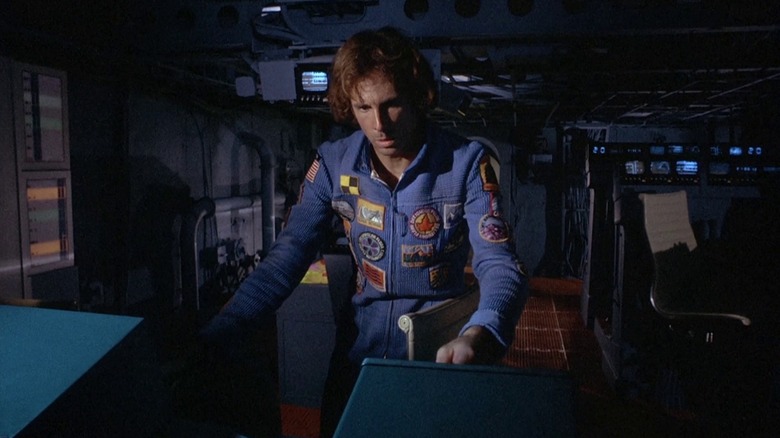
"Silent Running" ends on a note of hope, but also despair. There is a sense that life will go on, but it's not without some sacrifices. It's one of the great bittersweet endings in sci-fi cinema. The real tragedy, of course, is that most of humanity doesn't seem to care whether the environment survives. We can look out our windows over 50 years later, and see that the warnings of "Silent Running" are just as salient as ever ... as is our human incapacity for real action to protect our own world.
"Silent Running" was released before "Star Wars" caused ripples throughout popular culture, so exhilarating, action-forward sci-fi wasn't common at the time. Downbeat dramas about the failure of society and the cracks in the human condition were de rigueur, however, and "Silent Running" falls right into the middle of that. The late Douglas Trumbull, and many may know, was a VFX wizard who worked on some of the most influential sci-fi movies of all time. He helped improve the "Jupiter and Beyond the Infinite" sequence from "2001: A Space Odyssey." He created the viral images in Robert Wise's "The Andromeda Strain." He shot the effects sequences on Steven Spielberg's "Close Encounters of the Third Kind." He re-teamed with Robert Wise to create some of the more impressive V'Ger sequences in "Star Trek: The Motion Picture." He even worked on Terrence Malick's "The Tree of Life."
"Silent Running" is visually impressive, but it's powerful because of its cynicism. It may not be as lighthearted as something like "Project Hail Mary," but it deals with a very human crisis in a semi-realistic fashion.