

This '70s Phenomenon Led To The Cancellation Of Several Promising Western Shows
We may receive a commission on purchases made from links.
When "Gunsmoke" was abruptly canceled after a 20-year run in 1975, it was already somewhat of an anachronism. When the legendary Western series emerged in 1955, the small screen oater was entering a golden age built upon the success of shows such as the late-'40s TV Western featuring now forgotten actor William Boyd, "Hopalong Cassidy." By the mid-'70s, however, the TV landscape was almost unrecognizable. Much of that was due to a phenomenon known as the "rural purge" which saw networks pivoting away from rural-focused shows to deliver urban-based, socially aware entertainment. Viewed from that perspective, it was amazing "Gunsmoke" held on as long as it did. But that wasn't the only Western felled by the rise of urban-focused TV.
By the end of the 1960s the Western genre was already undergoing a major evolution. Gone were the days of John Wayne's simplistic Western heroes. In 1969, films such as Sam Peckinpah's "The Wild Bunch" and Sergio Leone's "Once Upon a Time in the West" were heralding the arrival of the revisionist era, and over the next decade Western films would present a much more irreverent and morally complex vision of the American West.
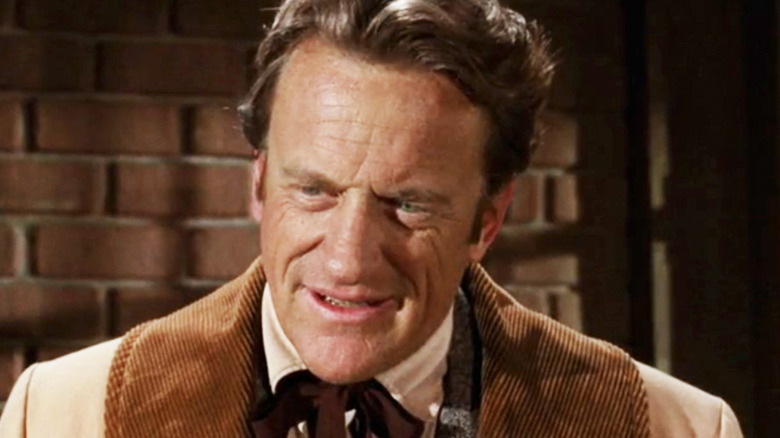
Meanwhile, TV was undergoing its own revolution. In 1970, there were still several Western series on the air. "Gunsmoke" was one example, but there was also the similarly long-running "Bonanza," as well as James Drury's "The Virginian" and "Death Valley Days." By the mid 1970s, however, they would all be canceled due to a series of factors entirely out of their control.
1971 was the year networks canceled anything with a tree
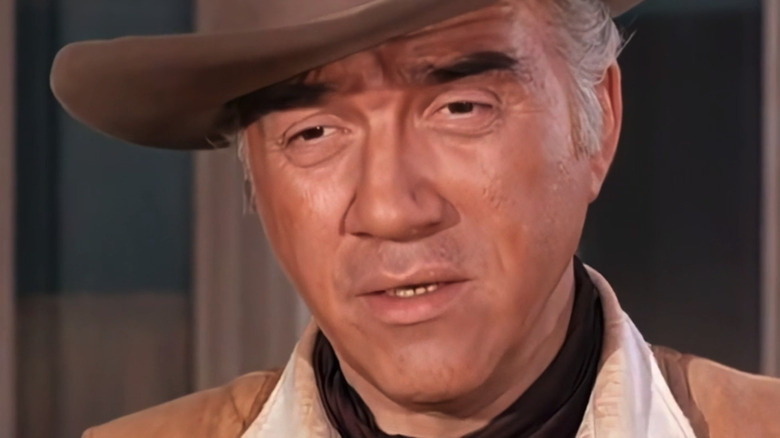
Leif Erickson's underrated Western series "The High Chaparral" began airing in 1967. Hailing from "Bonanza" creator David Dortort, the show was a hit but lasted nowhere near as long as "Bonanza," wrapping up in March 1971. It was far from the only TV show to get the axe that year.
As Pat Buttram of "Green Acres" famously put it, 1971 was "the year CBS canceled everything with a tree." The network had become well-known for capitalizing on the popularity of rural comedies throughout the 1960s, debuting such beloved shows as "The Beverly Hillbillies," "The Andy Griffith Show," "Petticoat Junction," "Hee-Haw," and Buttram's "Green Acres." CBS wasn't the only network to jump on the trend, either. It started with ABC's "The Real McCoys" which began airing in 1957 and functioned as an almost prototypical "Beverly Hillbillies," focusing on an Appalachian family who moves to the San Fernando Valley. By the end of the 1960s, however, all these shows were put on the chopping block. What happened? Well, the predilections of one CBS executive seem to be a big part of it.
Sara K. Eskridge, author of "Rube Tube: CBS and Rural Comedy in the Sixties" spoke to Woman's World about how much of the rural purge can be traced back to CBS programming chief Fred Silverman, who arrived in the late 1960s and started cleaning house. "He was looking at the data, which was not really something that had been done to any real extent before this," she explained. "He realizes only old people watch those [rural comedy-type] shows. They'd been on the air for more than 10 years, starting to lose favor with the younger crowd, so he cancels them."
Westerns were lumped into the rural purge
Sara K. Eskridge noted to Woman's World how Fred Silverman seemed to have a personal animus toward rural shows, which he'd previously expressed in his masters thesis. When he came to cancel those series en masse, then, many of them were still garnering significant ratings. "These are shows that were in the top 10, most of them in the top 20 when they were canceled," Eskridge said. As far as Silverman was concerned, however, they brought in a "lower class of viewers" and had to go.
Silverman's approach caught on. Suddenly networks were cancelling everything "with a tree in it," to use Pat Buttram's phrase. The mass cull came to a head at the end of the 1970–71 television season, where rural series were suddenly replaced by a new raft shows epitomized by the likes of "All in the Family" and "The Mary Tyler Moore Show." Meanwhile, Westerns found themselves lumped in with the "rural" series, and suddenly "The Virginian," which had only just welcomed Lee Majors as a new addition to its cast, and "The High Chaparral" were gone. "Bonanza" lasted until 1973, before James Arness' Marshall Matt Dillon was told to hand in his badge in 1975 when "Gunsmoke" was canceled.
But TV Westerns didn't die altogether. The same year James Drury and Leif Erickson were told to pack it up, ABC greenlit "Alias Jones and Smith," a show about two outlaw cousins trying to live on the straight and narrow. "Little House on the Prairie" arrived in 1974, and "Maverick" star James Garner began fronting an offbeat Western about a pacifist sheriff in "Nichols." Otherwise, however, TV had purged rural entertainment from the airwaves, and the cowboys were, for the first time since the 1950s, well and truly outnumbered.