

Why Cillian Murphy Didn't Wear A Full Scarecrow Costume In Christopher Nolan's Dark Knight Trilogy
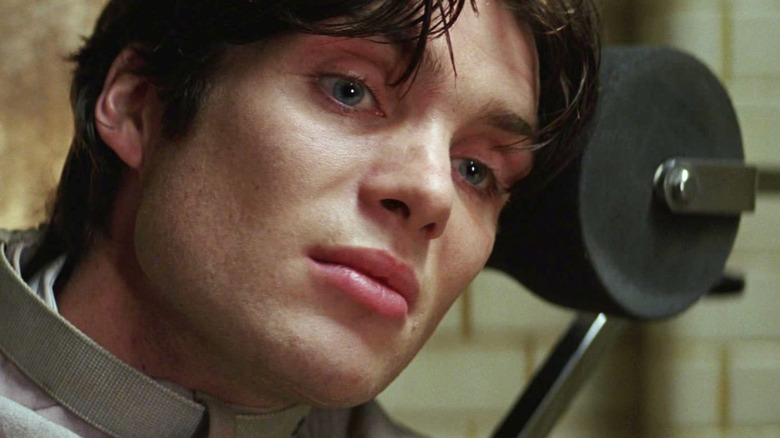
When Christopher Nolan directed "Batman Begins," he made the then-innovative choice to approach Batman with a lens of realism, both tactilely — explaining where Batman gets his gadgets and their individual purposes — and psychologically. This was a good mindset for an origin movie, and both "Batman Begins" and its sequels delivered an understanding of who Bruce Wayne (Christian Bale) is that previous live-action "Batman" films hadn't. But Batman isn't the only colorful character in Gotham City.
Look at the villains of "Batman Begins," and you can see Nolan pulling back on the fantasy. In "Batman" comics, Ra's al Ghul is a 700-year old warlord who keeps himself alive and vigorous with a literal fountain of youth (the Lazarus Pit). Obviously, that all got thrown out for Nolan's Ra's, with the film instead showing that Ra's (Liam Neeson) portrays himself as "immortal" with a series of decoys. The Scarecrow is slightly less fantastical, but Dr. Jonathan Crane is still a man who dresses up like a scarecrow and employs a "fear toxin" that induces not simple panic but cinematic (and often symbolic) hallucinations of terror.
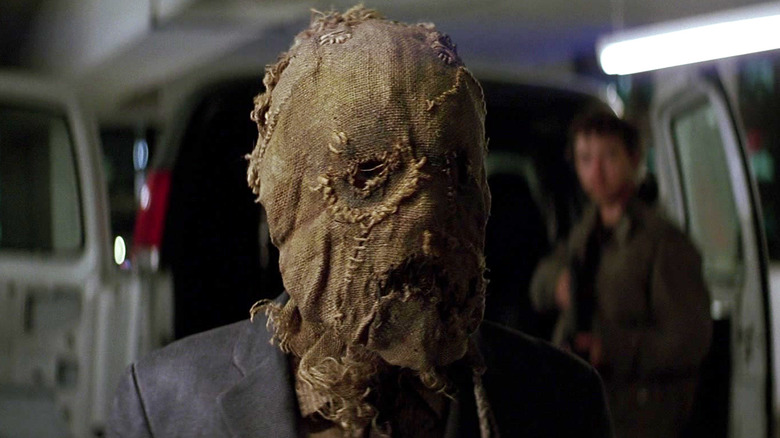
Crane in "Batman Begins" (Cillian Murphy) uses a fear toxin and wears a scarecrow's mask. But the mask is the extent of his costume. Scarecrow otherwise sticks to a blue business suit, creating a surreal combination with his mask. According to "Dark Knight" trilogy co-writer David S. Goyer (the Batman fanboy on the team), Nolan had to be convinced to even give Scarecrow the mask.
In "The Art and Making of The Dark Knight Trilogy" by Jody Duncan Jesser and Janine Pourroy, Goyer recounted that Nolan asked him if Scarecrow absolutely had to wear the mask. When Goyer insisted that, yes, he did, Nolan in turn insisted they find a practical reason for him to wear it.
Scarecrow's mask in Batman Begins offers function behind form
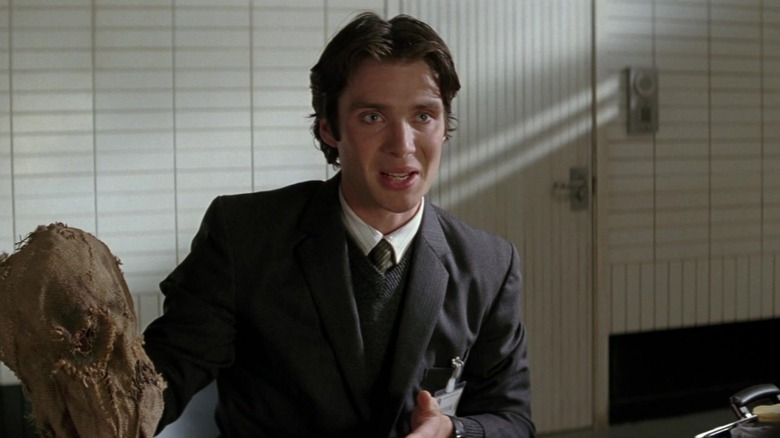
"The Art and Making of The Dark Knight Trilogy" adds that the Scarecrow's mask went through a rigorous creative process, including 20 mock-ups. The final version is a misshapen burlap sack, with sunken eyes and stitching giving the impression of facial scars. The mask also includes a severed noose that hangs around Crane's neck, borrowing from Scarecrow's undead-seeming look in the cartoon "The New Batman Adventures."
The first time we see Crane wear the Scarecrow mask in "Batman Begins" is an instructive one, demonstrating the "verisimilitude" that Christopher Nolan wanted. Mob boss Carmine Falcone (Tom Wilkinson), captured by Batman, fakes a psychotic break to get a meeting with Crane, the head of Arkham Asylum. When Falcone tries to bully Crane into obedience, the doctor rolls out the question: "Would you like to see my mask?"
Crane specifically notes the mask is part of his experiments, i.e. dosing Arkham Asylum patients with fear toxin and seeing their responses. "These crazies, they can't stand [the mask]," Crane boasts. One dose of fear toxin later, neither can a screaming-for-his-life Falcone. There's practical and theatrical reasons that Crane wears it. On the former, it's a gas mask, keeping Crane from inhaling his own toxin. But why not use a standard gas mask then? Because he's trying to terrify people. Having a burlap-skinned, jack-o'-lantern-faced monster screaming in your face when you've already been drugged with a poison to scare you out of your mind? Yeah, that'll do it.
Note, too, that Crane does this in response to Falcone bragging he's untouchable. Therein lies a thesis statement of escalation, as Jim Gordon (Gary Oldman) muses to Batman at the end of the movie. The mob is nothing compared to the new super-villains arriving in Gotham City.
Scarecrow shows the limits of Christopher Nolan's realistic Batman
That closing conversation in "Batman Begins" famously foreshadows the Joker as Batman's rising equal and opposite. Like Scarecrow riding a horse through the streets of Gotham City in the film's climax, this notion is taken from Jeph Loeb and Tim Sale's 1996 comic "Batman: The Long Halloween."
That book is a bridge. It shows how Gotham went from a mob-ruled metropolis in "Batman: Year One" to a super-villain hub, with members of the Falcone crime family being killed as costumed villains fill the vacuum. "The Dark Knight" adapts the spine of "The Long Halloween," including Harvey Dent (Aaron Eckhart) going from heroic district attorney to Two-Face.
Scarecrow shows up briefly in "The Dark Knight", reminding us that the Joker isn't the first criminal to share Batman's taste for theatricality. But Christopher Nolan is too much of a realist to take that to its operatic conclusion. His Gotham City never truly becomes a playground for costumed creeps like in the comics.
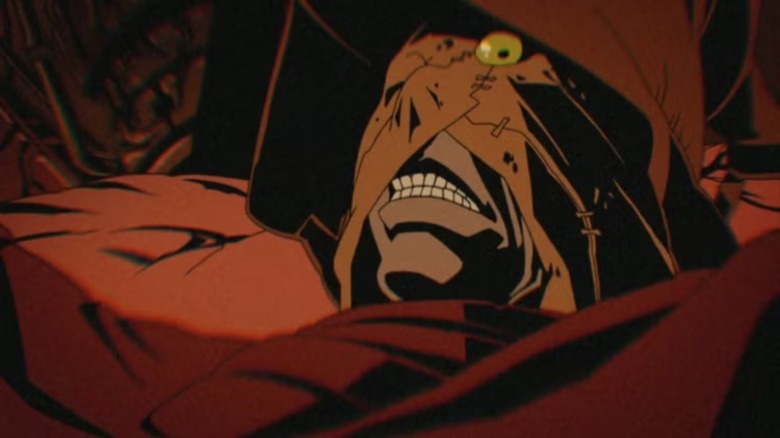
It wasn't until "Batman: Gotham Knight," an animated anthology meant as a prequel to "The Dark Knight," that we got Crane in a full costume. Scarecrow (Corey Burton) appears in the fourth segment, "In Darkness Dwells," written by David S. Goyer, and is decked out like the comics. The mask conceals one of his eyes, making him look like a cyclops.
 Warner Bros Animation
While promotional images for "The Dark Knight Rises" show Crane wearing the Scarecrow mask, he doesn't in the actual movie. Nolan probably thought there's no practical reason for Crane to wear the mask while acting as Bane's (Tom Hardy) judge, but I'd call that a missed opportunity. The mask, again, has a severed hangman's noose — a perfect symbol for a kangaroo court.