

Marshals Is Putting A Twist One One Of Taylor Sheridan's Yellowstone Traditions
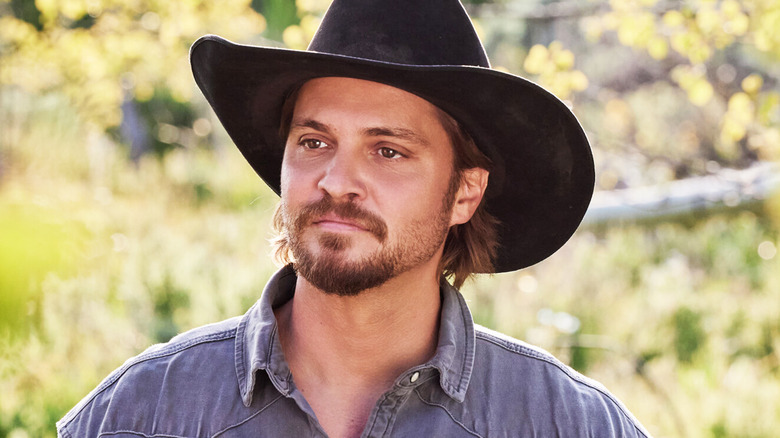
"Marshals" Season 2 got off to a disappointing start, but at least the writers are trying to go beyond the show's procedural format by injecting some good old-fashioned Taylor Sheridan-style symbolism. The latest episode of Luke Grimes' "Yellowstone" spin-off confirms that the buffalo Kayce Dutton saw in Episode 2 was much more significant than it seemed. That essentially makes this stoic beast the "Marshals" version of the wolves that hounded Kayce throughout "Yellowstone."
Before his wife Monica Dutton (Kelsey Asbille) was killed off in the worst way possible and Kayce joined the U.S. Marshals, he was struggling to figure out his place in the Dutton Dynasty. Throughout "Yellowstone," his conflict was symbolized by wolves, who showed up at numerous points throughout Sheridan's neo-Western and seemed to portend dark days ahead for John Dutton's (Kevin Costner) youngest son.
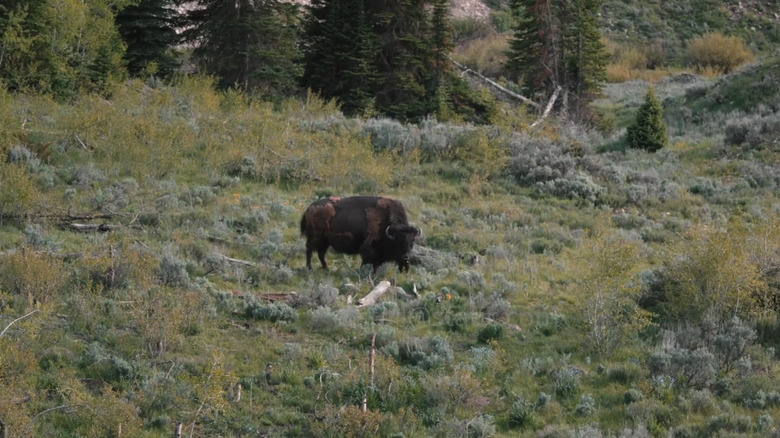
Now, however, we have a new animal symbol. The buffalo first appeared in "Marshals" Episode 2, wherein Kayce looked over his East Camp land and he spotted the beast grazing in the distance. He then left to find his son, Tate Dutton (Brecken Merrill), reflecting on recent events by John Dutton's grave. We got the sense the buffalo was supposed to represent something, but it was too fleeting a moment to really mean much. Now, Episode 2 has seen the return of this single creature, and it seems Kayce is just as confused as we are.
Marshals returns to Yellowstone's animal symbolism
In "Yellowstone" Season 3, Kayce and Monica Dutton encountered a wolf watching them while they camped. Kayce later saw the same animal outside his tent and approached it, saying, "I am not your friend. I'm your enemy. Whether I like it or not, I am." In that instance, the wolf seemingly represented the tension at the heart of the Duttons' determination to keep their Montana land. Nobody can truly own the natural world, and if anything, the land really belongs to nature itself, as represented by the wolf. The fact Kayce and his family's presence on the land puts them at odds with these rightful residents, whether Kayce likes it or not, highlights how something is deeply wrong with the Duttons' multi-generational enterprise.
Later, at the end of Season 4, Kayce takes part in an Indigenous ritual known as Haŋbléčeyapi, during which he has a vision of a girl in white — a human representation of his spirit animal, the wolf. The girl takes him to a cliff edge, where he sees two paths ahead of him, neither of which are revealed. Kayce later tells Monica he "saw the end of us." All of which is to say that wolves were hugely significant for the character in "Yellowstone," and now, despite the fact Taylor Sheridan is hardly involved in "Marshals," the spin-off's writers are continuing the tradition with the buffalo.
In Season 2, Episode 3, Kayce finds Tate Dutton doing some target practice and is immediately concerned, as his son has never shown any interest in guns. After trying and failing to connect with Tate, Kayce looks off into the distance only to see the buffalo watching him from afar. Again, we get the sense it's supposed to mean something, but what?
What does the buffalo really mean in Marshals?
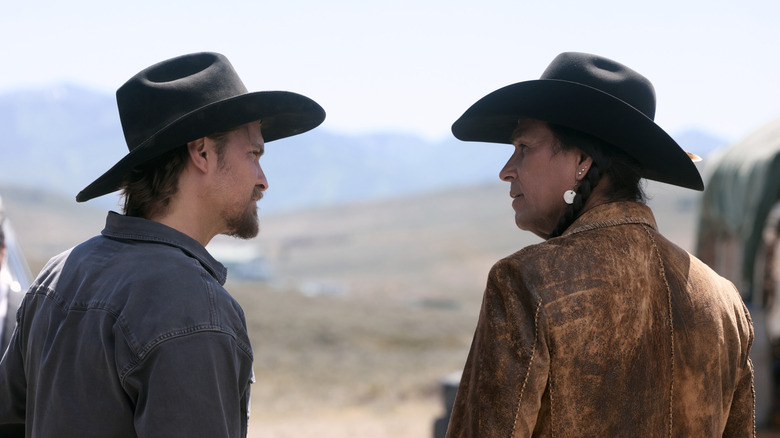
In "Marshals" Season 2, Episode 3, Kayce Dutton talks to Mo (Mo Brings Plenty) about seeing the buffalo, telling him. "I'm not sure it's even real." Mo then tells him that the buffalo "symbolizes self-sacrifice," adding, "But you already lost everything, except for Tate. The buffalo could be here to make you confront your shame. Spur you to take action."
"Marshals" has never been subtle, frequently having characters reiterate plot developments to hold the audience's hand as the narrative progresses. In the scene between Kayce and Mo, we once again have things blatantly spelled out. In that sense, the "Marshals" take on Taylor Sheridan's animal symbolism is far more on the nose, but it's at least nice to see the show calling back to "Yellowstone." "Marshals" has faced major criticism for failing to maintain the same tone as the mothership series (at least fellow spin-off "Dutton Ranch" fixed that major issue). But this animal-watches-from-afar motif is a small way of bringing some "Yellowstone" energy into Luke Grimes' offshoot.
What's interesting is that the buffalo comes with very different connotations to the wolf. Though Mo seems to think it symbolizes self-sacrifice, it's also clearly emblematic of resilience and the quiet power of nature. That's a very different thing than the more obviously predatory aura of the wolf, which highlighted how precarious the Duttons' hold on their land really was. It will be interesting to see how the writers continue to use this buffalo imagery as the show goes on — though no doubt multiple characters will tell us exactly what it's supposed to mean.