

A Rod Serling War Story Led To One Of Paul Newman's Most Underrated Movies
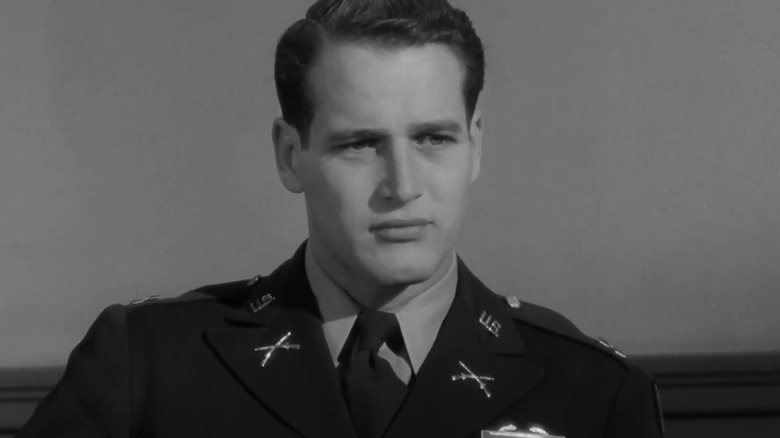
Arnold Laven's 1956 military courtroom drama "The Rack" isn't terribly well-remembered these days. If it's remarked upon at all, it may be for its performance from Paul Newman in one of his earliest film roles. It's also notable because its screenplay, by Stewart Stern, was adapted from a 1955 episode of the theatrical anthology series "The United States Steel Hour," which was penned by Rod Serling. Said episode, also called "The Rack," originally starred Marshall Thompson in the central role of Edward H. Hall Jr., a U.S. military Captain who has been accused of collaborating with the enemy during the Korean War.
In the movie version of "The Rack," Newman plays Captain Hall, while Walter Pidgeon plays Hall's father, a retired colonel. Hall returns from the war, having survived in a POW camp for a spell, and is mourning the loss of his brother, Peter, in combat. It's soon revealed that Captain Hall is about to be court-martialed for collaborating with the enemy. When Hall's father confronts him on the matter, he instantly admits that yes, he did collaborate with the enemy.
During the subsequent trial, it's revealed that Hall followed enemy instructions, making speeches and signing documents for them. Other American soldiers, meanwhile, withstood torture rather than giving aid to the opposing side. Hall is accused of being a coward. He wishes to plead guilty. Naturally, there is more to this story than initially implicated. The climax of the movie then reveals the horrors that Hall suffered at the hands of the enemy. However bad you think it is, dear readers, it's probably worse. Newman's performance is frank, tormented, and very good, and "The Rack" itself is one of the many underrated Paul Newman movies you should check out.
The Rack is a military legal thriller about the horrors of war
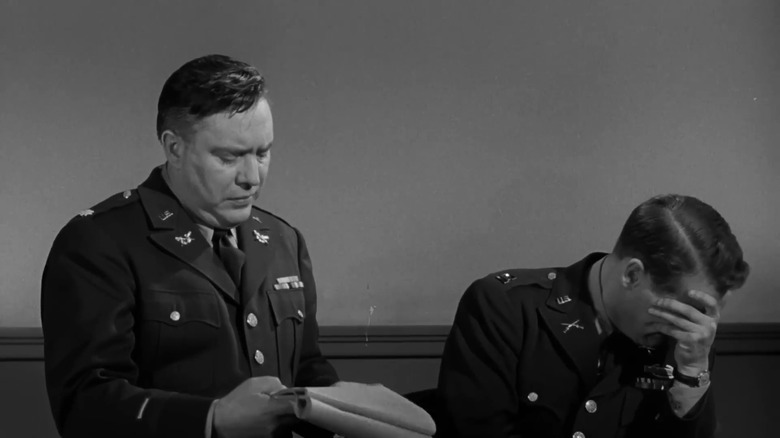
The "The Rack" was clearly designed to explore the horrors of war. When one goes back to the original Rod Serling teleplay, one can clearly see that "The Rack" is meant to be a condemnation of war violence, detailing just how horrible combat and wartime torture are. One can further read an essay on the Rod Serling website detailing Serling's PTSD and how he feared becoming a monster after fighting in World War II. Men his age had a unique set of phobias and concerns about combat. "The Rack" was clearly a means to explore Serling's fears.
The hour-long 1955 TV version of "The Rack" has been handily archived by the UCLA Film & Television Archive and can be accessed on YouTube. One will see immediately that the TV version is far more melodramatic than the movie iteration and features bigger, showier speeches. "I sold my soul for a filthy blanket that stunk of fish and urine!" Marshall Thompson's Captain Hall yells. "And three hours of uninterrupted sleep! And you know what else, Colonel? At the time, I felt it was one hell of a bargain!"
Thompson is a more demonstrative actor than Paul Newman, so one cannot even really compare their performances. It's like night and day. Thompson plays every emotion enormously, allowing his Captain Hall to emerge as wounded and pathetic. Newman, however, underplays everything, which makes the character richer and more intriguing. He's someone who knows how deeply his sins run.
As for the film version of "The Rack," one can find a vintage New York Times review, written by the inimitable Bosley Crowther, that praised Newman's performance. At the same time, though, Crowther disliked the movie's screenplay, describing it as "thin."
The Rack marked a turning point in both Paul Newman and Rod Serling's careers
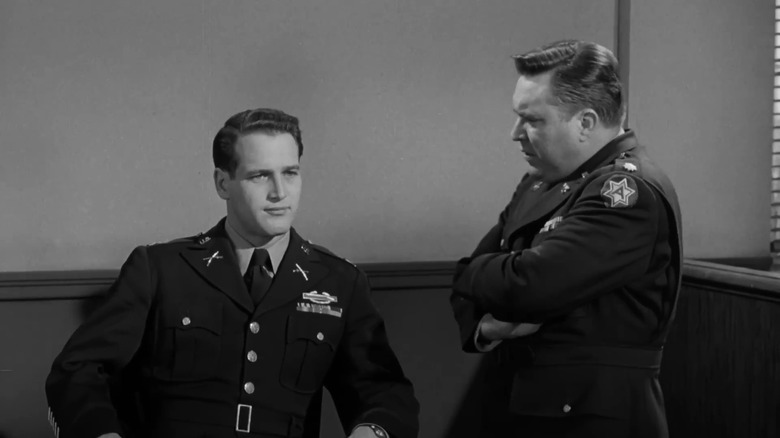
Having watched some of both versions of "The Rack," I can say that the TV version is way preachier. Rod Serling, as we know from his most famous creation, "The Twilight Zone," wasn't always a subtle author, preferring to get to the point.
Both iterations of "The Rack" were notable career turning points for Serling and Paul Newman, in turn. It was only after writing the TV version of "The Rack" that Sterling began contributing more heartily to the TV series "Playhouse 90," and, later on, writing screenplays for movies like "Patterns," "Saddle the Wind," and 1968's "Planet of the Apes." Then, "The Twilight Zone" kicked off in 1959, putting Serling on the American cultural map in perpetuity.
Newman, meanwhile, was a rising star when the big screen version of "The Rack" was released. He had previously been in the films "Somebody Up There Likes Me" and "The Silver Chalice," a disastrous flop that Newman once called his worst movie ever. (Seriously, it's bad.) Similarly, he had only made his TV debut a few years before on the underrated sci-fi anthology show "Tales of Tomorrow" (namely, in the 1952 episode "Ice from Space").
From there, of course, Newman continued to act for decades. No matter when you grew up in the time that followed, you were most likely introduced to him as a child, whether it was through his performance in "Cool Hand Luke" in the 1960s, "The Sting" in the 1970s, "The Color of Money" in the 1980s, "Nobody's Fool" in the 1990s, or even "Cars" in the 2000s. The man lived quite the life.