

Kevin Bacon's '80s Train-Themed Movie Barely Impacted The Box Office

In 1987, Kevin Bacon starred in a film that made such a negligible impact on both the box office and culture more widely that it might as well have not existed. Almost a decade after he made his feature debut in "National Lampoon's Animal House" and three years after breaking out with "Footloose," Bacon co-starred in "End of the Line," a drama about railroad workers who fight back after their yard is threatened with closure. It made less than $50,000 at the box office.
By his own admission, after "Footloose," Bacon tried to reject his newfound fame. As he put it on an episode of the Podcrushed podcast (via Entertainment Weekly), "I rejected it, full on. And really, I think in some ways, I tried to self-sabotage that piece of myself and my popularity." He couldn't have picked a better project than "End of the Line" in that regard.
The film marked the directorial debut of Jay Russell, who also wrote the script. After "End of the Line," Russell went on to direct one of the saddest movies of all time with 2000's "My Dog Skip," which saw him re-team with Bacon. Thankfully, that collaboration ended making a tidy $35.5 million on a $6 million budget. "End of the Line," however, made just $42,000, and you don't need to know the budget to know that's a flop by any measure. (The movie cost an estimated $3 million according to AFI, in case you're interested.)
In fairness, Russell's directorial debut seems to have been given a very limited release, with AFI also noting that the film opened regionally in Little Rock and Memphis ahead of hitting theaters in New York. But judging by the critical response, it wouldn't have been a hit had it been given a wider release.
Kevin Bacon plays a small town bookie in End of the Line
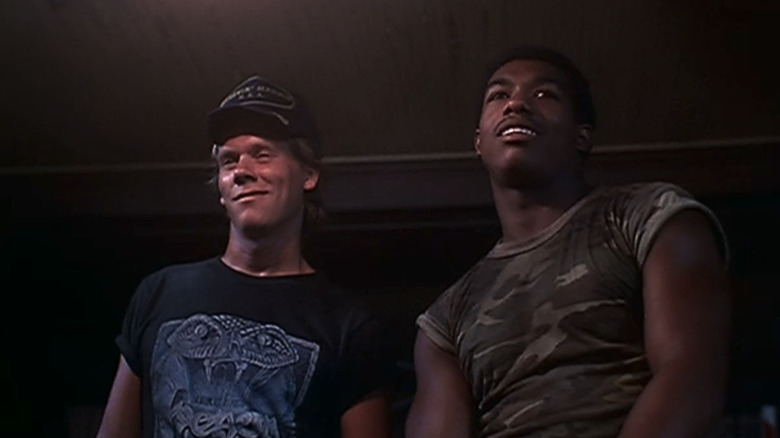
While Jay Russell was gearing up to make his directorial debut, a post-"Footloose" Kevin Bacon was busy "self-sabotaging" by appearing in a series of movies that either became box office flops or failed to win over critics. Sadly, while "Footloose" arguably could be one of the best '80s movies, "End of the Line" was yet another flop.
The movie stars Levon Helm and Wilford Brimley as Leo Pickett and Will Haney, two railroad workers from the fictional town of Clifford, Arkansas. The duo are dismayed to discover that the corporation in charge of their little rail yard is planning to close down the operation and dismiss the employees as part of an attempt to pivot to the air freight business. For the first half of the movie, we simply get to know Will and Leo, alongside the other characters in Clifford — one of which is Bacon's Everett. Will's former son-in-law, Everett used to be married to Holly Hunter's Charlotte and now runs a small-time bookie operation in Clifford alongside Michael Beach's Alvin. Once Will and Leo decide to take the fight directly to their corporate overlords, however, we don't see much more of Bacon or his fellow Cliffordians.
The two railroad workers come up with a plan that somewhat undermines the moderately convincing portrait of small-town America that Russell paints in the first half of the movie. Will and Leo decide to hijack a train and drive it directly to the corporate head office in Chicago, where they plan to confront the chairman, Thomas G. Clinton (Henderson Forsythe). It's a very Disney-esque development that, as some critics pointed out, doesn't do "End of the Line" any favors in the end.
End of the Line wasn't a hit with critics, either
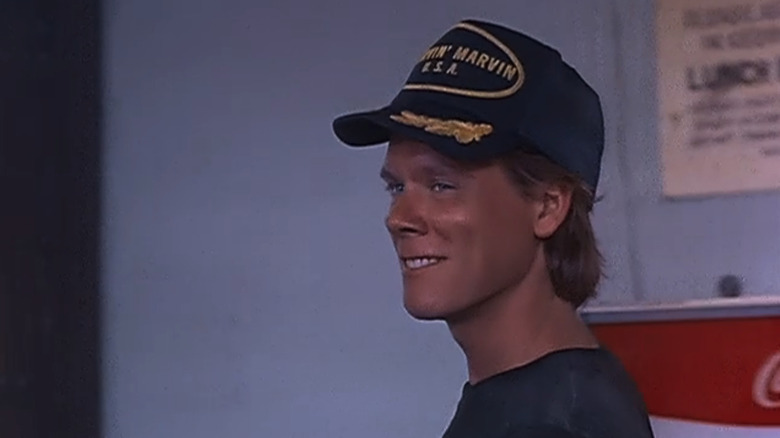
"End of the Line" sits at a 60% critic score on Rotten Tomatoes, though that is based on just five reviews, only one of which is from a "top critic." That critic is Roger Ebert, who gave the film two out of four stars and described it as "a movie that belongs in more innocent times." Ebert claimed to have struggled to believe in the main characters, who in his estimation belonged in a "heartwarming fantasy for the 1930s" and not in the cynical, uber-capitalist corporatocracy of the 1980s. Once the movie turns into what Ebert called "a fable of the Little Guy against the Big Corporation," in his view it "loses its energy."
Janet Maslin of The New York Times was similarly down on "End of the Line," finding Clifford to be a place "that is brought to life energetically at first, then effectively abandoned." That said, she was quite taken with Kevin Bacon, who, she writes, "struts nastily and is much more interesting than he is in nice-guy roles." Sadly, with "End of the Line" making just $42,000, it didn't do much to help Bacon's career troubles.
Those troubles came to a head as Bacon was preparing to front 1990's "Tremors." As the actor recalled in an interview with The Telegraph, "I broke down and fell to the sidewalk, screaming to my pregnant wife, 'I can't believe I'm doing a movie about underground worms!'" It seems Bacon was convinced his career would never recover after that particular horror about underground worms. Luckily, "Tremors" became a cult hit and things started to change thereafter. Meanwhile, "End of the Line" chugged its way down the line to obscurity, but it can be seen for free over on Tubi today.