

Star Trek: Strange New Worlds Season 4 Finale Gives Us A Taste Of A Year One Spin-Off
We may receive a commission on purchases made from links.
This article contains spoilers for "Star Trek: Strange New Worlds" Season 4 Episode 10 "Tomorrow's Enterprise."
"Star Trek: Strange New Worlds" Season 4 finale features Uhura (Celia Rose Gooding) teaming up with... herself? The Enterprise is observing a spatial phenomenon called a white hole, which is hypothesized to be the other end of a black hole. At that other end is the Enterprise, one year in the future, where things have shaken up a bit.
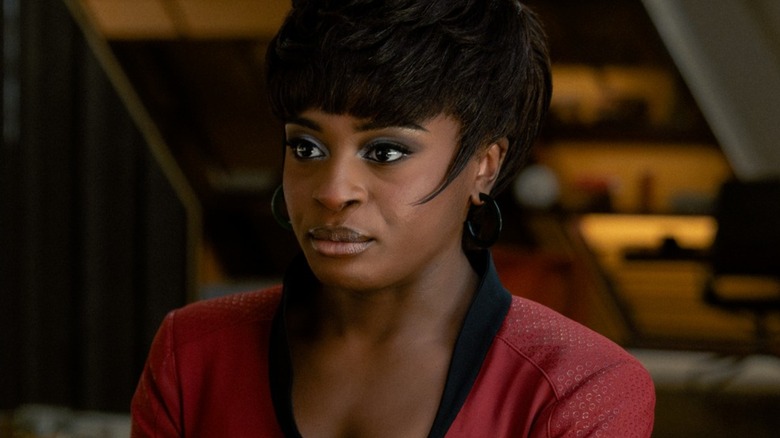
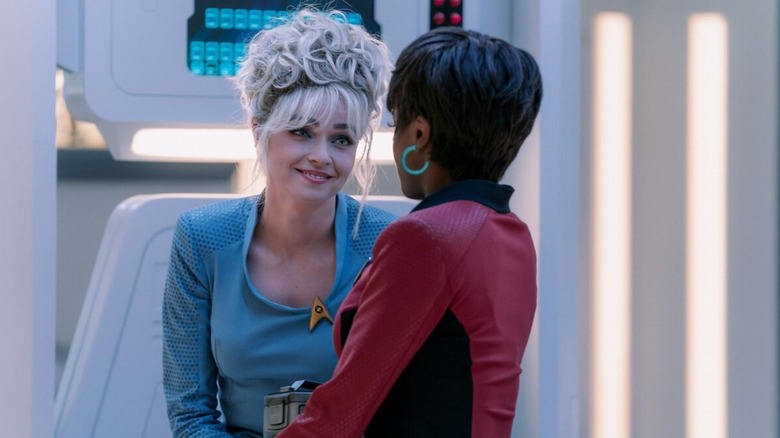
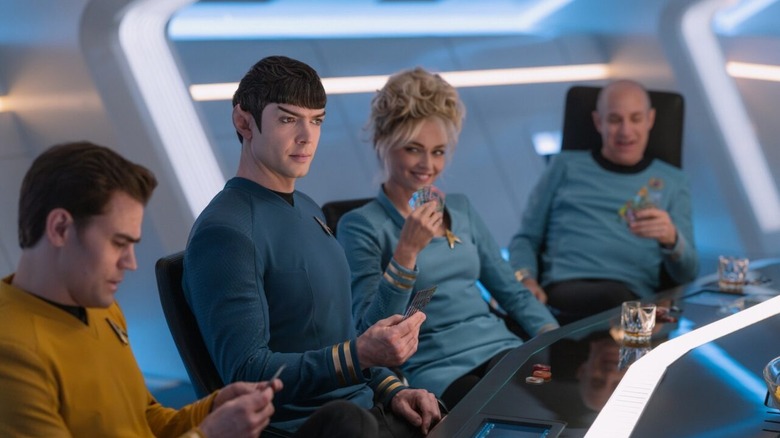
Captain Pike (Anson Mount) has left the Enterprise, and been succeeded by the promoted Captain Jim Kirk (Paul Wesley). Spock (Ethan Peck), Christine Chapel (Jess Bush), Scotty (Martin Quinn), and Uhura are still on board, but Una (Rebecca Romijn) and La'an (Christina Chong) are gone. Ortegas (Melissa Navia) has left to teach at Starfleet Academy, Dr. M'Benga (Babs Olusanmokun) is apparently planning a transfer to Vulcan, and Leonard "Bones" McCoy (who will be played by Thomas Jane come Season 5) is in line to replace him. Basically, everything on the Enterprise is looking a lot more like "Star Trek: The Original Series." Uhura and Chapel have even switched over to their "TOS"-era hairstyles and costumes.
It's known that the creators' hope was, after "Strange New Worlds" wrapped with Season 5 (one season for each year of the Enterprise's mission), that the series would essentially continue into the timeframe of the original series. This sequel was described as "Star Trek: Year One," because it would depict the first year of the Enterprise's five-year mission under Kirk. (The year 2264 AD.) However, Paramount did not greenlight "Star Trek: Year One," and with the "Strange New Worlds" sets having been torn down, the project is basically dead. "Tomorrow's Enterprise" offers a glimpse of what "Year One" could've been like, both aesthetically and its character dynamics.
Strange New Worlds feels like it was always building to Star Trek: Year One
The titling scheme "X: Year One" for geek property prequels goes back to 1987, with the publication of "Batman: Year One" by Frank Miller and David Mazzucchelli. "Year One" is near universally recommended as the place newbie Batman readers should start, and it's not hard to see why. Since its publication, most other DC heroes have gotten a "Year One" origin story: Superman, Wonder Woman, Green Arrow, etc.
There's an undeniable elegance and prestige to the "Year One" title, not to mention how welcoming it is for novices. It suggests you're seeing the definitive beginning, so no surprise "Strange New Worlds" co-creators Akiva Goldsman and Henry Alonso Myers used it to pitch a "Star Trek" prequel (albeit unsuccessfully). In fact, watching "Strange New Worlds," you sense that hand-off is what they always wanted to happen, eventually. Why else make Jim Kirk a recurring character, when he's not even stationed on the Enterprise in this timeframe? Moreover, "Strange New Worlds" has been showing how Kirk learned to be a captain, from "The Sehlat Who Ate Its Tail" (where he had to take command of the USS Farragut) to "Orders of Magnitude" (where Kirk disobeyed an admiral's orders because he felt they were immoral).
As far back as "Strange New Worlds" Season 1, there's been a metatextual theme of inevitability. We know from the original series, for instance, that Pike will wind up paralyzed and disfigured after being exposed to harmful radiation. Back on "Star Trek: Discovery," he had a premonition of this future. Pike's arc in "Strange New Worlds" Season 1 was him reckoning that he's got less than a decade left, and if he can change his future.
Tomorrow's Enterprise bridges Strange New Worlds and the undiscovered country
"Strange New Worlds" Season 1 finale "A Quality of Mercy" resolved Captain Pike's arc with him accepting his future. It did so by outright remaking a classic "Star Trek" episode, "Balance of Terror," the first appearance of the Romulans.
Traveling through time, Pike sees that if he is captain of the Enterprise during its encounter with the Romulans, his more trusting, diplomatic nature will lead to the event spiraling out of control. There will be numerous casualties, including Spock (who'll suffer similar radiation disfigurement as Pike) and open, decades-long war between the Federation and Romulans commences. During the episode, Kirk was by Pike's side advocating more decisive action, and we know from the original "Balance of Terror" that approach worked.
It's some rather mixed messaging, saying Pike needs to accept his end and late the generation behind him have their moment, yet it's also "Strange New Worlds" itself swearing fealty to the original series. That fealty went so far that the creators wanted "Strange New Worlds" to lead into a series that would essentially be an in-continuity remake of the original "Star Trek." If no one at Paramount changes their mind, the glimpse of Kirk as captain in "Tomorrow's Enterprise" might be the closest they get.
"Tomorrow's Enterprise" carries a similar meta feeling with the white and black holes connect the two timeframes; the phenomenon is a bridge between two eras of "Star Trek" like "Year One" would've been. The two Uhuras (a character who connects "Strange New Worlds" and the original series) even communicate with each other to prevent the death of Scotty, another case of preserving canon.