

5 Star Trek Episodes Where Starfleet Was Clearly In The Wrong
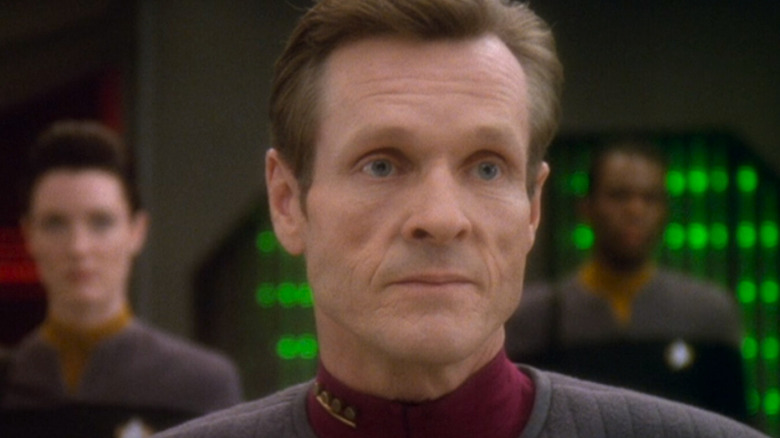
One of the most striking functions of "Star Trek," going all the way back to its beginnings, is that it serves as a handy, easily understood utopian text. It's set in a post-capitalist future where Earth has rid itself of divisions, countries, and war, and has united as a space-exploring, scientifically curious part of a large galactic community. Thanks to replicators and faster-than-light engines, resources are now plentiful and properly allocated, so no one really wants for anything. Starfleet officers zip around the Milky Way, commanding miraculous starships, merrily dispensing peace and studying quasars, living by an impeccable code of moral conduct. The Prime Directive, meanwhile, ensures that no colonialist thinking enters the Federation's mission of exploration.
But, as we see time and time again on "Star Trek," maintaining a utopia is tricky business. Humans are still humans, after all, and we have the propensity for violence, greed, and domination. Characters on "Star Trek" constantly test their own resolve, pushing the bounds of their ethics and trying to stay in the right. Starfleet itself has many rules and regulations that also need to be checked and rewritten constantly, lest the whole organization accidentally saunter vaguely downward into iniquity. If we remain complacent and inactive, even our most noble intentions can turn sour.
And, yes, we've seen it happen. Starfleet has made some horrible, morally dubious decisions throughout its existence, supporting everything from forced relocation to outright war crimes. There are bad actors in Starfleet who are happy to undercut the "Star Trek" utopia with concepts like ambition, violence, and torture. And sometimes, even the most stalwart Starfleet officers, in trying to do the right thing, will follow immoral orders without enough reflection. The following list highlights five episodes when Starfleet was in the wrong.
Journey's End
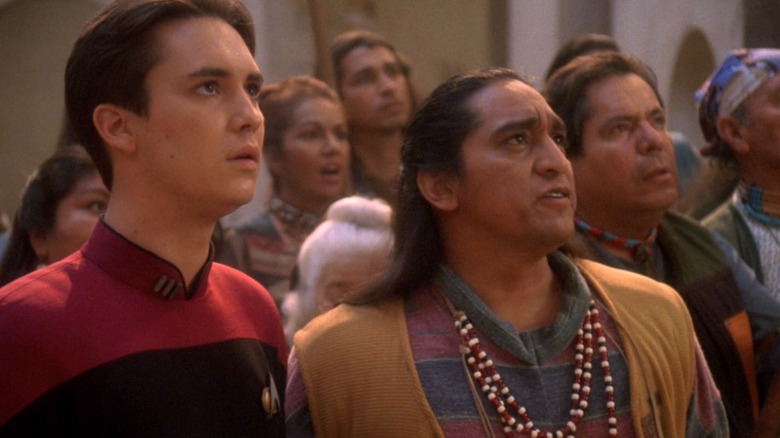
In a story that spanned both "Star Trek: The Next Generation" and "Star Trek: Deep Space Nine," the Federation negotiated a very bad treaty with the evil, militant Cardassians, which was to redraw the borders between their space. In so doing, however, multiple Federation colony planets suddenly found themselves living under Cardassian rule. Starfleet offered to relocate them to amenable new homes, of course, but many colonists didn't want to leave the planets where they had been living for years. Rather than leave their homes, the colonists formed a fighting force called the Maquis, which was hated by both the Starfleet and the Cardassians. The Federation ended up fighting its own citizens.
The consequence of the Cardassian treaty was the subject of the "Next Generation" episode "Journey's End," an episode about forced relocation. The world of Dorvan V is one of the planets ceded to the Cardassians, but its citizens refuse to leave. The colonists are all of Puebloan descent, and Dorvan V is the center of their surviving culture, carefully selected after two centuries of searching. Captain Picard (Patrick Stewart), under orders from Admiral Netcheyev (Natalija Nogulich) to talk the colonists off their own world, asks that they move elsewhere to placate the evil Cardassians. If that doesn't work, Picard is instructed to remove the colonists by force.
Frustratingly, Picard goes along with this. He feels his hands are tied by the Cardassian treaty, and by his superior officer's orders. Only the young Wesley Crusher (Wil Wheaton) sees the forced relocation as a moral failing. Wesley tries to point out that Starfleet intends to kidnap the colonists, and Picard chews him out. Picard wouldn't fight against forced relocation until the events of "Star Trek: Insurrection."
Inquisition
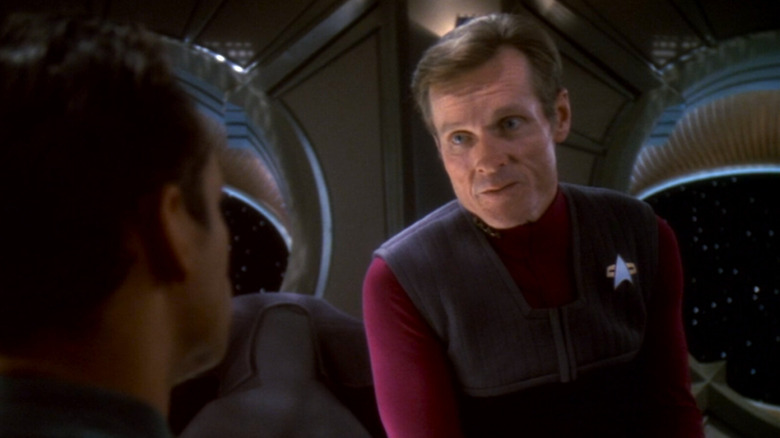
The "Star Trek: Deep Space Nine" episode "Inquisition" is the first to make mention of Section 31, essentially Starfleet's secret black-ops force. In the episode, Dr. Bashir (Alexander Siddig) is approached by a mysterious officer named Luther Sloan (William Sadler) who quietly reveals that one member of Deep Space Nine's senior staff might secretly be a spy for the evil Dominion. Sloan actually suspects Bashir himself, declaring that the doctor has been mindwiped by the Dominion (he had previously been kidnapped) and could very well be a sleeper agent without knowing it.
Eventually, it's revealed that all the interrogations have been a clever ruse by Sloan to test Dr. Bashir's loyalty. Sloan is a member of Section 31, a secret organization that was put together to do the Federation's dirty work, in the shadows. Sloan wants to recruit Bashir, but Bashir, hanging on to his Starfleet principles, questions the ethics of something like Section 31. If one has to sneak around interrogating people and, it is assumed, kidnapping or killing them in order to maintain a utopia, well, it's not much of a utopia, is it? In fact, it's a downright dystopia. You can live in peace and harmony — just toe the company line, and beware of the spooks in the shadows.
Many Trekkies hate the very idea of Section 31 because of how unethical it is on its face. Starfleet is about honesty, peace, and diplomacy. Section 31 is an organization predicated by suspicion. It's something that grows in the shadows of war, which "Deep Space Nine" was deeply embroiled in at the time. Section 31 is a condemnation of how war can corrupt one's ideals ... and Starfleet signed off on it.
Author, Author
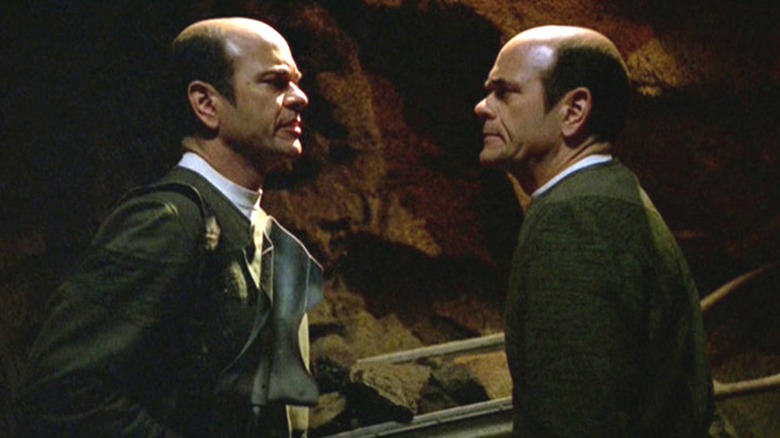
The chief medical officer on the USS Voyager began its life as a mere emergency medical hologram, left in operation when the ship's medical staff was killed in an accident. Because the EMH was left active for so long, its program began to expand, and it became clear that it eventually gained a consciousness. Robert Picardo played the Doctor on "Star Trek: Voyager," and the character's arc — scooting ever closer toward human — is fascinating to behold.
In the episode "Author, Author," the Doctor has authored a holodeck program that is a clear allusion to his own life on the ship. In the fictional story, the Doctor is abused and mistreated, and his human overlords are wicked taskmasters. Captain Janeway (Kate Mulgrew) asks the Doctor directly if he actually feels as if his real-life crewmates are abusing him. The Doctor admits that he feels like a second-class citizen on board, merely because he is a hologram. He then reveals that intelligent holographic programs like his have long been used in Federation mines as slave labor.
The last third of the episode involves the Doctor negotiating with a Starfleet representative about the potential human rights of a living hologram. As far as Starfleet is concerned, holograms are mostly not sentient and have no rights, and they deem that the Doctor is not a citizen as a result. Later on, it's revealed that hologram miners actually do make decisions and have some sort of artificial free will.
On "Star Trek," it had already been established that androids, exocomps, and even other holograms can be sentient, and have rights that are protected by the law. Why, then, did Starfleet create a gaggle of thinking, living holograms just so they can work as slaves in a mine? Sketchy, Starfleet. Very sketchy.
The Xindi
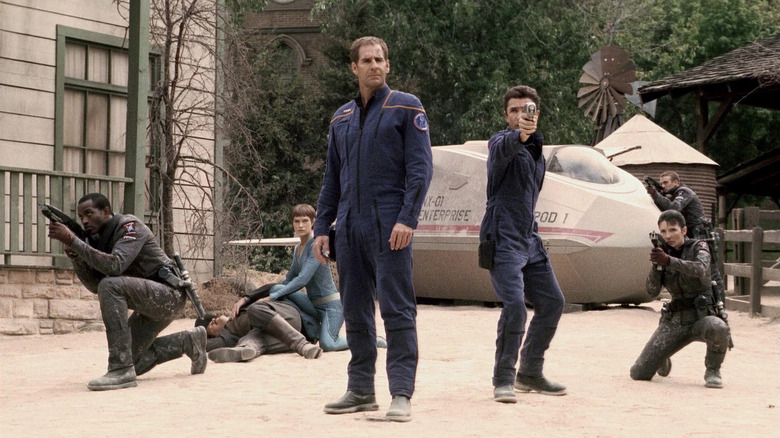
The third season of "Star Trek: Enterprise" began with a bang that was very clearly meant to serve as a sci-fi parallel to 9/11. The series, after all, debuted only a few weeks after 9/11, so the time was right to explore the messy moral ground that the world had entered into in its wake. The first episode of the season was called "The Xindi," and it was about how suddenly, and without warning, a mysterious and hitherto unknown alien species appears over Earth and destroys Florida. Starfleet intelligence learns that this might just be the preview of another, more cataclysmic attack, and the USS Enterprise is assigned to track down the Xindi, find out why they attacked Earth, and, it is implied, perhaps get a little revenge.
It should be recalled that "Enterprise" is set a century before the events of the original "Star Trek," so Starfleet didn't yet have a Prime Directive or other ethical codes of conduct in place yet. Rage and militant thinking, then, are welcomed with open arms. Indeed, a cadre of violent new characters are welcomed on board the Enterprise specifically to wield weapons and shoot others. The cadre is called the Military Assault Command Operations team, or MACO for short. They were less like Starfleet officers and more like the space Marines from James Cameron's "Aliens."
Seeing the MACOs on board the Enterprise only highlights that similar characters are noticeably absent from all the other "Star Trek" shows. On a ship devoted to science and diplomacy, you don't necessarily need ultra-soldiers with super-guns. A security detail will do. The MACOs, like Section 31, are what happens when warlike and combative thinking erases one's principles and welcomes violence into the world.
Dominion
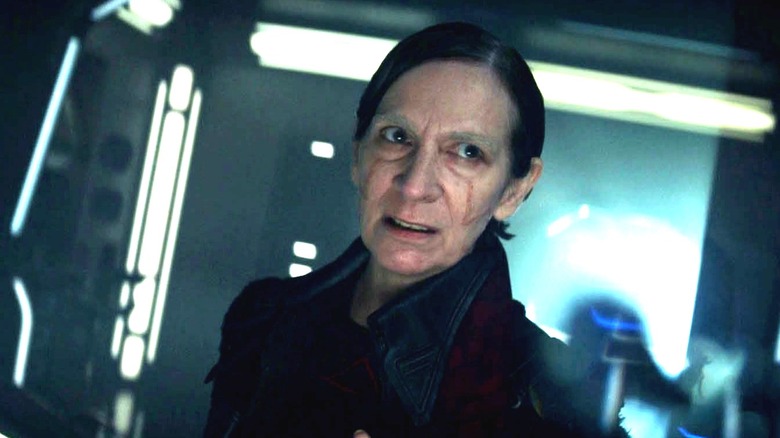
The third season of "Star Trek: Picard" is easily its best (although I am on record with my objections to the resurrection of the Enterprise-D for its corny action-packed climax). The season featured a malevolent Changeling named Vadic (Amanda Plummer) who spent the bulk of the series searching for Jack Crusher (Ed Speleers), Jean-Luc Picard's secret son, because of a dark secret hidden inside his brain. Vadic commands a ship called the Shrike, which is specially designed to rip other ships apart, or perhaps hurl them through miniature wormholes. Vadic is well prepared to kill as many people as she needs to to get to Jack.
In the episode "Dominion," it's finally revealed why she is so villainous, and frankly, her reasons are quite understandable. It seems that during the events of "Deep Space Nine," Starfleet kidnapped several Changelings and kept them in their liquid state in a secret Federation lab. Under a mission called Project Proteus, the Federation conducted torturous medical experiments on their Changeling prisoners, exposing them to chemicals, fire, ice, and anything else that might harm them. Vadic eventually managed to slip the evil doctor's bonds, murder her, and adopt her face as a disguise. Ever since, a rogue group of Changelings have sought to take down Starfleet from within.
Medical experimentation on POWs is perhaps one of the most evil things Starfleet has been involved with — and, darkly, Picard seems neutral on the matter. When he finds out about Project Proteus, he never contacts Starfleet about their crimes, never calls them to testify or be arrested. To be fair, there are more immediate threats he has to deal with first — the Borg invasion of Starfleet, for one — but it would have been nice if Starfleet paid for its crimes.