

Zach Cregger's Resident Evil Movie Has A Complicated Place In The Video Game Timeline
Warning: Zombies ahead. This article contains spoilers for "Resident Evil."
Not all adaptations are created equally. Fans online have followed the latest movie in the "Resident Evil" franchise quite closely in recent months, overanalyzing each word that comes out of Zach Cregger's mouth while scrutinizing his "fan cred" at every step. The final result, according to practically the entire critical community (as aggregated by Rotten Tomatoes), is a thrill-a-minute horror flick that perfectly evokes the feeling of playing the games — from the stress-inducingly low inventory space, to the thrill of uncovering new weapons as the game goes on, to the dread of walking into a dark room and jumping at every shadow in sight.
Compared to the straightforward, shot-for-shot remake that so many gamers seem to have wanted, I'd say we ended up with a much better (and, ironically, more faithful) film.
Of course, that's not stopping anyone from trying to figure out exactly how "Resident Evil" carves out a space for itself, within the timeline of the series anyway. Naturally, that's where things start to get a bit complicated. To the credit of both Cregger and co-writer Shay Hatten, the choice to focus on new characters and an original story frees audiences from these larger canon concerns, so consider this the exact, refreshing inverse of all the cross-media homework that Marvel or DC requires of us so often. However, when taking both the plot of the film and the setting of the various games into account, fans will likely end up scratching their heads in confusion. Here's our best attempt to untie this knot and make sense of this nerdiest of nerdy nitpicks.
Resident Evil's modern-day setting causes inconsistencies with the games
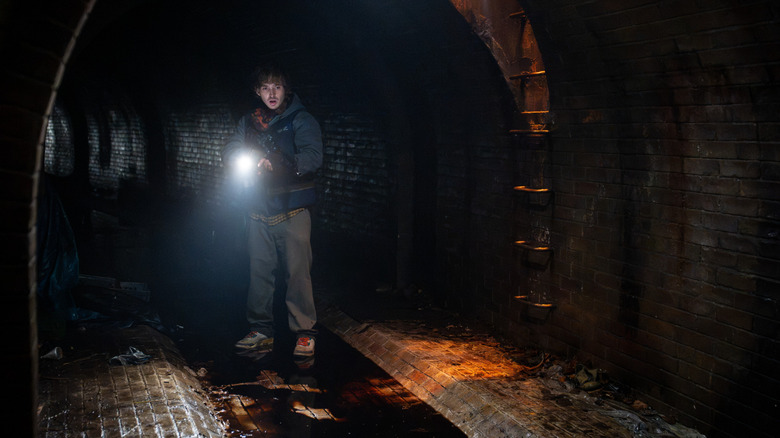
More than the lack of established video game characters or the wintery presence of (*gasp*) snow in the ever-rainy Raccoon City, perhaps the biggest sticking point surrounding "Resident Evil" has to do with that most pernicious of modern concerns: cell phones. While no title card or dialogue ever actually states the date of the movie, the use of such devices throughout the film obviously confirms this as a modern-day story. That's all well and good for the purposes of the standalone script, but it inevitably muddies up the waters when it comes to crafting a simple, linear head-canon of both the movie and games.
How, exactly? Well, it's actually a self-inflicted wound. Previously, Zach Cregger sought to clarify where this adaptation exists alongside the famous games. While speaking to IGN earlier this year, the filmmaker noted that:
"My rule for this movie was to try and make a movie that felt like my experience of playing the games, and that could live in the world of 'Resident Evil.' I feel like this movie takes place alongside the events of 'Resident Evil 2.' I like to think that everything that's going on in the police station could be happening in this world. This is just another dude on another mission on the other side of town."
"So yeah, it's not canon in that I'm using the [same] characters, but it's canon in that it lives in the actual day of reckoning in Raccoon City."
The problem? We know "Resident Evil 2" takes place in 1998. Considering nobody in "Resident Evil" walks around with pagers (look it up, kids) or is hyping up the historic championship season by the New York Yankees (look it up, nerds), that causes some inconsistencies.
Resident Evil doesn't fit seamlessly with the video games, but does it even matter?
At the risk of being controversial, I will humbly propose that this irreconcilable timeline difference between "Resident Evil" and the games is a complete and total nonissue. True, even without Zach Cregger's comments (which are easy enough to dismiss, as only what happens in the movie itself should matter), it's fair to point out that the film clearly documents the fall of Raccoon City — and, canonically, that tragedy goes down during the period-setting events of "Resident Evil 2." So how do we square this with our knowledge of the games? It's simple: It doesn't matter in the slightest.
This might fly in the face of modern fandom and its incessant need to connect as many canonical dots as possible, but this entire discussion essentially boils down to trivia. Would it have been a fun, fan-servicing little tidbit if Cregger and Shay Hatten had managed to make this fit seamlessly with the games? Of course! But does this invalidate their choice to focus on different priorities and do what was best for the story at hand? Of course not!
Besides, if trying to untangle the official canon is giving you headaches, may we introduce you to the convoluted, retcon-heavy video games themselves? If anything, Cregger making things (marginally) more confusing by building atop preexisting "Resident Evil" lore is as faithful to the franchise as it gets. In any case, "Resident Evil" already has all the video game elements that actually matter. Everything else is just zombie-induced noise.
"Resident Evil" is now playing in theaters.