

Resident Evil Director Zach Cregger Reveals What His Movie Had To Include From The Games [Exclusive]

One of the unique joys of the "Resident Evil" franchise is how varied it is. While some properties make a point of maintaining a fairly tight continuity and aesthetic approach, "Resident Evil" is a brand that can go to numerous places without blinking an eye. Whether you're considering the many, many video games in the franchise, the six films starring Milla Jovovich, the 2021 big screen reboot "Welcome to Raccoon City," or the short-lived 2022 live action Netflix show, "Resident Evil" is practically a variety showcase. On the whole, this makes the property one of the most continually exciting and engaging in all of media. Sure, say what you will about the lack of consistency when it comes to "Resident Evil" projects. (Plenty of irate fans certainly do.) Yet, unlike, for instance, "The Walking Dead," which is a fellow long-running franchise involving zombies, "Resident Evil" never feels same-y or repetitive.
That being said, the nearly wide-open range of possibilities that "Resident Evil" invites can make a new installment in the franchise a bit of a daunting prospect. That's what filmmaker Zach Cregger faced when he signed on to make his own live-action feature film version. With the movie's release date coming up quickly, virtually no one outside of its creatives have yet to glimpse the entire film, simply titled "Resident Evil." (I myself have only watched the first 20 minutes.) Even so, it's apparent from the footage unveiled so far that Cregger has taken his own unique, exciting approach to the property.
Indeed, I recently had the opportunity to speak to Cregger about making the film, and I asked what he considered to be the core components of "Resident Evil." His answer was deceptively simple: When it comes to this franchise, it's primarily about survival horror.
The aspects of the video games that Zach Cregger thought his Resident Evil had to have

While Zach Cregger's primary goal was to give his "Resident Evil" movie a sense of survival horror (more on that in a minute), he also believed that his film needed to contain other key elements from the video games to qualify as part of the franchise. He explained to me which game elements he felt were required for his movie adaptation:
"Well, I feel like, okay, there's a couple of aspects of the games that you have to have. So, you have to have the T-Virus, you have to have the Umbrella Corporation — even though, I mean, I don't think ['Resident Evil Village'] has that stuff in it, and that's okay. But, for me, I feel like it would be weird if I called this movie 'Resident Evil' and I didn't have those elements to it. [...] So, there are a lot of elements from the games that are put into this movie that I think make it uniquely 'Resident Evil.'"
So far, these elements have yet to appear in the "Resident Evil" footage that's been publicly unveiled, though they're clearly lying in wait. Moreover, while there are undoubtedly many surprises in the back two-thirds of the movie, it's clear that Cregger isn't all that interested in giving fans a story they already know backwards and forwards. Instead, we'll be getting to follow a new character, Bryan (Austin Abrams), on their harrowing journey, more or less at the same time.
Capturing a sense of survival horror was Zach Cregger's primary goal on Resident Evil
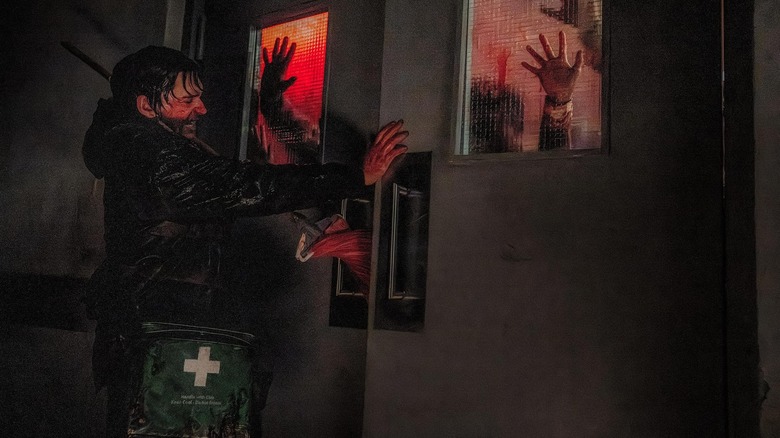
Based on what I have seen of "Resident Evil," the film establishes its focus on capturing a sense of survival horror right away. In a similar fashion to most of the video games in the franchise, the film follows a single character, Bryan, a medical courier who takes a job to bring a mysterious package to a hospital in Raccoon City. Once Bryan encounters some zombies and other deadly creatures mutated by the T-Virus, we follow his every move as he tries to look for supplies, weapons, and help. And even though we're watching a movie and not playing a game, Zach Cregger makes the experience virtually identical to that of playing a tense and terrifying game, allowing us to identify with Bryan as a fellow average person in extraordinary circumstances.
It's this element that Cregger primarily wished to translate to the movie screen, feeling that it hadn't been done with prior "Resident Evil" films (though he's admittedly never seen those other movies). As he explained to me:
"But really it's about the survival horror aspect. It's about the resource management and that sense of doom and the progression of the weapons."
Unlike the aforementioned T-Virus and Umbrella Corporation, these elements are visible in Cregger's "Resident Evil" right from the opening moments. In fact, the way Cregger uses them in the film not only makes the movie feel quintessentially "Resident Evil," it also makes it feel like a totally unique game-to-movie adaptation all on its own. So, just like if you or I were playing the games, it'll be thrilling to discover what surprises lurk around the next few corners of Bryan's odyssey.
"Resident Evil" charges into theaters on September 18, 2026.