

Why Ayn Rand's Dystopian Sci-Fi Story Was Rejected By Two Television Networks
We may receive a commission on purchases made from links.
For those of you who were assigned to read Ayn Rand's 1957 novel "Atlas Shrugged" in high school, you have my deepest sympathies. Running over 1,100 pages, the book is a massively pedantic, defensive, argumentative tome that is more interested in philosophy and making strawman arguments than telling a story or getting involved in a fascinating drama. And, to make matters worse, its central ideas are of dubious value at best. You may be familiar with the following joke: There are two works of literature one can read in high school that will ruin their life, namely "Atlas Shrugged" and "Lord of the Rings." One of them is a wild, outlandish, magical fantasy full of evil monsters, and the other one is "Lord of the Rings."
"Atlas Shrugged," if you're not familiar, is set in a dystopian future United States when powerful, heroic, wealthy, forward-thinking industrialists are being burdened by the unfair yoke of (horrors!) government regulation. The book argues that wealthy industrialists are the ones who are really running the world. Hence, they should be appeased at all times, allowed to operate their ultra-brilliant brains to keep innovating and inventing and building, all for the benefit of humankind. In the novel, a mysterious billionaire named John Galt has been appearing to other industrialists and spiriting them away, convincing them to "go on strike" and slow the engine of the world. The book ends in a libertarian utopia wherein Galt starts his own society. Rand's novel espouses a philosophy called Objectivism, which vaunts "rational self-interest" and praises wealth.
According to a 1979 issue of Starlog Magazine, there had been efforts at the time to adapt "Atlas Shrugged" to television via an eight-hour miniseries. However, both NBC and ABC had already turned it down due to its dense, philosophical content.
The Atlas Shrugged miniseries never got off the ground in 1979
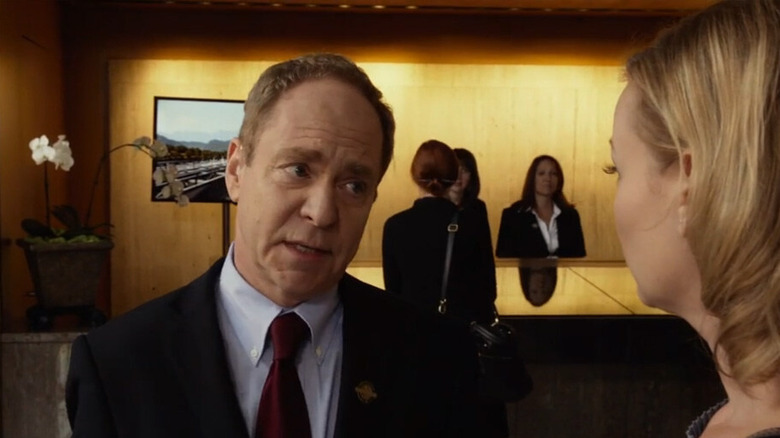
For the record, "Atlas Shrugged" did eventually make its way to the big screen in the form of a trilogy of movies, released in 2011, 2012, and 2014. Each film was helmed by a different director, and the two lead characters were played by different actors in each movie. Producer John Aglialoro remained the only consistent player. "Atlas Shrugged" believes that powerful ideas will move money in a laissez-faire marketplace and that everyone should rely on their own wits to rightfully earn their cash. It's an irony, then, that "Atlas Shrugged Part III: Who Is John Galt?" needed to be partly funded by a Kickstarter campaign and that all three films lost a pile of money.
Perhaps that was what TV network execs sensed back in 1979 when producer Michael Jaffe tried to get an "Atlas Shrugged" miniseries off the ground. As reported by Starlog Magazine, NBC rejected the miniseries because "'Atlas Shrugged' is too heavy with philosophy." Jaffe then reportedly pitched the idea to ABC, but the network was equally dismissive, stating it wasn't "entertaining or melodramatic or escapist enough." Moreover, ABC felt "it makes people think too much."
After those plans fell through, Jaffe announced that he could instead make "Atlas Shrugged" into a four-hour epic feature film for the low, low price of only $10 million, hoping to hit up wealthy Ayn Rand fans to invest. He added that he had an alternate plan to turn the book into a 10-hour miniseries, provided he could get backing from the Operation Prime Time committee. (More on that to follow.)
There've been so many attempts to adapt Atlas Shrugged for film and TV
Operation Prime Time is probably not well-remembered to this day, having lived from 1976 to 1987. It was a federation of local networks that banded together to form a loose "fourth network" to compete with the "big three" of the day (NBC, ABC, and CBS). There was a unique ad-selling structure at OPT that allowed it to sell ad space for much less than the main networks. Getting into the nitty-gritty of it is confusing and dull and involves things like financing and ad deals, so, needless to say, it was a "last option" for Michael Jaffe to get "Atlas Shrugged" to audiences.
The network of networks wasn't ever as successful as its competitors, but it did manage to produce a good deal of original programming. By 1979, it had already backed a four-hour miniseries version of John Jakes' novel "The B*stard" and the equally long "Evening in Byzantium," based on the novel by Irwin Shaw. OPT seemed to be the one to go to if you wanted adult-skewing, long-running miniseries. That might have been Jaffe's best bet in 1979.
The 1979 failure to get "Atlas Shrugged" to the screen was just one of many. According to Joan Carter's book "The History of the Atlas Shrugged Movie Trilogy," John Aglialoro acquired the rights to make an "Atlas Shrugged" movie as early as 1992. The project, however, kept passing hands, with scripts being written and rejected several times during production. It took until 2011 to finally get "Atlas Shrugged" to the big screen. And after all that, the audience shrugged. It seems there aren't enough Objectivists or Libertarians or whatever to make millions for a movie that declares how great rich people are.