

5 Years Ago Today: Clint Eastwood Released A Western That Flopped In Theaters
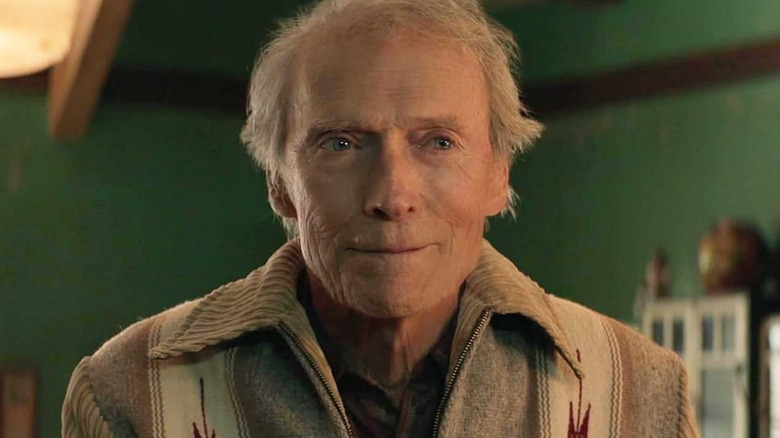
Way back in the halcyon days of 2021, it was a wild and lawless time. The ninth "Fast & Furious" movie was upon us, audiences were going wild for "Venom: Let There Be Carnage," and we thought that no Spider-Man movie would ever top "Spider-Man: No Way Home." It was also the year of the seventh "Wrong Turn," the retraction of racist Dr. Seuss books from publication, and a specific January incident in the U.S. Capitol. Wild times indeed.
In addition, 2021 saw the release of Clint Eastwood's "Cry Macho," which features the screen icon's most recent on screen appearance at the time of writing. Like most of Eastwood's directorial efforts, the film is a calming, gentle, downbeat movie about an older man's twilight years. Quite literally, he's been telling "one last job" stories since at least "Unforgiven" back in 1992. Eastwood, now 96, would be a legitimate Hollywood legend even if he had never been an actor. He's a prolific and thoughtful film director who's made biopics, musicals, romances, and Westerns ... although, it would be fair to say that, more than anything, he makes Dad Movies. As comedian Dana Gould once joked, he took his elderly, grumpy father to see Eastwood's "Gran Torino," which is like watching "Mighty Joe Young" with a gorilla.
Yet, "Cry Macho" isn't as rugged as you might expect. Indeed, its title alludes to a pet rooster that has been rescued from a life of cockfighting and how Eastwood's character forms a grandfatherly bond with its teenage owner. The Western was the victim of a bad release, however, being made available on HBO Max the same day it hit theaters on September 17, 2021. But even if that hadn't been the case, "Cry Macho" was always expected to become a box office flop.
Clint Eastwood had almost starred in Cry Macho years earlier
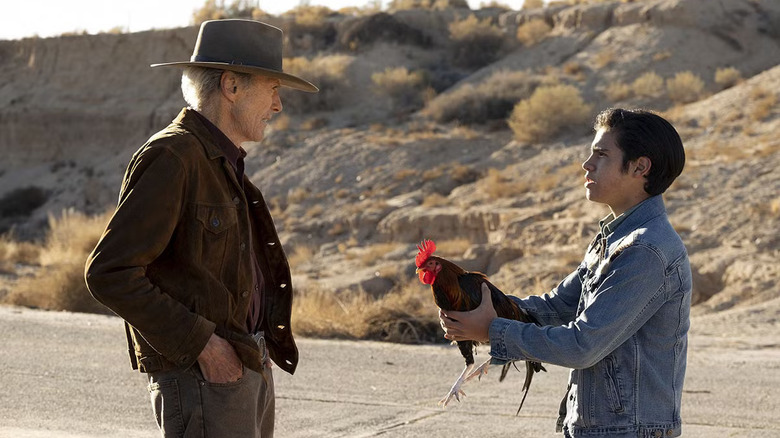
"Cry Macho" is based on the 1975 novel by N. Richard Nash, and it spent decades in development. The story goes that Nash wrote a screenplay for "Cry Macho" that was widely rejected, so he decided to rework it as a book instead. When the novel became a success, Nash then brushed off his initial script and managed to sell it. From there, though, the screenplay drifted around Hollywood for many, many years. Eventually, in 2011, Arnold Schwarzenegger became attached to star, by which point several other actors before him had passed on the film, Clint Eastwood among them. Finally, about a decade later, Eastwood had warmed to the material and decided to direct the film after the version starring Schwarzenegger failed to move forward. It only took, what, 45 years?
In "Cry Macho," Eastwood plays Mike Milo, a long-retired Texan rodeo star who lives happily on his modest property in 1979 Texas. That's when an unsavory old friend named Howard (Dwight Yoakam in his first movie role since "Logan Lucky") approaches him with a potential side gig: to trek into Mexico and "retrieve" his long-lost 15-year-old son, Rafo (Eduardo Minett), from the boy's mother, a gangster named Leta (Fernanda Urrejola). At one point, Leta teases Mike by trying to mock-seduce him, which is hilarious given Eastwood's age.
Rafo, Mike learns, is heading down a bad path and is already involved in illicit fighting tournaments with his rooster, Macho. So, Mike manages to get Rafo into his truck, and the movie evolves into a mellow conversational piece between the two characters.
Cry Macho is a thoughtful character piece
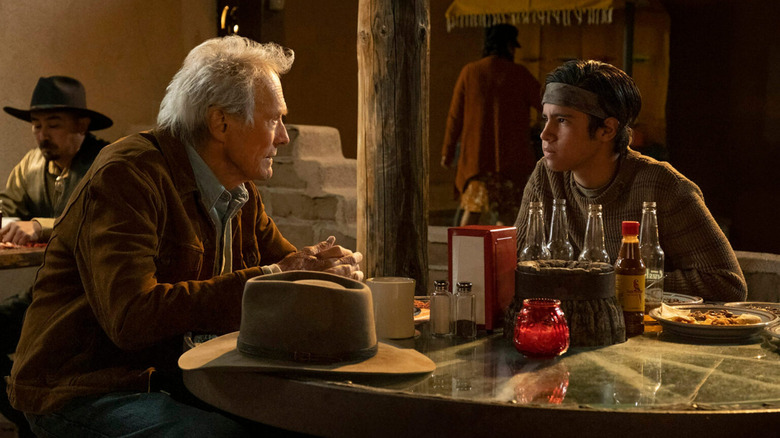
It's during the prolonged conversation scene that the movie's theme emerges. Rafo talks a lot about how his mother and her gangster goons would abuse him when he was younger, all the while talking about what constitutes machismo. Rafo and Mike have different ideas of what "macho" means, however, and they begin to slowly unravel notions of modern masculinity. This is especially striking in a Clint Eastwood movie, seeing as the actor/director is often held up, in the pop firmament, as one of the exemplars of modern masculinity. It's almost as if Eastwood, by age 90, finally wanted to refute his own reputation. "Cry Macho" isn't especially explicit or profound in this regard, but it's amazing that such themes were included at all.
Eastwood is notorious for shooting quickly and for giving his actors minimal direction (he gave a single note to Kevin Bacon on "Mystic River," for example), and his films tend to be direct and frills-free. In the case of "Cry Macho," as it were, Eastwood's economic storytelling put off many critics. FIlm's own "Cry Macho" review at the time gave it a 6/10, remarking that the movie takes its sweet time. It also noted that "Cry Macho" needs to be engaged with in context as a film where a 90-year-old Hollywood legend seemingly comments on their own legacy.
Glenn Kenny, writing for RogerEbert.com, liked the film more, giving it three-and-a-half stars out of four. He wrote that "events transpire in beautifully shot, unhurried scenes. This is Eastwood's version of pastoral. Mike pieces his ruined life back together in a sense."
Yes, it's good.