

25 Years Ago Today: Mariah Carey Starred In One Of The Worst Movies Ever Made

Mariah Carey has given us one of the best acting performances by a musician, and one of the worst movies ever made. Her naturalistic performance as harried social worker Anna Weiss in 2009's "Precious" was captivating. Her performance as singer Billie Frank in 2001's "Glitter," however, seemed to suggest she would never be allowed near a film set again. Clearly, she proved everyone wrong in the end, but for a while Carey's movie career really did seem to be over. 25 years later, "Glitter" remains a fascinating entry in the "worst movies of all time" category.
The movie saw Carey play a singer with a tragic past and dreams of making it big — which she does, only to encounter tragedy all over again. Sadly, the film itself was plagued by tragedies of its own from the very start. Carey conceptualized the project as an album and musical called "All That Glitters" back in 1997. But due to contract issues it took some time for her to actually bring it to fruition. When she did, she wasn't exactly in the best mental space.
During the promotional campaign for the film and its accompanying album, also titled "Glitter," Carey essentially had a very public breakdown including an infamously chaotic appearance on "Total Request Live." She was then hospitalized and diagnosed with bipolar disorder.
As such, revisiting "Glitter" just to tear it down again 25 years later seems, at best, a tad distasteful. That said, the film really wasn't very good. Carey's movie star debut holds a dismal 6% on Rotten Tomatoes to this day. On its 25th anniversary, then, it's hard to avoid the negative reaction to the movie, though perhaps some of that had more to do with the culture of the time than the film itself.
Mariah Carey's Glitter was tropey box office bomb
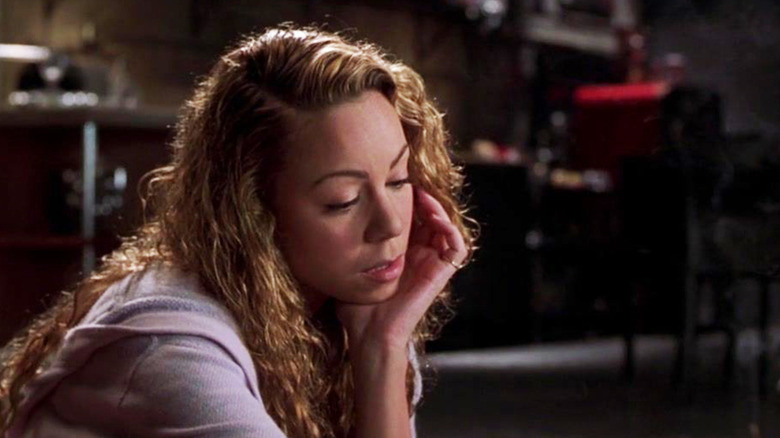
"Glitter" stars Mariah Carey as Billie Frank, the daughter of alcoholic nightclub performer Lillian Frank (Valarie Pettiford). After Lillian falls asleep with a lit cigarette one night, she almost manages to burn the house down, prompting social services to place her daughter in foster care. We then flash forward to 1983, where an adult Billie has followed in her mother's footsteps and is working as a dancer in a club. It's there that Terrence Howard's producer Timothy Walker spots Billie and her friends' talents, hiring them as backup singers and dancers for pop star Sylk (Padma Lakshmi).
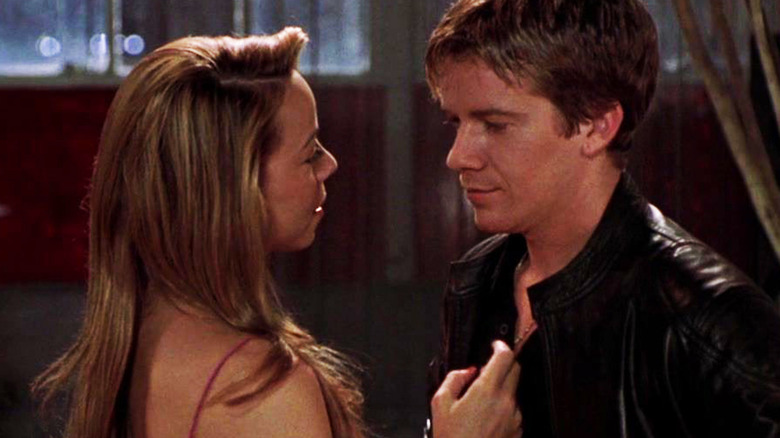
Turns out, Sylk doesn't actually sing, instead relying on a lip sync track from Billie. DJ Julian "Dice" Black (Max Beesley) sees through the charade and immediately starts working with Billie, who eventually makes it big. But it turns out her future holds just as much tragedy as her past, and while her dreams of fame come true, she loses more than she ever could have imagined along the way.
The story is coherent enough, and there are some convincing insights about the music industry (unsurprising given Carey's experience). But the film as a whole feels rushed and relies too much on tired tropes. Some of these problems might have come from the fact the script was reworked throughout production. As Carey MTV during a 2001 interview, "We were rewriting a lot on the set. A lot of things came from improvisation." Clearly it didn't help. "Glitter" debuted on the inauspicious date of September 21, 2001, making just $5.3 million on a $22 million budget and being nominated for six Golden Raspberry awards (though it's long since been time to retire the Razzies forever). The reviews were even worse.
Glitter was savaged by critics, but there's more to the story
While it does seem redundant to attack a film that's already been savaged, there's just something relentlessly offensive about the poster, on which Carey presents her smiling visage as if proud of the fact she's made you watch what Megan Rosenfeld of the Washington Post described as "primarily a showcase for her breasts." It also perfectly encapsulates the film's disjointed and confused nature. In her MTV interview, the pop star spoke about how the film was about dysfunctional relationships, with her character feeling "abandoned by her mother" and her eventual love interest representing a recrudescence of that same "semi-dysfunctional" relationship. But the poster seems to sum up the film's artistic statement as nothing more than "Look at me!" That same tension between human drama and a kind of celebration of pop star vacuity was also at the heart of "Glitter" and its various shortcomings.
Some of the critical opprobrium "Glitter" prompted was perhaps an expression of a general revulsion at the prospect of a hugely popular singer daring to depict herself as hard-done-by and dispossessed, even if it was in a fictionalized story. What's more, there was a specific kind of misogyny to the raunch culture of the era, something which the documentary "Woodstock '99" does an excellent job of parsing.
Even 25 years later, however, there's still no escaping the fact "Glitter" was, to put it politely, hardly one of the best movies of the 2000s. Still, many of the critics were ultimately proved wrong. Carrie Rickey of the Philadelphia Inquirer, for example, wrote that Carey "simply does not register on the big screen" — a claim completely undermined by her later performance in "Precious."