

This Acclaimed '90s Sci-Fi Show Created By Two X-Files Writers Was Canceled Too Soon
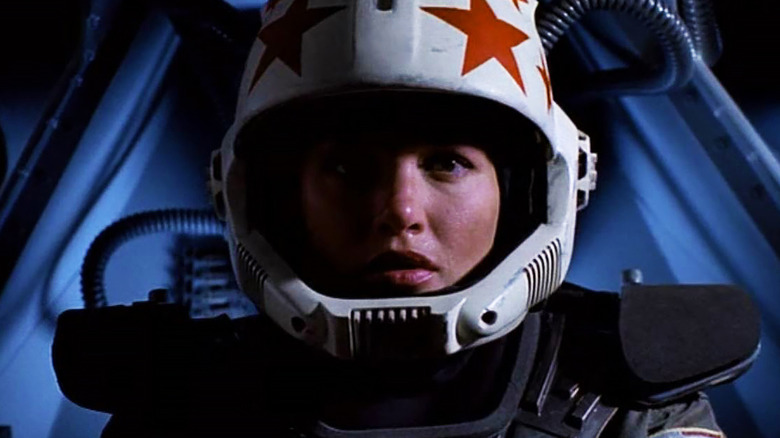
Glen Morgan's and James Wong's sci-fi series "Space: Above and Beyond" ran for only one season back in 1995 and 1996, turning out an impressive 23 episodes before slipping from the collection consciousness. One can look to the mid-1990s and see a slew of ambitious-but-short-lived sci-fi shows, most of them reacting to the success of either "Star Trek: The Next Generation" or "The X-Files." Those two shows (for the most part) proved that sci-fi was a viable, popular genre, and the TV landscape changed around them. All of a sudden, space operas were de rigueur.
But they weren't all successful. For every "Babylon 5," there were a dozen "Space: Above and Beyonds." And it's surprising that "Space: Above and Beyond" tanked after one season, as Morgan and Wong were a writing team that worked extensively on "The X-Files." Morgan and Wong, incidentally, also created the "Final Destination" franchise, so we're in good hand with this show.
"Space: Above and Beyond" takes place in the near future of 2063, when humanity has figured out how to map and take advantage of natural wormholes that appear in Earth's vicinity. The wormholes have allowed humans to easily colonize other planets, but also seemingly attracted a vicious race of alien marauders called the Chigs. The Chigs have, without explanation, wiped out all of Earth's new colonies, and the series picks up right when the alien invaders are closing in on our solar system. The aliens control ships that can travel faster than light, putting them at a distinct advantage over Earth's fighting forces.
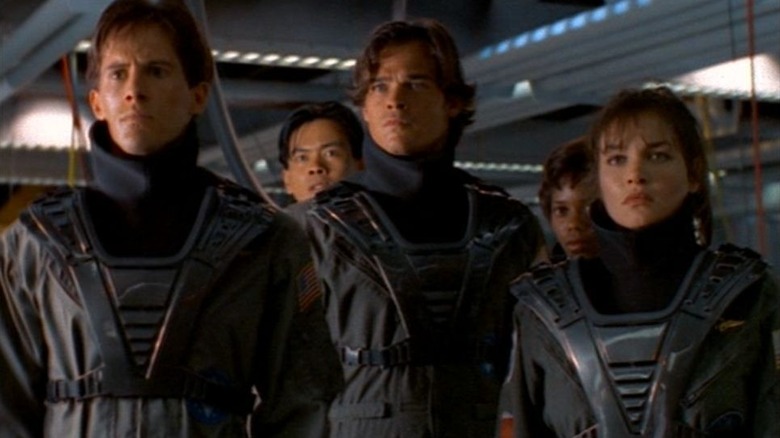
The series follows a group of undertrained space pilots nicknamed Wildcards who operate from a mothership called the USS Saratoga.
Space: Above and Beyond was a short-lived sci-fi war series
Oh yes, and there are several additional wrinkles to the series. In the future, for one, humanity had already fought and won a war against an army of their own intelligent robots. Called Silicates, the androids developed intelligence and rebelled against humanity, eventually stealing multiple spacecraft and fleeing into the stars. There is constant suspicion from the show's main characters that the Chigs and the Silicates might be joining forces.
Additionally, the military is populated by many cloned soldiers referred to as In Vitros. They have little belly buttons on the backs of their necks and have been genetically engineered to fight in the war against the Silicates. Because they were developed to be disposable, however, and because they don't have a lot of emotional experience in the galaxy, In Vitros are seen as second-class citizens. Naturally, the In Vitros are used to explore themes of racism as well as themes of mistreatment of veterans.
Additionally, additionally, there is a story arc about a shadowy corporation called Aero-Tech that supplies and possibly controls the military. You can bet that two "X-Files" writers would include a conspiracy subplot in their own series.
Each of the main characters of "Space: Above and Beyond" have nicknames taken from various playing cards. Joel de la Fuente, for instance, plays Paul Wang, a.k.a. Joker. Captain Shane Vansen (Kristen Cloke) was referred to as Queen of Diamonds. Lieutenant Nathan West (Morgan Weisser) was called King of Hearts, etc. "Space" also attracted numerous notable guest stars. David Duchovny has an uncredited cameo in one episode, kind of giving the series its "X-Files" blessing. Coolio turns up on one episode, as does Richard Kind, R. Lee Ermey, and Adam Goldberg.
Space: Above and Beyond had a five-year plan
"Space: Above and Beyond" was mostly an episodic series, but was one of many primetime shows of the era that attempted to break into more serialized stories. Although the show only lasted for 23 episodes, it had four two-parters, revealing that the showrunners really, really wanted to break into giant, longer-lasting stories.
And indeed, the plan for "Space" was way more ambitious than we ever got to see. In an interview on a "Millennium" website, conducted back in 1998, James Wong and Glen Morgan talked about how upset they were that "Space" was canceled, and that they already had laid the groundwork for a second season, eager to get to their big story twists and character developments. Wong noted that they wanted the series to run for five years,
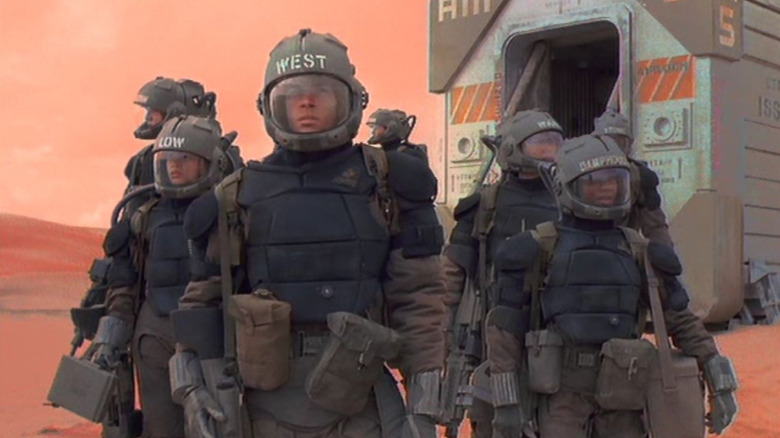
"Space" was also visually striking when compared to a lot of the other shows of the day. I personally recall thinking that there was something wrong with my TV when I first tuned in, as everything was a gritty grey. It turns out that the photography of the series was deliberately desaturated, as proven by a glance at the show's DVDs. The colorlessness of "Space" was a creative choice, made to make the series more realistic.
And the stories went everywhere. There was a lot of aggression and double-crossing among the human characters as the war raged on. Multiple story arcs operated simultaneously, and loyalties changed. It was a heady, and intense series that deserved enough time on the air to explore its vast premise. Sadly, one year was all it got. It's not on streaming, but there are some DVDs on the second-hand market that might be worth tracking down.