

Star Trek When It's Evil: The Mirror Universe Explained
Welcome to Trekspertise, a series where we break down the technology, history, details, and decisions that make the Star Trek universe so complex — and so fun.
The "Star Trek" episode "Mirror Mirror" opens with Captain Kirk (William Shatner), Uhura (Nichelle Nichols), Scotty (James Doohan), and Dr. McCoy (DeForest Kelley) returning from a failed diplomatic mission with the Halkan Council, wherein they have been denied permission to mine dilithium crystals on their planet. Despondent, they retreat to the USS Enterprise, beaming up through an unexpected ion storm. Unpredictably, the storm forces their transporter beam through some kind of dimensional membrane, and the quartet lands in a parallel universe where everything is the same ... but evil.
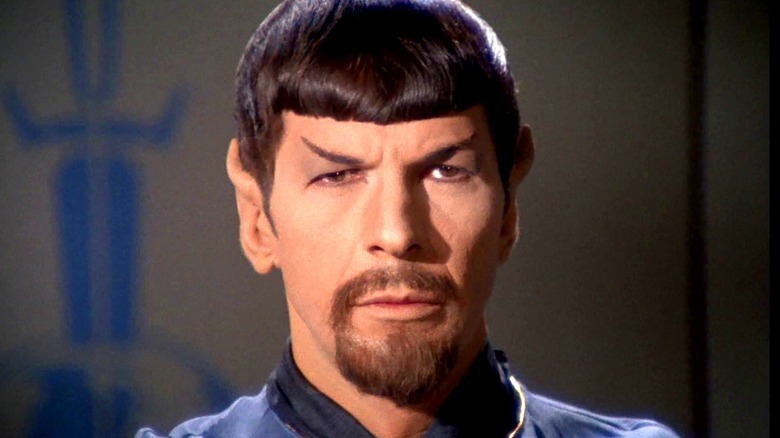
The USS Enterprise is now the ISS Enterprise, an Imperial Starship devoted to conquest and war. Kirk and company have swapped places with their parallel universe counterparts, who are all devoted to violence and ambition. (It's common in this universe for captains to be assassinated by their underlings.) Everyone carries devices called agonizers on their belts, which are activated as a disciplinary measure. When an agonizer is not enough, one can be sentenced to time in an agony booth. Spock (Leonard Nimoy) has a goatee in the evil universe, and thanks to the popularity of "Mirror Mirror," goatees have become pop culture shorthand for "evil twin."
The evil universe has come to be known as the Mirror Universe among Trekkies, and it has been revisited several times throughout the franchise. Indeed, the timeline of the Mirror Universe even began to alter over the centuries. The Mirror Universe's in-canon history is never explicitly explained, but the dramatic function of the Mirror Universe is clearly to provide a juxtaposition to the ordinarily utopian peacefulness of "Star Trek."
The Mirror Universe was built as the anti-Star Trek
The Mirror Universe was visited a few times on "Star Trek: Deep Space Nine," on "Star Trek: Enterprise," and was pivotal to the early seasons of "Star Trek: Discovery."
Of those shows, "Enterprise" is set earliest on the "Star Trek" timeline, and its two-part episode "In a Mirror Darkly" was incredibly fun, as it was set entirely in the Mirror Universe. The makers of "Enterprise" even altered the episodes' opening credits to denote that we, the audience, were watching a TV episode from another dimension. The brilliant opening credits posited that the Mirror Universe diverged from ordinary Earth history sometime in the 1700s with the launch of the "HMS Enterprize." This is the only real indicator of how the evil got started.
By the 23rd century, the Mirror Universe was host to a galactic Empire, run by evil versions of "Star Trek" characters, piloting weapons-heavy ships devoted to combat. In the logic of the Mirror Universe, people will all be born at about the same time across both universes, and they will typically follow the same geographical paths, but their personalities and fates are very different.
After the events of "Mirror Mirror," however, history in the Mirror Universe diverged dramatically from the one we all know. It seems that the pesky Earth empire was getting too powerful, and the Bajorans teamed up with the Cardassians and the Klingons to form a supra-alliance that was capable of defeating Earth. By the 24th century, the Earth Empire had fallen apart, and humans, now disparagingly called Terrans, were captured as slaves. All of this was first explored in the "Star Trek: Deep Space Nine" episode "Crossover." It would be the first of five "DS9" episodes to deal with the fate of the Mirror Universe.
The Mirror Universe occasionally popped up in newer Star Trek shows
Throughout "Deep Space Nine," there was yet another power shift in the Mirror Universe wherein the Regular Universe Captain Sisko (Avery Brooks) had to lead a human uprising in the place of his dead Mirror counterpart. By this point, people in the Mirror Universe had figured out ways to pass to and from our world with relative ease; ion storms and accidents were no longer a prerequisite.
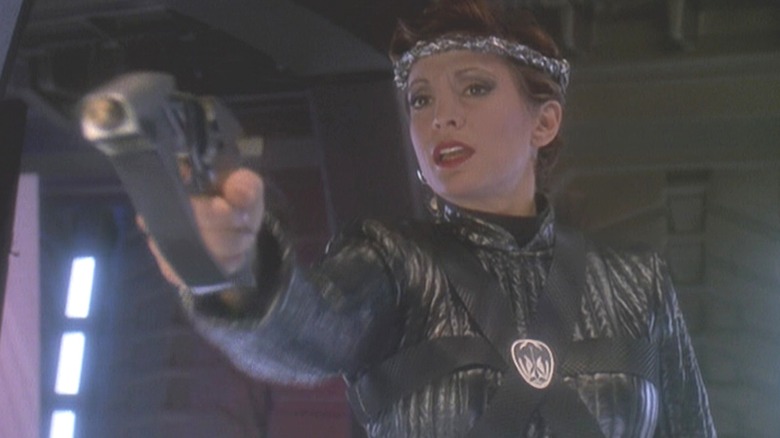
Part of the fun of the Mirror Universe is seeing ordinarily principled characters let loose as cartoonish villains. On "Deep Space Nine," Major Kira (Nana Visitor) is an ex-resistance fighter with a short temper and a strong sense of justice. In the Mirror Universe, she's a leather-clad bisexual sadist. It's fun.
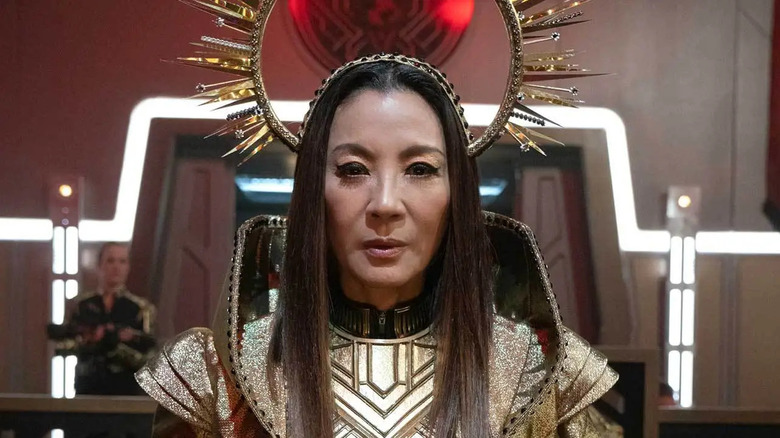
On the 23rd-century-set "Star Trek: Discovery," it was a delight to see international superstar Michelle Yeoh play a staunch and principled starship captain named Philippa Georgiou. The captain was killed early in the series, and, thanks to a series of interdimensional plot contrivances, she was replaced by her Mirror Universe counterpart, the actual Empress of the Mirror Empire. Empress Georgiou ended up staying in the main universe, and Michelle Yeoh had a wonderful time playing the character like a supervillain. She was the main character in the most recent "Star Trek" movie, "Star Trek: Section 31."
"Discovery" also had an evil captain from the Mirror Universe named Lorca (Jason Isaacs) play a major role in the show's first season. The Mirror Universe was most recently visited on an episode of "Star Trek: Prodigy," wherein we meet late-24th-century Mirror versions of Admiral Janeway (Kate Mulgrew) and Chakotay (Robert Beltran). By that point on the Trek timeline, the Terran Empire has reasserted itself and become conquerors once again. Sometimes even evil is consistent.