

What Are Star Trek's Dilithium Crystals, And What Do They Do For A Starship?

We may receive a commission on purchases made from links.
Welcome to Trekspertise, a series where we break down the technology, history, details, and decisions that make the Star Trek universe so complex — and so fun.
The makers of "Star Trek" have always endeavored to keep their fantastical sci-fi conceits with one finger in reality. I have always liked that Starfleet vessels, while capable of traveling many times the speed of light, still have to contend with the very real — and very, very vast — distances of the actual Milky Way Galaxy. And while "Star Trek" boasts wild, fantasy technologies like transporters and food replicators, a team of technical advisors was always on hand to make sure there was some semi-plausible technobabble that explained how those things might work. These efforts made "Star Trek" seem more realistic than, say, "Star Wars," which never concerned itself with the technical machinations of a lightsaber (at least, not in the movies themselves).
But then, when delving deeper and deeper into Trek's imaginary technology, even the most stalwart technical advisor is eventually going to have to invent something entirely new. This is where dilithium crystals come in.
Dilithium is a fictional, energy-synthesizing mineral that rests inside the engine of every Starfleet vessel in "Star Trek." The engines on a starship are essentially souped-up versions of internal combustion engines, but whereas internal combustion engines convert burning petroleum fuels into energy, a starship engine converts matter/antimatter explosions into energy. One can learn about antimatter on the CERN website, but for "Star Trek" purposes, all we need to know is that matter and antimatter, when they come into contact, create a massive explosion. The energy from that explosion passes through a specially arranged dilithium crystal, which, thanks to its unique properties, aids in the safe conversion of that explosion into propulsion.
How does dilithium work?
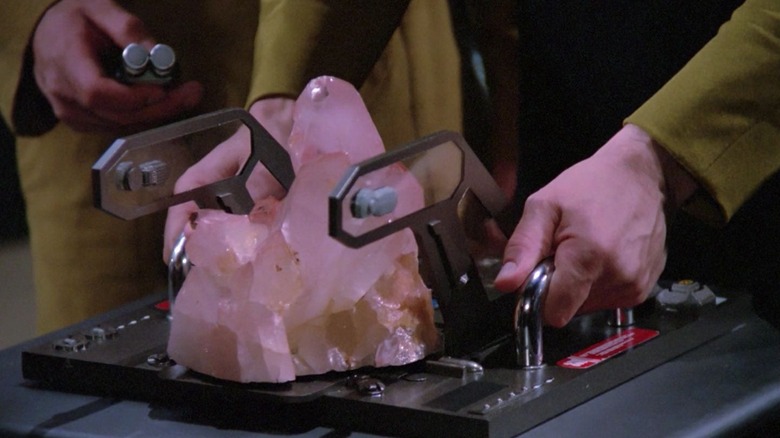
Dilithium has been glimpsed multiple times throughout "Star Trek," and it looks unremarkable, like a large pink quartz. Indeed, the props probably are just quartz crystals. In the invaluable "Star Trek: The Next Generation Technical Manual" by Rock Sternbach and Michael Okuda, it's explained that dilithium is unique in that it's porous to antihydrogen. Antimatter can pass through it without sparking a reaction, though only once the crystals have been subjected to a high-frequency electromagnetic field.
Matter and antimatter are injected into the central engine core via a huge, long, glowing tube. The big pulsing blue "core" often seen on "Star Trek: The Next Generation" is the device through which the matter and the antimatter are shunted. They then mix in quantities that are regulated by the dilithium crystals, and the resulting explosion is contained in a very controlled fashion inside the central core, then directed into a tuned plasma stream that provides propulsion.
Although it's not addressed on-screen, the dilithium crystals serve two functions. One is to convert the explosions into raw energy, but the other is to pump the right balance of energy into the ship's massive warp nacelles. The magnetic fields and the matter/antimatter injections need to be carefully adjusted for every different warp factor. Now you can understand why there are always so many engineers rushing around the engine room of the USS Enterprise — there's a lot to keep track of. And if something goes wrong, a large chunk of the ship might suddenly explode, which is certainly unadvisable.
This is also why, in a pinch, the Enterprise might eject its entire engine core in an emergency. That's the ship's most explodiest part. Maybe even more so than the photon torpedoes.
The configuration of dilithium crystals can affect engine efficiency
Of course, if a plasma beam is to exit from a dilithium crystal properly, then the energy needs to cascade through the crystal in the right direction, right? Think of the prism on the cover of Pink Floyd's "Dark Side of the Moon." If you wanted that rainbow to angle up instead of down, you'd need to rotate it 180 degrees, right? Also, it will work better if you synch it up to "The Wizard of Oz."
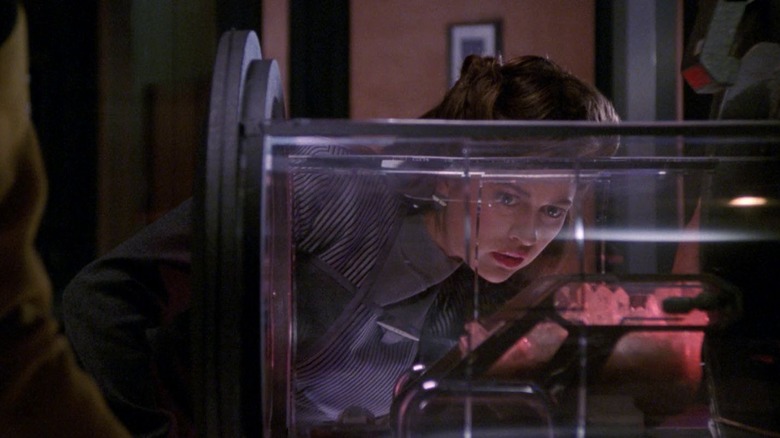
Well, same with dilithium crystals. You need to arrange the crystals in just the right formation for them to work properly. In the "Star Trek: The Next Generation" episode "Galaxy's Child," it's revealed that starship engineers have different ideas as to what kind of crystal arrangements can produce the most energy-efficient output. There are standards, of course, but dilithium is a naturally occurring mineral and no two crystals are, by the rules of the natural world, going to be identical. As such, arranging specific crystals in an engine core is going to rely on very careful analysis of the crystals' facets and atomic structure, as well as the careful eye of an experienced engineer who knows what they're doing. Geordi La Forge (LeVar Burton) and the Enterprise's designer, Leah Brahms (Susan Gibney) once argued over the recklessness of readjusting crystals on the fly.
It's nice to know that even this fantasy mineral has enough nuance to be argued over. It's also worth noting that, because they are constantly being bombarded by electromagnetic fields and are at the center of massive explosions, dilithium crystals do break down over time. A bad reaction can even damage them (or, uh, open a wormhole, as it did in "Star Trek: The Motion Picture"). They're a rare mineral, and do need to be replaced or recrystallized periodically.
Dilithium crystals are a natural resource ... and very rare

Dilithium crystals are a natural resource and they only grow on certain planets in the galaxy. Indeed, dilithium is said to be pretty rare overall. The crystals still need to be mined and processed, and planets often negotiate with the Federation to make sure their natural minerals are mined safely. Some Trekkies might recall that dilithium mining access was the story impetus in the episode "Mirror, Mirror." As seen in the movie "Star Trek VI: The Undiscovered Country," mining can still be pretty brutal in the future, even in the clean and comfy "Star Trek" universe. Miners still have to live in caves, dig manually through rock, and risk their lives. Of course, in that movie, the mine was also a Klingon labor prison; one might assume that Federation mining practices are easier and more humane.
There have been a few instances of Starfleet engineers using techno-miracles to extend the lives of dilithium crystals. It was mentioned in the "Star Trek: Voyager" episode "Innocence" that a crystal could last for about three years without needing to be replaced, undoubtedly using restructuring and recrystallization methods. The crew of the USS Voyager also, in the episode "Threshold," discovered a form of dilithium that grew in a perfect atomic lattice, making it ideal for their starship engines. But because it's a natural formation, one can't rely on consistent quality. Before you build a starship, be sure to get a geophysics professor on the horn.
Importantly, though, dilithium crystals cannot be manufactured artificially. Although the future of "Star Trek" is all about reallocating resources and subscribing to efficiency, there is still a limited natural resource at the heart of it. One can assume, though, that engineers are constantly looking for dilithium-free energy alternatives.